
Yesterday was Lucy, the dynamite widow with three husbands. Today we go further back — past Michigan, past the lumber mills — all the way to Virginia, 1863, and a 27-year-old corporal in a blue uniform who never came home.
Watch the Ancestor of the Day short film:
If you want the deep file first, I wrote about him years ago: American Civil War Soldier: Theodore Barber (2012). Today’s telling is the family version — the records on screen, the way I do it.
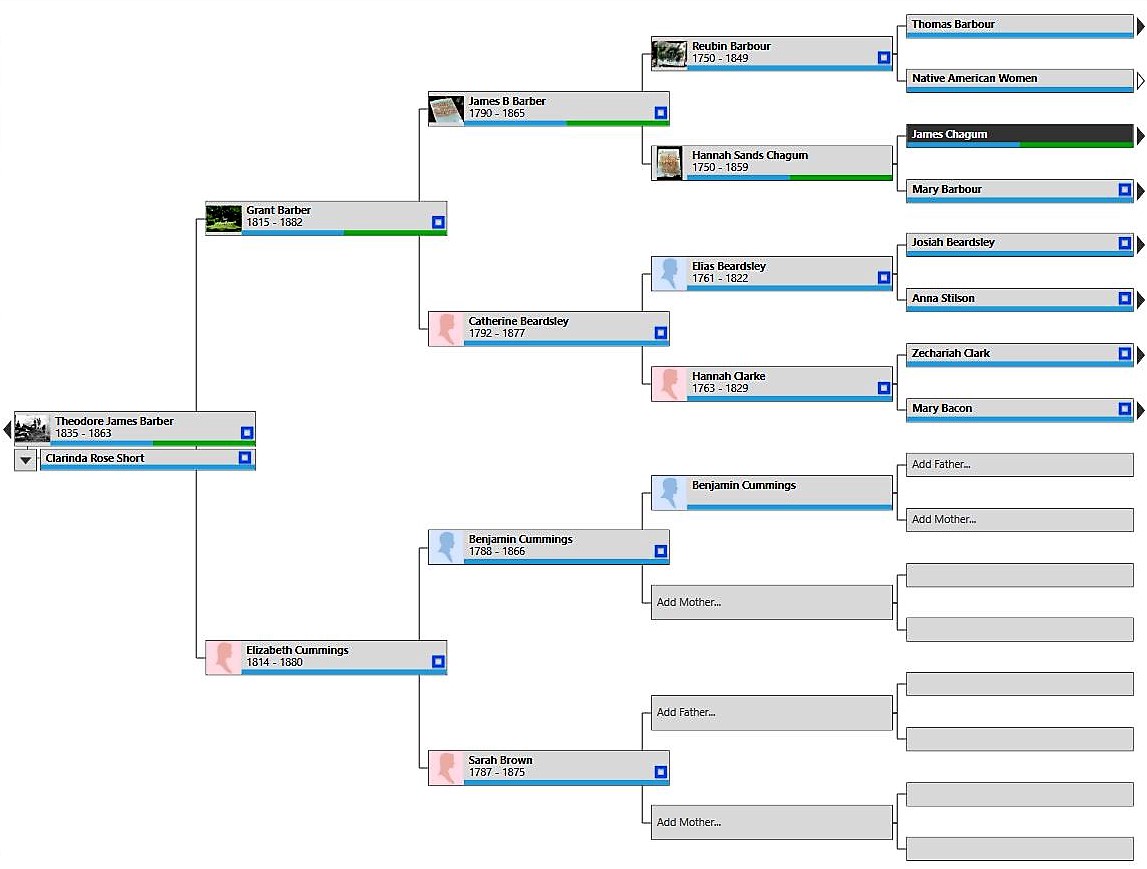
Theodore James Barber was born in August 1835 in Catlin, Chemung County, New York — the son of Grant Barber, a farmer, and Elizabeth Cummins. The 1850 census finds him at 15 in Caton, New York, one of eight children in a farmhouse: Harriet, Eli, Mary, Charles, Amanda, Nancy, baby Caroline — and Theodore. By 1860 he’d crossed into Tioga County, Pennsylvania. Somewhere around 1855 he married Clarinda Rose Short. Their son William Henry was born in 1857.
Now look at the family chart above — really look at it. Follow Theodore’s line back: his great-grandparents were Reuben Barber/Barbour and Hannah Sands Chagum. Hannah Sands — the daughter of James Chagum and Mary “Molly” Barber. The founding couple of the Barkhamsted Light House Village. My people.
So when Theodore James Barber marched off to war, he carried Lighthouse blood in a Union uniform.
On November 1, 1861, at Titusville, Pennsylvania, he enlisted as a Private in Company K of the 57th Pennsylvania Infantry, under Captain Cornelius S. Chase. He was 26. He rose to Corporal. And for the next eighteen months the 57th carried him through the whole hard road of the Army of the Potomac: the Peninsula, Yorktown, Williamsburg, Fair Oaks, the Seven Days, Second Bull Run, Fredericksburg in December 1862, the Mud March.
Then came Chancellorsville.
The 57th belonged to the 1st Brigade, 1st Division, 3rd Corps. On May 1st, 1863, they marched and countermarched along the Plank Road and bivouacked near the Chancellor House. On May 2nd they took position on the extreme right flank of the corps — and at dusk, Stonewall Jackson’s flank attack fell on the Union line to their right and rear like a hammer. The division was marched to the rear in the chaos.
At dawn on May 3rd, the Confederates attacked. The regiment was moved at the double-quick and deployed near the Chancellor House. They counter-charged the enemy — and were driven back with heavy casualties. The brigade fell back about a mile and held its line for two more days.
Theodore James Barber died that day: May 3, 1863. My records say the death was gangrene from a foot/leg wound — that’s what the family papers hold, and I give it to you as the family holds it. He was 27 years old. He rests now in Fredericksburg National Cemetery.

A correction, because the pledge is the pledge. For years I have shared a famous photograph with Theodore’s story — wounded Union soldiers tended under great trees at a Fredericksburg field hospital — believing the gentleman laying down might be my 3rd great-grandfather. In November 2026 I had the photograph traced to its original glass plate, and the record is plain: it was taken in May 1864, a full year after Theodore died, at the hospital on Marye’s Heights that received the wounded of Spotsylvania. It is not him, and it was not taken the day before he died. The wrong date — “Chancellorsville, May 2, 1863” — came from the caption on the old web pages where I first found the picture, and that caption turns out to descend from the National Archives’ own older published description of this very photograph, which the Archives has since corrected. I carried it forward in good faith.
I keep the photograph with his story for one honest reason: it truly shows what the wounded of his army went through — the shade of the trees for a hospital, the wounded laid on planks and bare earth, men with bandaged limbs waiting their turn. Theodore died of gangrene from a wound to his foot and leg. If a camera had found him in his last days, this is what it would have looked like. That much the photograph can truthfully say — and I let it say only that.
He left behind Clarinda — about 24 years old, with six-year-old William Henry. She would marry again, years later, to another Civil War veteran, Allen Porter — and if that name rings a bell, it should: they’re the “They Go Together” couple, the pair who died two hours apart in 1912 and were buried in a single grave. I told their story here in 2013. But that’s her story. This one’s his.
William Henry grew up, married, had a daughter named Ada May. Ada May married George Arthur Allen. Their son Alvin married Marion — my grandmother. Their son Rex was my father.
That’s the chain. That’s how a corporal who fell at Chancellorsville in 1863 reaches all the way to me, typing this in Louisiana in 2026.
Theodore James Barber. The soldier who never came home. Remembered.

Your turn: Who do you want to see next? Tell me below — I read every suggestion.
One Ancestor of the Day each week is YOUR ancestor. Brick wall? Send it through my contact form at https://conidubois.fyi/contact.
— Coni
Sources: Individual Report for Theodore James Barber, by Coni Dubois (service record: Private enlisted 1 Nov 1861, Co. K 57th PA Infantry; rank Corporal; died 3 May 1863 Chancellorsville VA; burial Fredericksburg National Cemetery; Find A Grave #6831641126) · Coni’s “Ancestors of Coni Dubois” research manuscript (birth Aug 1835 Catlin NY; 1850 census Caton NY; 1860 census Tioga PA) · American Civil War Soldier: Theodore Barber (this blog, 2012 — service record, Bates’ History of Pennsylvania Volunteers regimental excerpt, field-hospital photograph (see the correction in this post)) · 57th Pennsylvania Infantry regimental timeline, civilwarintheeast.com · Family tree chart, Coni’s own tree (theodore-chart.jpg) · Clarenda (Short, Barber) Porter death records — “They Go Together” (this blog, 2013)
#AncestorOfTheDay #EverWideningCircle
