Posted in Coni Dubois, Coni's Stuff, Ken Feder, Travel, Tribal

Ancestor of the Day #5: Clorenda Rose Short Barber Porter — “They Go Together”

Yesterday I told you about Theodore — the 27-year-old corporal who never came home from Chancellorsville. Today I’m telling you about the woman who waited for him, buried him in her heart, and went on living for forty-nine more years.

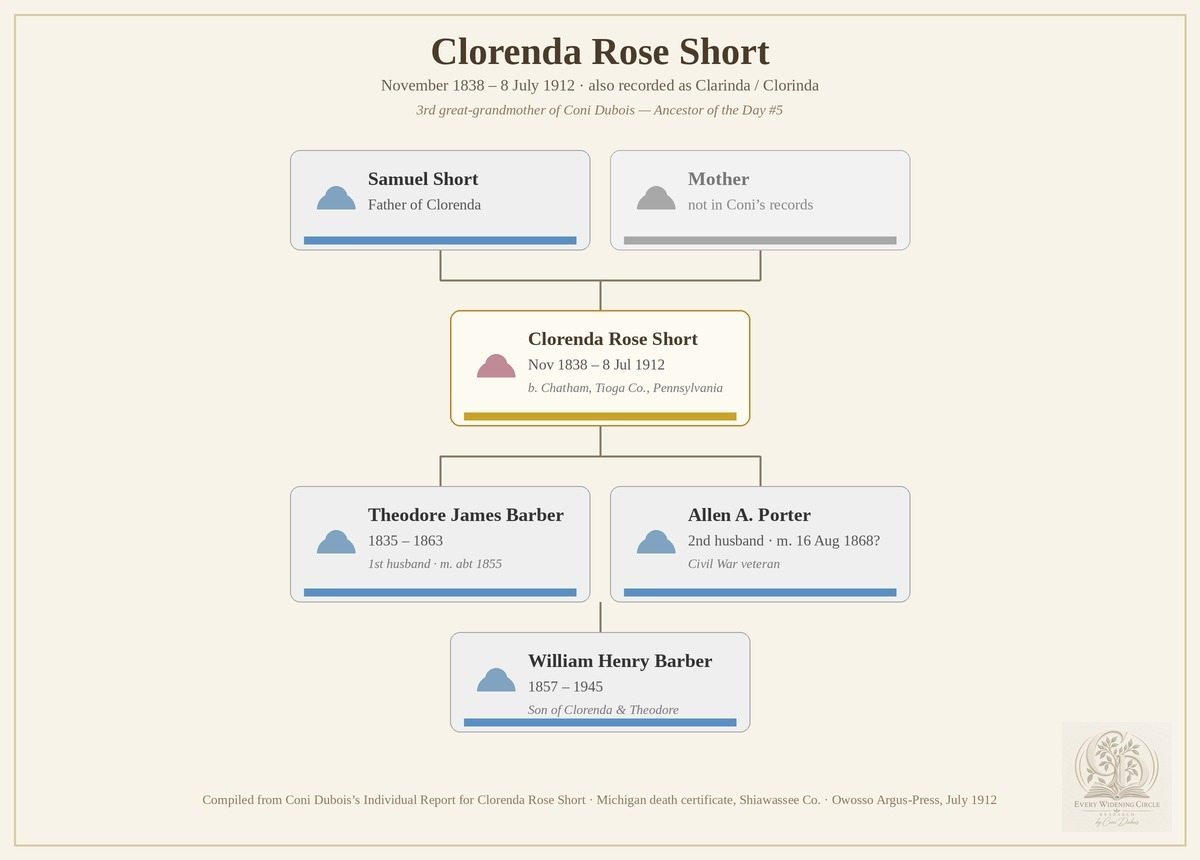
Family tree chart showing Clorenda Rose Short Barber Porter (1838–1912), her first husband Theodore James Barber, their son William Henry Barber, her father Samuel Short, and her second husband Allen A. Porter

Her name was Clorenda Rose Short. The records spell it three different ways — Clorenda, Clarinda, Clorinda — so you can pick your favorite, but she was my 3rd great-grandmother, and this is her story.

She was born in November 1838 in Chatham, Tioga County, Pennsylvania, the daughter of Samuel Short. Somewhere around 1855 she married Theodore James Barber, and in 1857 their son William Henry was born. Then came the war, and in May 1863 Theodore died at Chancellorsville. Clorenda was about twenty-four years old, a widow with a little boy.

She did what widows did — she kept going. And years later she married again, to another Civil War veteran: Allen A. Porter. (My records say August 16, 1868 — but there’s a question mark beside it in my own files, so I’m giving it to you with the question mark still on. The pledge is the pledge.)

They built a life together near Henderson, Michigan. Decades of it. And then came Monday, July 8, 1912.

Cabinet-card photograph of Clarinda Short and Allen A. Porter, Coni's 3rd great-grandparents

That evening, at about nine o’clock, Allen Porter died.

And about two hours later, according to the Owosso Argus-Press, Clarinda walked out onto the porch, cried out — and fell dead in the farmhand’s arms.

The coroner, Guy A. Cole of Owosso, wrote her cause of death on the Michigan death certificate in words I’ll never forget: “a shock occasioned by the death of her husband.” Her heart, the certificate says, had been troubled for years. Her son Frank gave the information. She was buried at Henderson Cemetery on July 11th.

Michigan Certificate of Death for Clarinda Short Porter, July 8, 1912 — cause of death 'a shock occasioned by the death of her husband'

The newspaper ran the story under a headline that says everything: “THEY GO TOGETHER — Wife Succumbs To Heart Trouble Two Hours After Husband’s Death.” And it described the funeral this way: “The two sombre caskets were placed side by side… At the cemetery they were both lowered into one large grave, where the departed will sleep the long sleep together, as they went through the greater portion of their lives.”

Owosso Argus-Press headline from July 1912: 'THEY GO TOGETHER — Wife Succumbs To Heart Trouble Two Hours After Husband's Death'

One large grave. Together. As they went through the greater portion of their lives.

Now follow her line forward, the way I showed you Theodore’s yesterday: Clorenda’s son William Henry grew up, married, and had a daughter named Ada May. Ada May married George Arthur Allen. Their son Alvin married Marion — my grandmother. Their son Rex was my father.

So the woman who died of a broken heart on a Michigan porch in 1912 is the reason I’m here telling you about it. That’s how this works. That’s the ever widening circle.

I wrote about this couple years ago — They Go Together (2013) — and I keep a whole chapter on Clarinda in my files. But today she gets her Ancestor of the Day, because a love like that deserves its afternoon.

Who do you want to see next? Tell me below. 💛

Family tree chart for Clorenda Rose Short Barber Porter

— Coni

Sources: Michigan Certificate of Death for Clarinda Short Porter, Shiawassee Co., Rush Twp., July 8, 1912 (written copy in Coni’s files; Coroner Guy A. Cole) · Owosso Argus-Press, July 9/10/11, 1912 — “THEY GO TOGETHER” (clippings collected by Pauline Goodwin, 2013; in Coni’s files) · Individual Report for Clorenda Rose Short, by Coni Dubois · Find A Grave #566602325 · Chapter 16, Clarinda Short Porter (Coni’s files).

#AncestorOfTheDay #EverWideningCircle

© 2026 Ever Widening Circle Research by Coni Dubois LLC. All rights reserved.

Posted in Coni Dubois, Coni's Stuff, Ken Feder, Travel, Tribal

Ancestor of the Day #4: Theodore James Barber — The Soldier Who Never Came Home From Chancellorsville

Yesterday was Lucy, the dynamite widow with three husbands. Today we go further back — past Michigan, past the lumber mills — all the way to Virginia, 1863, and a 27-year-old corporal in a blue uniform who never came home.

Watch the Ancestor of the Day short film:

If you want the deep file first, I wrote about him years ago: American Civil War Soldier: Theodore Barber (2012). Today’s telling is the family version — the records on screen, the way I do it.

Theodore James Barber was born in August 1835 in Catlin, Chemung County, New York — the son of Grant Barber, a farmer, and Elizabeth Cummins. The 1850 census finds him at 15 in Caton, New York, one of eight children in a farmhouse: Harriet, Eli, Mary, Charles, Amanda, Nancy, baby Caroline — and Theodore. By 1860 he’d crossed into Tioga County, Pennsylvania. Somewhere around 1855 he married Clarinda Rose Short. Their son William Henry was born in 1857.

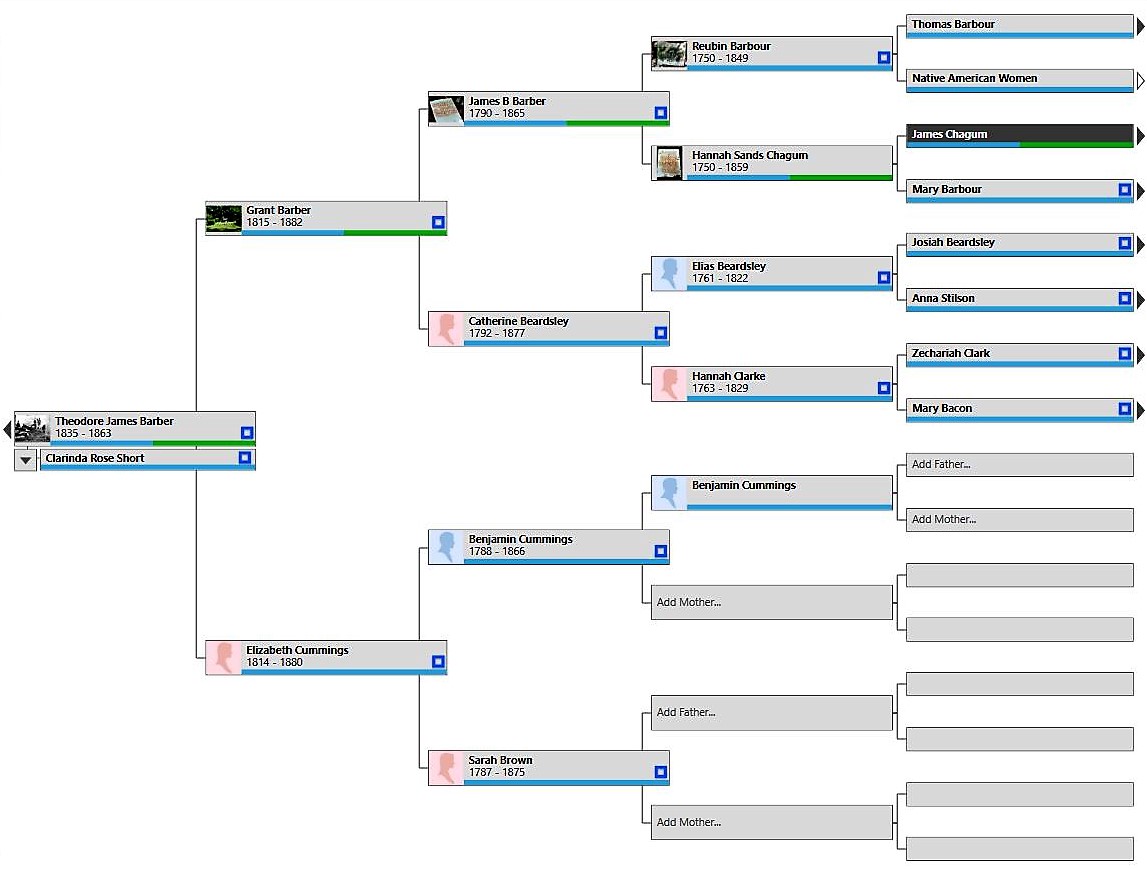
Now look at the family chart above — really look at it. Follow Theodore’s line back: his great-grandparents were Reuben Barber/Barbour and Hannah Sands Chagum. Hannah Sands — the daughter of James Chagum and Mary “Molly” Barber. The founding couple of the Barkhamsted Light House Village. My people.

So when Theodore James Barber marched off to war, he carried Lighthouse blood in a Union uniform.

On November 1, 1861, at Titusville, Pennsylvania, he enlisted as a Private in Company K of the 57th Pennsylvania Infantry, under Captain Cornelius S. Chase. He was 26. He rose to Corporal. And for the next eighteen months the 57th carried him through the whole hard road of the Army of the Potomac: the Peninsula, Yorktown, Williamsburg, Fair Oaks, the Seven Days, Second Bull Run, Fredericksburg in December 1862, the Mud March.

Then came Chancellorsville.

The 57th belonged to the 1st Brigade, 1st Division, 3rd Corps. On May 1st, 1863, they marched and countermarched along the Plank Road and bivouacked near the Chancellor House. On May 2nd they took position on the extreme right flank of the corps — and at dusk, Stonewall Jackson’s flank attack fell on the Union line to their right and rear like a hammer. The division was marched to the rear in the chaos.

At dawn on May 3rd, the Confederates attacked. The regiment was moved at the double-quick and deployed near the Chancellor House. They counter-charged the enemy — and were driven back with heavy casualties. The brigade fell back about a mile and held its line for two more days.

Theodore James Barber died that day: May 3, 1863. My records say the death was gangrene from a foot/leg wound — that’s what the family papers hold, and I give it to you as the family holds it. He was 27 years old. He rests now in Fredericksburg National Cemetery.

Wounded Union soldiers being tended in a field hospital near Fredericksburg, photographed May 2, 1863, the day before Theodore James Barber died at Chancellorsville

I want to tell you one more thing, honestly, because the pledge is the pledge. In my 2012 post I shared a famous photograph — wounded Union soldiers being tended in a field hospital near Fredericksburg, taken May 2, 1863, the day before Theodore died. And I wrote what I still believe: I believe the gentleman laying down is my 3rd great-grandfather. Believe — not prove. I can’t prove it. But I’ve looked at that photograph a hundred times, and a granddaughter knows.

He left behind Clarinda — about 24 years old, with six-year-old William Henry. She would marry again, years later, to another Civil War veteran, Allen Porter — and if that name rings a bell, it should: they’re the “They Go Together” couple, the pair who died two hours apart in 1912 and were buried in a single grave. I told their story here in 2013. But that’s her story. This one’s his.

William Henry grew up, married, had a daughter named Ada May. Ada May married George Arthur Allen. Their son Alvin married Marion — my grandmother. Their son Rex was my father.

That’s the chain. That’s how a corporal who fell at Chancellorsville in 1863 reaches all the way to me, typing this in Louisiana in 2026.

Theodore James Barber. The soldier who never came home. Remembered.

Family tree chart for Theodore James Barber

Your turn: Who do you want to see next? Tell me below — I read every suggestion.

One Ancestor of the Day each week is YOUR ancestor. Brick wall? Send it through my contact form at https://conidubois.fyi/contact.

— Coni

Sources: Individual Report for Theodore James Barber, by Coni Dubois (service record: Private enlisted 1 Nov 1861, Co. K 57th PA Infantry; rank Corporal; died 3 May 1863 Chancellorsville VA; burial Fredericksburg National Cemetery; Find A Grave #6831641126) · Coni’s “Ancestors of Coni Dubois” research manuscript (birth Aug 1835 Catlin NY; 1850 census Caton NY; 1860 census Tioga PA) · American Civil War Soldier: Theodore Barber (this blog, 2012 — service record, Bates’ History of Pennsylvania Volunteers regimental excerpt, Chancellorsville field-hospital photograph) · 57th Pennsylvania Infantry regimental timeline, civilwarintheeast.com · Family tree chart, Coni’s own tree (theodore-chart.jpg) · Clarenda (Short, Barber) Porter death records — “They Go Together” (this blog, 2013)

#AncestorOfTheDay #EverWideningCircle

Posted in Coni Dubois, Coni's Stuff, Ken Feder, Travel, Tribal

Ancestor of the Day #3: Lucy Genevieve Amo — The Dynamite Widow With Three Husbands

Yesterday I told you about Ernest Emmit Griffith — my great-grandfather, killed by dynamite on September 23, 1915. He was 26. If you missed it, the full story with the records is here: https://conidubois.com/2026/09/26/ancestor-of-the-day-2-ernest-emmit-griffith-the-morning-the-dynamite-went-off/

Watch the Ancestor of the Day short film:

Today is about the woman he left behind.

Lucy Genevieve Amo was born April 22, 1882, in Berlin — that’s Rockwood — in Monroe County, Michigan, to Samuel Amo and Mary Campeau. I have her birth record in my files, certified copy and all: Lucy J. Amo, female, white. By 1900 the family was up in Whitney Township, Arenac County — Lucy 18, still her father’s daughter.

Certified copy of Michigan birth record for Lucy J. Amo, born April 22, 1882, in Berlin, Monroe County, to Samuel and Mary Amo

On March 29, 1909, in Au Gres, she married Ernest Griffith. The license says he was 19 and she was 26. The witnesses were Albert and Katherine Amo — her people, standing up for her. The 1910 census finds them in Whitney Township: Emmit 20, a farmer; Lucy 27; and a one-month-old baby girl.

Then the hard years came, the way they came for everybody then. They buried a baby boy, Murther, who died of cholera at five months and ten days in August 1911 — and it was Ernest himself who stood informant on that death certificate. Read that again: the grieving father signed the paper. Then September 1915, the dynamite. Lucy was 33 years old, a widow with small children. Five weeks before Ernest died, she’d given birth to a daughter, Marion — the baby who grew up to be my grandmother.

Here is what the records say next, and I want you to sit with the timeline the way I did.

Eleven months after the dynamite, on August 4, 1916, in East Tawas, the widow Lucy Griffith married Francis C. Baker. The marriage return is in my files — Iosco County, record number 33, and you can read it yourself in the photos. He was 69. She was listed as 40. (Her birth record says 1882, which would make her 34 — I report the record’s words as written, and I keep my own count beside them. That’s the pledge.)

1916 Iosco County, Michigan marriage return, record number 33, showing Francis C. Baker, 69, and Mrs. Lucy Griffith, 40, married August 4, 1916, in East Tawas

Now here’s the part that stopped me cold. Francis C. Baker was a Civil War veteran — Company 91 of the New York Infantry and Company A of the 147th. He’d filed his own invalid pension back in 1889. And in my files there’s his pension index card, plain as day: soldier Baker, Francis C. — dependent, widow, Baker, Lucy — widow’s filing, August 19, 1918, from Michigan.

U.S. Civil War pension index card for soldier Francis C. Baker, showing his widow Lucy Baker’s filing dated August 19, 1918

So Lucy married a Civil War veteran nearly thirty years her senior, and within two years she was a widow again — drawing a Union widow’s pension. The 1920 census finds her back in Whitney Township in her father’s house, and next to her name the record might as well say what it says: Francis Baker, deceased.

She married a third time on November 10, 1924, in Standish — William Wesley Nicholas. The record calls him William W. Nichols; my files say Nicholas. He was 58, a farmer, a widower with four previous marriages. Lucy — listed as “Mrs. Lucy Baker,” 42, keeping house, twice married before — became his fifth wife.

The censuses carry her forward: Paradise in Chippewa County in 1930, Mackinac in 1940. And then the last record, the one that undid me.

Lucy died February 25, 1947, at 10:55 in the morning at the Newberry Clinic — pulmonary embolism, age 64. She’s buried at Forest Home Cemetery in Newberry. And on her death certificate, in the box marked “Name of husband,” the clerk wrote two words:

Emmett Griffith.

Michigan certificate of death for Lucy Genevieve Griffith, died February 25, 1947 — the ‘name of husband’ line reads ‘Emmett Griffith’

Not Baker. Not Nicholas. Emmett Griffith — the 26-year-old farmer blown apart by dynamite thirty-two years earlier, the father of her children. After two more marriages, after a Civil War widow’s pension, after a fifth-wife wedding in Standish — when they asked her, or asked for her, who her husband was, the answer was Emmett.

The informant on that certificate was Mrs. Alvin Allen of Germfask. My grandmother Marion — Lucy’s own daughter — reporting her mother’s death. My own family, holding the pen at the end.

She had a hard life — that’s what I was always told, and the records don’t argue. Widowed at 33 with babies. Married again at 34 to a 69-year-old veteran. Widowed again. Married a third time to a man who’d already buried four wives. And at the end of it all, her heart’s answer never changed.

That’s Lucy Genevieve Amo. The dynamite widow with three husbands. My great-grandmother.

Sepia group photograph of the Amo family — parents Samuel and Mary Amo seated with their seven children standing around them, outdoors

🔍 MINI CONI HUNT: I hid my little Mini Coni somewhere in the Amo family photo above — first one to spot her and tell me in the comments gets a shoutout in tomorrow’s Ancestor of the Day!

🗳️ YOU PICK ANCESTOR #4: The last vote came up empty, so I’m trying again — and this time I’m counting on you! Here are your three choices:

  1. Clorenda Rose Short Barber Porter (1838–1912) — my 3rd great-grandmother. In July 1912 her husband, a Civil War veteran, died at 9 PM — and two hours later, shattered by the shock, she walked onto the porch, cried out, and fell dead in the farmhand’s arms. The coroner wrote her cause of death as “a shock occasioned by the death of her husband.” They were buried in a single grave.
  2. Theodore James Barber (1835–1863) — he marched off with the Union’s 57th Pennsylvania at 28 and never came home from Chancellorsville.
  3. Murther Richard Griffith (1911–1911) — Lucy’s baby boy. He lived five months and ten days, died of cholera — and his grieving father signed the death certificate himself.

Your turn: What does your family’s death certificates say in the “name of husband/wife” box — and does it match the life they actually lived? Tell me in the comments.

Tomorrow afternoon: another ancestor, another record. And remember — one Ancestor of the Day each week is YOUR ancestor. Brick wall? Send it through my contact form at https://conidubois.fyi/contact.

— Coni

Sources: Individual Report for Lucy Genevieve Amo, by Coni Dubois (U.S. Federal Censuses 1900–1940; Michigan Marriage Records; Michigan Death Records) · Certified copy of birth record, Lucy J. Amo, Monroe County #160 Book C-77 (Coni’s files) · Iosco County Return of Marriages, quarter ending Sept 30, 1916, Record No. 33 (Coni’s files) · U.S. Civil War Pension Index, General Index to Pension Files

1861–1934 — Baker, Francis C., widow Lucy Baker, filed Aug 19, 1918 (Coni’s files) · State of Michigan Certificate of Death, Luce County, State File No. 1677, Feb 25, 1947 (Coni’s files) · Ancestor of the Day #2: Ernest Emmit Griffith (this blog, 2026)

Posted in Coni's Stuff

A Dedication 💛

To my beautiful daughters — you are my heart walking around in this world. Everything I am is because I got to be your mom.

And to all my precious grandchildren — you are why the stories must be told. May you always know where you come from, and may you always know how fiercely you are loved.

This book is for you. This story is yours now. Carry it well.

Love you all so big! 💛

Posted in Coni Dubois, Coni's Stuff, Ken Feder, Travel, Tribal

Ancestor of the Day #2: Ernest Emmit Griffith — The Morning the Dynamite Went Off

Oval studio portrait of Emmett Griffith, a young man in a suit and tie, circa 1910s

He was 26 years old, a farmer in Whitney Township, Michigan, and he died at 11:30 on a Thursday morning — September 23, 1915. His death certificate says it in handwriting I can read plain as day: “Dynamite Shot (accidental).”

Watch the Ancestor of the Day short film:

Michigan certificate of death for Emmet Griffith, died September 23, 1915 — cause of death written as 'Dynamite Shot (accidental)'

Ernest Emmit Griffith was my great-grandfather. The newspaper called him Emmett. The death certificate calls him Emmet. My own research files say Ernest Emmit. I believe they’re all the same man — records spell names the way ears heard them — and his mother’s name wobbles the same way: Cortright, Courtright, Cartnight. I grew up hearing “Cartright.” That’s how family history really sounds.

Here’s what happened that morning, from the Arenac County Independent, September 23, 1915 — “EXPLOSION KILLS TWO MEN”:

Emmett Griffith and 19-year-old Robert Smith were blowing up stumps, clearing farmland the way everybody did it then. They sat down on a log to rest a moment. Beside them sat a pail holding 20 sticks of dynamite, a quantity of dynamite caps, and fuse. Both men were smoking, and the supposition is that a spark from one of their pipes fell into the pail. The explosion came a few minutes after they sat down.

Griffith had both legs blown off near the thigh and was otherwise mangled. He lived two to three hours. Smith lost a leg and an arm and died about five o’clock that afternoon. Both men regained consciousness before they died, and both told the same story. The funerals were held Saturday and Sunday.

Here is the article itself, word for word:

“Explosion Kills Two Men: Two Delano Farmers, Robert Smith and Emmett Griffith, Have Fatal Accident with dynamite. As a result of a premature explosion of 20 sticks of dynamite, the lives of two well known Delano farmers were snuffed out last Thursday. Emmett Griffith and Robert Smith were blowing up stumps and had set down on a log to rest a moment. Near them was a pail containing 20 sticks of dynamite, a quantity of dynamite caps and fuse. They both were smoking and the supposition is that a spark from one of their pipes fell into the pail and caused the explosion which occurred a few minutes after they had seated themselves. Griffith had both legs off near the thigh and otherwise mangled. He lived for only two or three hours after the accident. Smith had one leg and one arm blown off and suffered other severe injuries. He died about 5 o’clock that afternoon. Both men regained consciousness before they died and told the same story as to how the accident occurred. The funerals were held Saturday and Sunday. Griffith was 26 years old and leaves a widow and one child. Smith was 19 years old and single. The sympathy of the entire community is extended to the bereaved relatives.”

— Arenac County Independent, September 23, 1915 (transcription contributed by Penny Bliss, MIGenWeb Arenac County; the clipping in Coni’s research files is credited to researcher Penny Carney)

He was buried September 25, 1915, at Sims-Whitney Cemetery in Au Gres — the same Griffith family plot I wrote about here on the blog back in 2014: http://conidubois.com/2014/07/08/griffith-family-plot-sims-whitney-cemetery-also-known-as-point-lookout-cemetery/

Now here is what the newspaper didn’t know, or didn’t print. Ernest had married Lucy Genevieve Amo on March 29, 1909 — he was 19, she was 26. They’d already buried a baby boy, Murther, who died of cholera at five months in 1911. And five weeks before that dynamite went off, on August 19, 1915, Lucy gave birth to a daughter. That baby grew up to be my grandmother.

The paper said he left “a widow and one child.” My records say more than that. I report the paper’s words as written — and I keep my own count beside them. That’s the pledge: the record, honestly, even when the records argue with each other.

He was 26. A farmer. A husband. A father who never got to watch his youngest grow up. The clerk wrote “Dynamite Shot (accidental)” and moved on to the next certificate. I don’t move on. He’s mine.

Outdoor photograph of Emmett Griffith standing beside his seated wife Lucy Amo Griffith, who holds their small child on her lap, circa early 1910s

🔍 LOGO HUNT: I hid my Ever Widening Circle logo somewhere in the family photo above — first one to spot it and tell me in the comments gets a shoutout in tomorrow’s Ancestor of the Day!

🗳️ YOU PICK ANCESTOR #3: Starting today, YOU vote who I feature next! Here are your three choices:

  1. Lucy Genevieve Amo (1882–1947) — Ernest’s widow. She buried her dynamite-killed husband in September 1915… and was married again by the next August. Then married a third time. The dynamite widow with three husbands.
  2. Clorenda Rose Short Barber Porter (1838–1912) — my 3rd great-grandmother. In July 1912 her husband, a Civil War veteran, died at 9 PM — and two hours later, shattered by the shock, she walked onto the porch, cried out, and fell dead in the farmhand’s arms. The coroner wrote her cause of death as “a shock occasioned by the death of her husband.” They were buried in a single grave.
  3. Theodore James Barber (1835–1863) — he marched off with the Union’s 57th Pennsylvania at 28 and never came home from Chancellorsville.

Vote in the comments below (or in the Facebook group poll) — winner gets featured next, and I’ll read out the results in tomorrow’s post. Get your people voting!

Your turn: Has a sudden death ever rewritten your family tree in a single day? Tell me in the comments.

Tomorrow afternoon: another ancestor, another record. And remember — one Ancestor of the Day each week is YOUR ancestor. Brick wall? Send it through my contact form at https://conidubois.fyi/contact.

— Coni

Sources: State of Michigan Certificate of Death, Arenac County, Whitney Township (Sept 23, 1915 — Coni’s files) · “EXPLOSION KILLS TWO MEN,” Arenac County Independent, Sept 23, 1915 (transcription at MIGenWeb Arenac County https://migenweb.org/arenac/wp-content/uploads/2023/04/d-explosion-kills-griffith-smith-bliss.pdf, contributed by Penny Bliss; the clipping in Coni’s research files is credited to researcher Penny Carney) · Individual Report for Ernest Emmit Griffith, by Coni Dubois (1900 & 1910 U.S. Federal Census; Michigan Marriage Records; Michigan Deaths and Burials Index; Find A Grave #62841351) · Griffith Family Plot @ Sims-Whitney Cemetery http://conidubois.com/2014/07/08/griffith-family-plot-sims-whitney-cemetery-also-known-as-point-lookout-cemetery/ (this blog, 2014)

#AncestorOfTheDay #EverWideningCircle

Posted in Coni Dubois, Coni's Stuff, Ken Feder, Travel, Tribal

Ancestor of the Day #1: Mary “Molly” Barber Chagum

Ancestor Story mascot

Every village has a founding couple. Ours has a legend — and a record. Today I’m giving you both, honestly, because that’s the pledge I made yesterday.

Watch the Ancestor of the Day short film:


The legend goes like this. Around 1740, Molly Barber of Wethersfield was forbidden by her parents from marrying the man of her choice. She declared she would marry the first man who offered himself. That man was James Chaugham, a Narragansett man from Block Island. They married — some versions say in secret — and left Wethersfield for the wilderness of Barkhamsted, where they raised a family and founded a community. The poet Lewis Sprague Mills put it in verse in 1932, and a thousand retellings followed.

That’s the story. Here is what I can tell you with a document in my hand.

I cannot find Molly’s birth record. I cannot find her marriage record. No one can — the historical sources say so plainly. What I CAN show you is the end of her life, itemized in a clerk’s handwriting.

In January 1821, the estate of “Mary Chogum, late of Barkhamsted” was inventoried: one iron kettle, $1.25. One small kettle, fifty cents. One old chest of drawers, fifty cents. Fourteen acres of land at ten dollars an acre. Total: $142.25. That was her whole world, appraised.


Her estate couldn’t cover her debts — the town of Barkhamsted itself held a claim of about $272 for the support she had needed in her old age. Her 14 acres were sold to her son-in-law, William Wilson, for $100, and the town took the loss. I’ve transcribed the whole probate packet on this blog — the administrator’s bond, the inventory, the final settlement of January 1822 — and you can read it here: https://conidubois.com/2026/07/23/unlocking-history-the-1821-estate-of-mary-chogum/

So the legend gives me a defiant young woman of Wethersfield, and the record gives me an old woman whose kettles and chest of drawers were worth two dollars and twenty-five cents. Both of them are Molly. Both of them are mine. She was one of the two people who founded the Barkhamsted Lighthouse community — the white wife and the Narragansett husband, about 1740 — and her descendants, in the hundreds, are still here. I’m one of them.

That’s the thing about ancestors. The story tells you who they were to the world. The record tells you what they had when they left it. I want both.

Your turn: What legend lives in YOUR family tree — and what record backs it up, or breaks it? Tell me in the comments. I want to hear it.

Tomorrow afternoon: another ancestor, another record. And remember — once a week, one of YOUR ancestors takes this spotlight. Got a brick wall? Send it through my contact form at https://conidubois.fyi/contact.

— Coni

Sources: [Barkhamsted Lighthouse](https://en.wikipedia.org/wiki/Barkhamsted_Lighthouse) (Wikipedia) · [The Oddest Lighthouse](https://www.ctmq.org/the-oddest-lighthouse/) (CTMQ / CT Freedom Trail) · [Barkhamsted Lighthouse — Bringing Light to the Connecticut Hills](https://newenglandhistoricalsociety.com/barkhamsted-lighthouse-bringing-light-connecticut-hills/) (New England Historical Society) · [Chaugham Family of Barkhamsted CT](https://www.rockvillemama.com/chaugham.htm) (Town of Barkhamsted Family Outlines / USGenWeb) · [Unlocking History: The 1821 Estate of Mary Chogum](https://conidubois.com/2026/07/23/unlocking-history-the-1821-estate-of-mary-chogum/) (this blog) · Lewis S. Mills, The Story of Connecticut (1932), quoted at [conidubois.com](http://conidubois.com/2019/01/14/what-is-the-true-name-of-the-chief-of-the-barkhamsted-lighthouse-chaugham-vs-chogam-chagum-part-1-land-transactions/)

#AncestorOfTheDay #EverWideningCircle

Posted in Coni Dubois, Coni's Stuff

Ancestor of the Day — A New Daily Series

Welcome to my blog!

I’ve traced over 70,000 people in more than 30 years of research. To most folks they’d just be names and dates. To me, every one of them is a story.

So I’m starting something new: every afternoon, I’m going to introduce you to one ancestor. One person. One record — a census line, a will, a land deed, a newspaper clipping, a photograph. And the story behind it: who they were, what their life tells us, and sometimes what the record tried to hide.

Why daily? Because genealogy isn’t a once-a-year hobby. It’s a daily practice. I want this blog to feel like sitting down at the kitchen table with me every afternoon. (I’m a night person — mornings are for the roosters.)

Why me? Because these are my people, out of my own research. Nobody else can tell you these particular stories. And here’s what I’ve always believed: we are all related in one form or another, in an ever widening circle. So my ancestors’ stories have something to say to your family too.

And here’s my pledge: every story comes with its receipts. Each Ancestor of the Day names its record — the deed book and page, the census line, the newspaper — and links you to the source, so you can check my work yourself. No made-up stories. If I can’t prove it, I’ll tell you so.

Here’s how it works:
– Every afternoon, a new Ancestor of the Day right here on the blog — this is home base.
– I’ll share each one on Facebook and Instagram too, so you can follow along wherever you already are.
– Every story ends with a question, because I want to hear YOUR ancestor stories in the comments.
– And once a week, one of YOUR ancestors takes the spotlight. Got a brick wall, a family mystery, an ancestor with a story begging to be told? Send it through my contact form at https://conidubois.fyi/contact and I may feature them — with full credit to you.

And if reading these makes you think of your own brick wall — that one ancestor you just cannot find — that’s what I do. I opened Ever Widening Circle research for exactly that reason. More on that soon.

See you tomorrow afternoon. We’ve got 70,000 introductions to make.

— Coni

Posted in Coni Dubois, Coni's Stuff, Tribal

2026 Native American record releases and how to use them for research

This spring two major things happened at once. FamilySearch pushed a huge batch of new and re-indexed records in its April 2026 update, over one billion records total, and inside that update was an expansion to the core Native collection: United States, Native American, Census Rolls, 1885-1940. At the same time the National Archives and Records Administration has been finishing a multi-year push to get Bureau of Indian Affairs records out of the basement and online, including a new BIA Photographs Finding Aid and near-complete digitization of the most-used BIA microfilm publications in Record Group 75.

The center of all of this is NARA microfilm publication M595, Indian Census Rolls, 1885-1940. It is 692 rolls of annual censuses that Indian agents were required to file after an Act of Congress on July 4, 1884. This is not the regular federal census. This is the reservation census taken every year, often on June 30. If your ancestor was enrolled and living on or near a reservation, they should be in M595. The information changes by year. Early years are just name, age, sex. By the 1920s and 1930s you often get English name and Indian name, roll number, age, sex, relationship to head of household, marital status, degree of blood, and sometimes allotment or residence notes. NARA now has these rolls digitized in its Catalog as Indian Census Rolls and they are also on microfilm as M595, and copies are on FamilySearch, Ancestry and Fold3.

FamilySearch also maintains state-specific slices of the same film, most notably Washington, Native American, Census Records, 1880-1952. If you have Northwest ancestry it is worth searching both the national collection and the Washington collection because indexing was done at different times and a name that is missing in one can appear in the other. The national collection recently had 112 newly indexed entries added, which sounds small but each entry unlocks a full page of relatives.

There is a second collection that most people miss: United States, Native American Birth and Death Records, 1885-1940. This is the birth and death supplement that was filed with the annual rolls, especially for 1925 to 1933. When it is present it gives you census roll number, surname and given name, date of birth or death, sex, tribe, ward status, degree of father’s blood, degree of mother’s blood, degree of child’s blood, and whether the person was at the jurisdiction where enrolled. For western reservations like Western Navajo this supplement is often on roll 644 and similar rolls.

The NARA side is equally important. NARA has said that digitization of the most heavily used BIA microfilm publications in RG 75 is about 95 percent complete, including records that used to be held in Anchorage for Alaska Natives. That includes school censuses, allotment records, and annuity rolls. In early 2026 NARA also expanded its BIA Photographs Finding Aid, which finally brings together photos that were scattered across regional facilities. You can now search by tribe, school, or agency. For boarding school history, the National Indian Boarding School Digital Archive is building a parallel portal and so far offers records from nine schools including Chemawa, Carlisle Indian Industrial School, Cushman Indian School in Tacoma, and Pipestone Indian School. NARA itself also holds school land and building records and maps that can help you pinpoint where a school was and what records might exist for it.

How to use it all together in practice. Start with one solid hit in M595. Write down the agency name exactly as written, the year, the roll number, and the page number. Then browse that same agency three years before and three years after. Agents kept families in the same order year to year, so you can track births, deaths, and marriages even when the index fails. Pay attention to the roll number column. A sudden new number often means marriage to someone from another family or enrollment from another agency. Note the remarks column, it often says died, married, transferred, or dual enrollment.

Once you have a cluster of years, pull the birth and death rolls for that agency. That gives you exact dates and parental blood degree, which you will need for lineage packets. Then go to NARA’s Indian Census Rolls page and its tribal rolls overview. If your family is one of the Five Civilized Tribes in Indian Territory before 1907, M595 is just a clue. You will need to go to the Dawes Commission Final Rolls and enrollment cards. For almost every other tribe, you will want to use the agency and years you found to ask for that tribe’s base rolls, allotment rolls, and other enrollment lists in RG 75. The government has never created one master list of all Native Americans, so you have to work agency by agency.

For organizing and sharing, make a simple packet per ancestor. One folder with all M595 images for that person across years, one image of the birth or death roll, any BIA photo or school attendance record, and a full citation that reads NARA M595, Indian Census Rolls, 1885-1940, roll number, agency, year, and line or family number. Tribal enrollment offices and family members both want the citation, not just a screenshot.

Finally, search the same name in three places. FamilySearch search, the NARA Catalog, and Ancestry or Fold3 free at a library or NARA facility. All three use the same M595 film but different handwriting interpretations. If you search all three you will find about twenty percent more relatives that one index alone would miss. If you have a surname and a state or a suspected tribe, start with M595 and then layer the birth and death rolls and the photo finding aid. That combination is what makes the 2026 releases so powerful.

Core Links:


1. FamilySearch April 2026 overview listing the United States Native American Census Rolls 1885-1940 as an expanded collection: https://www.familysearch.org/en/newsroom/new-free-historical-records-from-31-countries-april-2026-update

2. Detailed list of April 1-30 2026 new and updated collections on The Ancestor Hunt which mirrors FamilySearch release notes: https://theancestorhunt.com/blog/familysearch-new-and-updated-collections-april-1-30-2026/

3. FamilySearch collection page for United States Native American Census Rolls 1885-1940 collection ID 2761958 which is NARA microfilm M595: https://www.familysearch.org/search/collection/2761958

4. FamilySearch collection page for United States Native American Birth and Death Records 1885-1940 the supplement that gives blood degree and birth dates: https://www.familysearch.org/search/collection/2765178

5. NARA main page for Indian Census Rolls 1885-1940 explaining M595 is 692 rolls and how to access the digitized series in the National Archives Catalog: https://www.archives.gov/research/native-americans/census/research-indian-census.html

6. NARA guide to Bureau of Indian Affairs Records Tribal Rolls Record Group 75 explaining that there is no single master list and rolls were created by agency: https://www.archives.gov/research/native-americans/rolls

7. NARA article Increasing Access to Native American Records describing the new BIA Photographs Finding Aid: https://www.archives.gov/about/speeches/2022/increasing-access-native-american-records

8. NARA guide to BIA Boarding School Records including land and building records and where maps are held: https://www.archives.gov/research/native-americans/schools

9. NARA other Indian School Records list with sample entries like Sisseton Agency School Attendance Records 1922 and notes about photographs through the BIA Photographs Finding Aid: https://www.archives.gov/research/native-americans/schools/school-records-more.html

10. For general context on M595 use and the 1884 law requiring annual agency censuses: https://www.archives.gov/research/native-americans/census/research-indian-census.html

11. If you want to browse all FamilySearch Native American resources in one place: https://www.familysearch.org/en/wiki/United_States_Native_American_Records

Posted in Coni Dubois, Coni's Stuff, Uncategorized

Navigating Mental Health, Loss, and Survival in America Today

We are living in an era of profound overwhelmedness. Behind the closed doors of our neighborhoods, people are quietly carrying immense burdens. We are seeing friends navigate painful divorces, neighbors losing businesses they poured their hearts into, and everyday Americans simply losing touch with the joy of living because they are entirely focused on just surviving.

Depression is a very real, very present issue in our communities. The compounded grief of personal loss, economic instability, and a deeply divided political climate has left many feeling isolated and exhausted. It is time we talk about it openly, look at the facts, and most importantly, share the resources that can save lives.

The Real Toll of Economic and Political Stress
The stress we are feeling is not just in our heads—it is a documented, national crisis. Financial insecurity and political division are fundamentally altering our mental well-being.

In the American Psychological Association’s (APA) 2024 Stress in America survey, 77% of adults reported the future of our nation as a significant source of stress.

The economy is the second most common stressor, affecting 73% of adults.
Day-to-day survival is becoming harder, with 65% of adults citing housing costs as a significant driver of anxiety.

Sadly, the very financial pressure causing this distress is also a barrier to healing, as 60% of people have avoided seeking mental health support specifically because of the cost.

When we talk about the “economy,” we aren’t just talking about numbers on a screen; we are talking about the loss of livelihoods, the strain on marriages, and the deep anxiety of not knowing how to pay for basic necessities. This chronic stress keeps our bodies in a constant state of fight-or-flight, eventually leading to severe anxiety and depression.

A Silent Epidemic: Understanding the Suicide Crisis
When the weight of these losses—whether it is a business, a marriage, or a sense of hope—becomes too much, the consequences can be devastating. We must face the reality of the suicide crisis in our country so that we can actively prevent it.
Suicide is a leading cause of death in the United States, resulting in over 49,000 deaths in 2023 alone.

Overall, suicide rates have increased by about 31% from 2003 through 2023.
These numbers represent mothers, fathers, siblings, and friends. They represent people who felt they had run out of options. But there are options, and there is a massive network of support waiting to catch those who are falling.

Hope and Help: Suicide Prevention and Resources
If you are reading this and feeling like the walls are closing in, please know that you are not alone, and your life is incredibly valuable. Reaching out for help is the bravest thing you can do.

In July 2022, the federal government launched the 988 Suicide & Crisis Lifeline. This service provides 24/7, free, and confidential support for people in distress, as well as prevention and crisis resources.

You can call, text, or chat 988 from anywhere in the country to be connected with a trained crisis counselor.

Between July 2022 and September 2025, about 19.1 million calls, texts, and chats were routed to these crisis centers.

That number tells us something vital: Millions of Americans are asking for help, and they are receiving it. You do not have to carry this weight alone.

Let’s Check on Each Other

We cannot always fix the economy or change the political climate overnight, but we can change the environment in our own circles. Check on your strong friends. Check on the friend who just closed their business. Check on the family member going through a divorce.

Grace, compassion, and a listening ear can be the lifeline someone desperately needs today.

Sources and Documentation
For further reading and to verify the statistics shared in this post, please refer to the following official reports:

American Psychological Association (APA): Stress in America 2024: A nation in political turmoil. This report details the significant stressors impacting Americans, including the economy and the political climate. (Available at: https://www.apa.org/pubs/reports/stress-in-america/2024)

U.S. Government Accountability Office (GAO): Suicide Prevention: Capacity and Federal Assessment of the 988 Lifeline (July 2026). This report documents the tragic rise in suicide rates to over 49,000 in 2023, alongside the utilization metrics for the 988 Lifeline. (Available at: https://www.gao.gov/products/gao-26-108114)

LifeStance Health Research: Financial Stress, Anxiety, and Depression (July 2026). This details the psychological load of financial distress and the barriers to affordable mental health care. (Available at: https://lifestance.com/blog/financial-stress-anxiety-depression/)

To my family and friends,
Recent events have really put things into perspective for me, reminding me just how much we all rely on one another. Life can be heavy right now, and so many of us are carrying things we don’t always talk about.

I just want to remind everyone: we got you. We are here for each other. Let’s make a promise to get back to taking care of one another, checking in, and making sure nobody has to walk through hard times alone.

❤️Love you all, just pick up phone and call someone, we are stronger together~

“We are stronger together”

Posted in Coni Dubois, Coni's Stuff

LINEAGE LOG – DUBOIS KINSHIP PRESERVATION SERIES


The document “LINEAGE LOG – DUBOIS KINSHIP PRESERVATION SERIES.pdf” is a comprehensive genealogy workbook created by Coni Dubois.

It is designed as a professional working archive to meticulously document family history. The workbook provides structured templates for recording a wide variety of genealogical data, from basic relationships and vital records to oral histories, migration patterns, property ownership, military service, and family artifacts.
Key Features and Organization

This Revised & Expanded Edition contains a Master Index that outlines 30 distinct, purpose-driven worksheets to help researchers organize their findings. The 34-page PDF is fully fillable, allowing readers to type directly into the fields. Four worksheets are brand new to this edition: Research Plan & Next Steps, Ancestor Timeline, Tribal & Native Heritage Record, and DNA & Genetic Genealogy.

The major categories include:
* Core Ancestral Profiling: Includes individual biographical data, vital record analysis and mapping, ancestral profiles, and a master family profile for lineage reconstruction.
* Family and Household Reconstruction: Features dedicated logs for spouses and unions, children of those unions, grandchildren summaries, and household census extractions.
* Research and Evidence Tracking: Provides structured sheets for a master source and citation log, an evidence review and lineage proof summary, and a log for research notes and findings.
* Historical and Cultural Context: Contains an ancestor profile deep-dive for narrative biographies, migration and movement logs, and a dedicated worksheet for family legends and oral histories.
* Specialized Historical Records: Includes highly specific templates for logging land and property records, military service data, occupation and skills profiles, community and social standing, medical and health histories, religious and spiritual life, and economic and financial profiles.
* Artifact and Media Preservation: Features an heirloom and artifact catalog, as well as a two-part photographic record index to catalog family objects, provenance, and historical images. Each worksheet is designed with verification checklists at the bottom to ensure all sources are cited, dates are verified, and relevant data is fully confirmed.

TO DOWNLOAD: Click Here