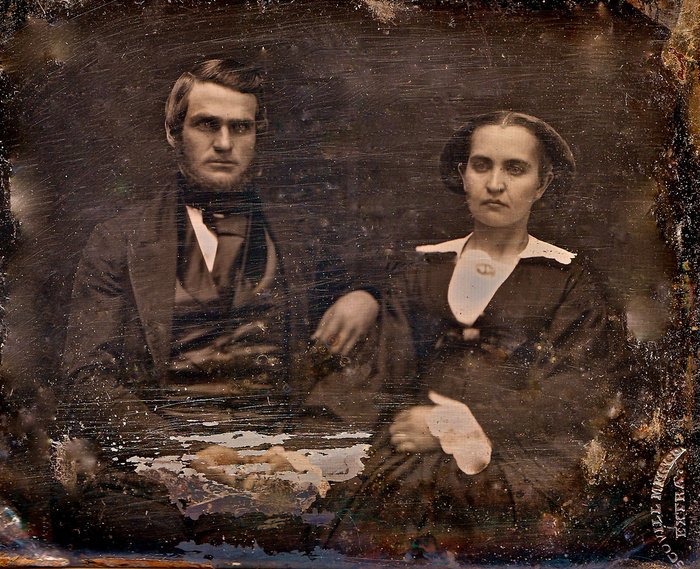
From our whole gang to yours — Mini Coni, Jaybird, Desi, Sassy, Ancestria, Lumi, and Penny — we’re wishing you a night full of moonlight, lanterns, and just the right amount of spooky.
Tonight is for remembering, too. While the little ones are out gathering candy, we light our candles for the ones who came before us — the ancestors whose stories brought us here. If you walk a cemetery this weekend, walk it slow. Read the stones. They have so much to tell us.
Tell me in the comments: who are you remembering tonight?
With love, from my Ever Widening Circle to yours — Coni 🧡
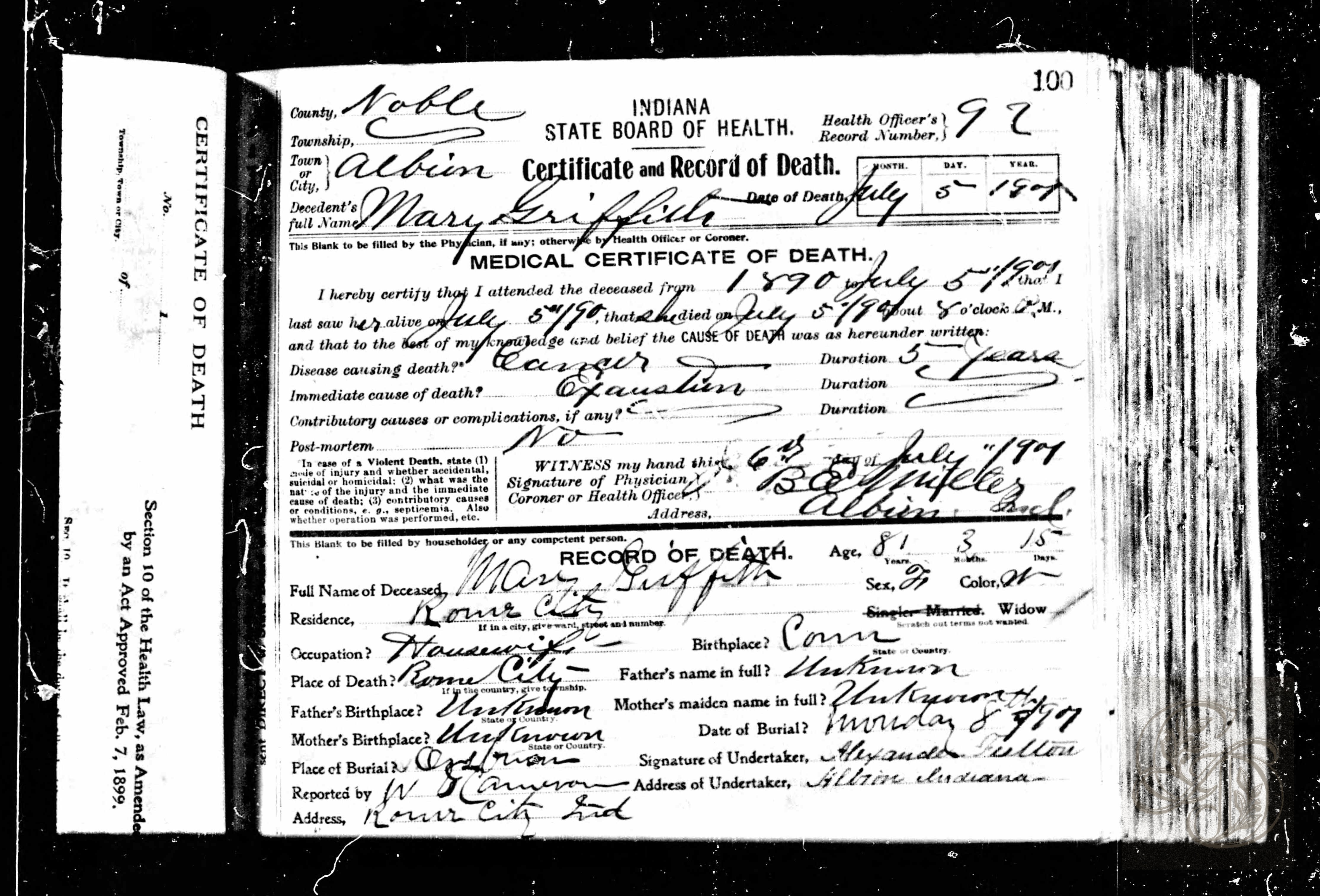
Mary Griffith’s death certificate, Rome City, Indiana, 1901 — the record that writes “Unknown” for both of her parents
By Coni Dubois
Her own death certificate doesn’t know who she was.
When Mary Griffith died in Rome City, Indiana, on Friday, July 5, 1901, the man who reported her death was her son-in-law, Dr. W. G. Cameron — a man who had known her for years, in whose home she had been living. And where the certificate asked for her father’s name, he had to write “Unknown.” Where it asked for her mother’s maiden name: “Unknown.” Their birthplaces: “Unknown,” and “Unknown.”
This Wednesday I’m going back for the woman behind the name Parker — and the first surprise of the hunt is that Parker turns out to be real. What’s missing is everything behind it.
The woman as the records show her
Mary Parker married Elihu S. Griffith (born March 14, 1817, at Richburg, Allegany County, New York) about 1840 — the marriage itself is carried by family knowledge and the census household trail; no marriage record has been read yet, and that record is one of the keys this wall needs (more on that below).
Together they raised five children:
Sheldon D. Griffith (born February 1841–43)
Elizabeth Fidelia Griffith (born 1845, married Andrews)
D. Elton Mathye Griffith (born July 30, 1849, at Girard, Pennsylvania)
Lavira Matilda Griffith (born January 26, 1851, married Stetson E. Southworth)
Ida M. Griffith (born 1857, married Dr. William G. Cameron)
The census trail follows the family the way so many New York families moved — a short hop, then a long one:
1850, Girard, Erie County, Pennsylvania: Eli (33, farmer), Mary (30, born New York), Sheldon 7, Elizabeth 5, and baby “Mysthus” 1, born in Pennsylvania. And one extra man in the house — Napoleon VanPatton, 28, born New York, a currier by trade. Hold that name. A boarder who travels with a family is often kin, and he comes back in the hunt plan below.
1860, Girard, Pennsylvania: the household grown to seven, the younger three children born in Pennsylvania.
1870, Sheridan Township, Calhoun County, Michigan: the classic “Yorker” jump — New York and lake-shore Pennsylvania families poured into southern Michigan farmland in those years, and the Griffiths went with them.
1880, Clarence, Calhoun County, Michigan: Elihu 63, farming; Mary 60, keeping house; Ida 23, still at home.
Elihu died at Clarence on February 14, 1886, and lies in Clarence Center Cemetery. By 1889 the Battle Creek city directory lists Mary Griffith, widow of Elihu, at 718 N. Eaton. And about 1890 — her Indiana doctor’s certificate says he attended her from that year — the widow made the last move of her life, the commonest move of all: she followed a married daughter. By the 1900 census she is in Albion, Noble County, Indiana, listed plainly as mother-in-law in the home of her daughter Ida and Dr. Cameron, with her son Sheldon, 57, in the same house.
The 1900 census, Albion, Indiana — Mary Griffith at 80, in her daughter Ida Cameron’s home
She died there a year later, on July 5, 1901, at 8 p.m., of cancer — five years of it (my book note says cancer of the face) — with exhaustion the immediate cause. She was buried Monday, July 8, in Orange Cemetery, Rome City, Plot 3-15, after a funeral at the Free Will Baptist Church. Her obituary, printed July 12, is three lines long:
“Griffith Mary, mother-in-law of Dr. W. G. Cameron, died last Friday, aged 81 years 3 months and 15 days from cancer of the face. Funeral at the F.W.B. Church Monday. Burial, Orange Cemetery.”
Even “died last Friday” checks out — July 5, 1901 was a Friday. The record-keeping around her death is careful. It’s her beginning nobody could write down.
A moment in Rome City, July 1901: a small Indiana town in high summer, a widow of 81 buried on a Monday from the Free Will Baptist church she had chosen as her own, by a family who loved her, knew her children and her grandchildren — and could not have told the health officer her parents’ names if their lives depended on it. That is how a brick wall is born: not from neglect, but from one generation’s silence becoming the next generation’s blank page.
What this week’s digging already moved
Brick Wall Wednesday usually starts at the wall. This week the wall moved before the post even ran, because three records already sitting in my own files had never been read side by side:
Her death certificate (Indiana, Noble County, Health Officer’s Record No. 92) — read in full. It gives her birthplace as “Conn.” — Connecticut — and then the four Unknowns for her parents.
Her son D. Elton Griffith’s Michigan death certificate (he died December 15, 1916, in Arenac County) — in the box for maiden name of mother, his son wrote “Mary Parker.” For her birthplace, he wrote “Vermont.”
Her daughter Lavera Southworth’s Michigan death certificate (she died May 20, 1927, in Calhoun County) — a different informant, eleven years later, in a different county, wrote in the same box: “Mary Parker.” For her birthplace: “New York.”
Two children. Two informants. Eleven years apart. Both of them, asked for their mother’s maiden name, wrote Parker.
So Parker is not a guess and not a clerk’s fancy — it is the name her own family used for who she was before she married. The wall is no longer “was she a Parker?” The wall now is: which Parker family — and where?
The honest flags — shown, not hidden
Her birthplace is a four-way split, and I won’t pretend otherwise. Connecticut (her death certificate, one informant’s word) · New York (all five federal censuses, 1850–1900, and her daughter Lavera’s certificate) · Vermont (her son Elton’s certificate). New York is the widest pattern. But Elton’s “Vermont” is a loose thread worth pulling, not discarding — a Vermont birth with a New York childhood would fit a family that moved, and it matters for the name question below.
Her birth date is computed, not proven. No record gives it. Her death record’s age — 81 years, 3 months, 15 days, at death on July 5, 1901 — works back to March 21, 1820. My tree has long carried April 21, 1820, from a working note of mine whose subtraction slipped a month (July 5 minus 3 months is April 5, and April 5 minus 15 days crosses back into March). The honest way to print it: born about March 1820, computed from her death record. I’m correcting my own tree the same way I’m showing it to you.
And then there’s “Pasket?” My files carry Mary as “also known as Pasket?” — question mark and all, in my own tree, with no source attached to it anywhere. I have searched my Drive for Pasket and Pasquet and found nothing. It may be a real alternate surname (a stepfather’s name? a French-Canadian Pasquet under a clerk’s spelling — which would sit very comfortably beside a Vermont birth). It may be a misreading of somebody’s handwriting, or a note parked from a fellow researcher’s tree. Until a record carries it, it stays exactly what it is: an unsourced hint with its own question mark, flagged and not built on.
A reader’s note, the day this posted: Linda Stufflebean wrote in with a handwriting observation — in old script, “Pasket” and “Parker” carry the same word-shape (tall, two short, tall, short, short), so a faded “Parker” is easily written down as “Pasket.” I had reached the same thought while writing this piece; hearing it independently from another researcher steadies it. It isn’t proof — but it’s one more reason to read “Pasket?” as a transcription ghost of Parker. Thank you, Linda.
The marriage paper in my tree isn’t real yet, either. Two Indiana marriage-index citations are attached to Mary and Elihu’s marriage in my files — unread, and geographically wrong for a couple who were in New York and Pennsylvania in the early 1840s. Most likely a namesake couple. They stay labeled unverified until somebody reads the actual records.
What would crack it
Any one of these could name her parents:
Her marriage record, about 1840 — Allegany County, New York, or Erie County, Pennsylvania church registers (New York kept no county marriage records that early). A witness, a bondsman, an officiant from her side of the aisle names her family.
A Parker will, estate, or deed in Allegany County NY, Erie County PA, or a Vermont town, naming a daughter or sister Mary Griffith.
The full original obituary — the three lines in my files are a fellow researcher’s extract. Noble County papers often printed a full sketch: born in ___, came to Indiana in ___, survived by a brother in ___. That paper is a named pull.
The Free Will Baptist Church records of Rome City — her funeral church, her chosen anchor. Membership rolls and letters of transfer often carry a maiden name and the church she came from.
The Orange Cemetery lot card, Plot 3-15 — lot ownership and burial cards sometimes hold the next-of-kin and birth data the certificate left blank.
The rest of her children’s certificates — Elizabeth Andrews (died 1912, Michigan), Sheldon Griffith (died October 30, 1921, Michigan), and Ida Cameron (died 1930). Three more informants answering the same two boxes. Elton’s “Vermont” already shows the answers wander — a fourth and fifth voice either steadies Parker in one place, or surfaces that other name outright.
The hunt, in order
Finish the children first — pull Elizabeth’s, Sheldon’s, and Ida’s death records, and read the Michigan marriage records already in my files (Michigan marriages name both parents of bride and groom).
Rome City — the full obituary, the Free Will Baptist rolls, the cemetery lot card.
Work the cluster, not the woman alone. Napoleon VanPatton, the 28-year-old currier boarding with the family in 1850 — Van Patten is an old Albany–Schenectady Dutch name. If he is Mary’s brother or cousin, his family is hers. And Joe Griffith, the researcher my death and obituary notes came through — his files are the first place to ask what “Pasket?” ever was.
The 1840 marriage ground — church registers around Richburg and Girard, and the county-history biographical sketches: a son’s or grandson’s printed biography often names the mother’s family outright.
Search every drawer for the name — Parker · Pasket / Pasquet / Pasquette · Baskett · Parks — remembering that to a hurried clerk, a flowing “Parker” and a “Pasket” are one bad pen-stroke apart.
DNA — cluster my Griffith-line matches and look specifically for Parker — and Pasquet — families of Allegany County, Erie County, and Vermont. A shared cluster with a paper trail would be a genuine lead, labeled as a lead until a record lands.
Still hunting — maybe you hold a piece
If you descend from Elihu and Mary Griffith of Girard, Pennsylvania, or Calhoun County, Michigan — through Sheldon, Elizabeth Andrews, D. Elton, Lavira Southworth, or Ida Cameron — or if your Parker (or Pasquet) family of Allegany County, Erie County, or Vermont has a daughter Mary, born about March 1820, who married a Griffith and vanished west — I would love to hear from you. Somebody’s family Bible, church roll, or letter home knows who her parents were. Her own death certificate didn’t. Maybe yours does.
Sources
We source everything. Every fact above traces to one of these:
Death certificate of Mary Griffith, Indiana Death Certificates 1899–1911, Noble County, Health Officer’s Record No. 92 (died July 5, 1901, Rome City) — read in full from my files.
Death certificate of D. Elton Mathye Griffith, Michigan Death Records 1867–1950 (Arenac County, died December 15, 1916) — names mother “Mary Parker,” her birthplace “Vermont.”
Death certificate of Lavera M. Southworth, Michigan Death Records 1867–1950 (Calhoun County, died May 20, 1927) — names mother “Mary Parker,” her birthplace “New York.”
U.S. Federal Censuses — 1850 & 1860, Girard, Erie Co., PA; 1870, Sheridan Twp., Calhoun Co., MI; 1880, Clarence, Calhoun Co., MI; 1900, Albion, Noble Co., IN.
Obituary of Mary Griffith, July 12, 1901 (newspaper unnamed in the extract), via the research of Joe Griffith, as carried in my compiled record.
Battle Creek, Michigan city directory, 1889 — Mary Griffith, widow of Elihu, 718 N. Eaton.
Ancestors of Coni Allen by Coni Dubois — the compiled family record this research started from (Mary Parker entry, pp. 623–626 and 1078–1079).
Find A Grave: Mary Griffith #41706990; Elihu S. Griffith #20445967 (index/secondary).
I can finally say the words: Heirloomie is complete.
Every room is built, every door has been opened and checked, and as of this morning she is officially published. Now we move into beta testing — the last step before she opens to the world on Google Play.
Here’s where we stand:
🌿 11 of our 20 tester seats are filled — 9 seats left
📱 I especially need 7 more Android testers (iPhone and computer folks — you can test through the web, and you’re welcome too!)
💛 Every beta tester gets six months free when Heirloomie launches, as my thank-you
Testers all go in together, keep the app at least two weeks, and tell me honestly what you love and what trips you up. First come, first seated — when the 20 are gone, they’re gone.
Want a seat? Sign up on the beta form at heirloomie.com 💛
Some ancestors you find in a courthouse. Thomas William Nickerson I found in a barn — a livery barn, in a little Indiana town, with the horses stamping in their stalls and the smell of hay and harness leather in the air. That was his world, and for a while it was a good one.
Thomas William Nickerson. From Coni’s research files.
Thomas was born in McLean, McLean County, Illinois, on November 30, 1871 — a son of George Albert Nickerson and Malinda Ann Johnson. (My own family file long carried November 20; his Indiana death certificate says November 30, and where the records argue, the man’s own record is the one I follow — the argument is shown at the end of this post rather than hidden.) The 1880 census finds him at eight years old in Wapella, De Witt County, Illinois, in a full house: his parents, brothers James, Everett, and little Richard, a baby sister Cora, and Jennie, sixteen. A farm boy in a farm family, one of many — nothing yet to say where his road would run.
His road ran to a Kentucky-born girl. Nancy Elizabeth Pratt was born September 12, 1873, in Estill County, Kentucky, a daughter of William Henry Harrison Pratt and Caroline M. Trent. Thomas and Nancy were married September 28, 1892, at Heyworth, Illinois — the McLean County marriage register itself says so (License No. 19759), with her obituary and the 1900 census in agreement. The register keeps the witnesses’ names too: Arthur Johnson and James A. Nickerson — Thomas’s own brother James stood up with him — and the minister was M. F. Ingraham, of the Christian church. Their first boy, Oliver, arrived in March 1894. Hold onto that Trent name, because it matters to this family twice over: Nancy’s mother Caroline was a daughter of Zachariah Green Trent — the sheriff and justice of the peace some of you met here as our Ancestor of the Week on October 11 — and of Matilda Coffman, the great-grandmother at the heart of my mother’s-side mystery. So when Thomas married Nancy, the Nickersons didn’t just gain a wife and mother. They married straight into the Trent line I have chased for years.
The marriage register, McLean County, Illinois, p. 305, License No. 19759: Thomas W. Nickerson and Nancy Pratt, married September 28, 1892, at Heyworth. Image via FamilySearch (film 007625296).
They settled in Pulaski County, Indiana — Nancy’s obituary says they came in 1893 and “lived here continually” — and Thomas built his living the way a horse-country man could: a livery and feed stable in Francesville. The old listing reads like a promise: “Livery & Feed Stable — Barns 5, Residence 35 — 1st class rigs.” In 1900 the census finds the young family in Salem Township: Thomas, 28, head of house; Nannie, 26; Oliver, 6; Orval, 4; and baby Viola, 1. By 1910 he’s working at the livery barn, and the house has filled out — Nancy, Ollie at 16, Orval at 14, Viola at 11, and Bessie at 9. Four children, a working stable, a church they belonged to. If you had passed through Francesville in those years and needed a rig, Thomas Nickerson is who the town would have sent you to.
Then the sorrows came, the way they did to so many families of that generation — not all at once, but one after another, until the shape of the family was changed for good.
Nancy had been sick, her obituary says, “much of the time during the past fourteen years.” In October 1915 she underwent an operation for acute abdominal trouble at the home of Mrs. Anna Banwart in Francesville. She rallied, and her recovery looked hopeful — and then, the paper says, “heart complications unlooked for counteracted her only chance and she sank into unconsciousness and death.” Her death certificate fixes the moment: Sunday, October 24, 1915, at two o’clock in the morning — the very words her obituary used. She was 42 years old. The Pythian Sisters of Francesville Temple No. 385 draped their charter in mourning for thirty days and sent their resolutions to “the bereaved husband and children.” She was laid to rest in Nauvoo Cemetery, outside Francesville, where her own Pratt kin already rested. Thomas was 43, with four children, the youngest fourteen.
Nancy’s death certificate, Indiana, 1915: died October 24, 1915, Francesville, Pulaski County. Indiana Death Certificates, 1899–2011, from Coni’s research files.
Three and a half years later came the knock every soldier’s family dreaded — except Ollie had nearly made it home. Oliver Holl Nickerson, the oldest boy, had enlisted on May 12, 1917, at Fort Thomas, Kentucky — Private First Class, 30th Infantry. He married Katherine Auer in August 1918. He was, the Francesville paper wrote, “soon to be released” when, on April 28, 1919, the bus he was riding near Camp Merritt, New Jersey — he was on his way to see his wife — met another bus head-on at the top of a hill. Seven people were killed. Ollie was not killed outright; he was taken to the hospital, where he died as surgeons amputated his crushed right leg. He was 25 years old. A comrade, Private Brown, escorted his body home as far as Monon. The funeral was held from the Christian church in Francesville, and Ollie was buried at Nauvoo, near his mother. The full newspaper account is in my files, and it is in the records below — I have not softened a word of it, because it was written by people who were there, and it deserves to be read the way they wrote it.
Oliver’s headstone application, U.S. Headstone Applications for Military Veterans, 1925–1963 (National Archives). From Coni’s research files.Oliver’s tombstone, Nauvoo Cemetery, Pulaski County, Indiana. Photograph from Coni’s research files.
His younger brother Orville — Sergeant First Class Orville Albert Nickerson — had signed up ten days before Ollie, on May 2, 1917, at the same Fort Thomas. Orville came home: the Army transport lists carry him back, and he lived on in Plymouth, the son who signed his father’s death certificate as informant in 1946. We tell his piece of the story from those records, which are in the list below.
Orville Albert Nickerson, the sergeant. Photograph from Coni’s research files.
Thomas carried on. He married again, to Daisy Fenton — a widow when he met her, Daisy (Fenton) McClure; she is in the family photograph with him and his father George — and they had no known children. That marriage did not last: her death certificate records her as divorced, under the name Daisy McClure, working as a hospital maid in South Bend when she died there on April 29, 1929. She was brought home to Plymouth and laid in Oak Hill Cemetery on May 1, 1929 — the same ground where Thomas himself would rest seventeen years later.
Thomas Nickerson and Daisy (Fenton) McClure, with Thomas’s father George Nickerson. Photograph from Coni’s research files.Daisy’s death certificate, Indiana, 1929: died April 29, 1929, South Bend; buried Oak Hill Cemetery, Plymouth. From Coni’s research files; her obituary came by the help of the Plymouth Public Library.
The censuses follow him the way they follow so many men of his time: 1920 in Plymouth, Marshall County, then 1930 and 1940 in Vernon, Jennings County, where the 1930 census taker wrote him down as a widower. Late in life he came back to Plymouth, and there, on Saturday, April 27, 1946, at 12:30 in the afternoon, at the Austin Nursing Home, after an illness of three weeks, Thomas William Nickerson died at 74. His obituary remembers him plainly: a member of the Christian Church, survived by his son Orville and his daughter Mrs. Bessie Gilbert, both of Plymouth, by ten grandchildren and eleven great-grandchildren, by a brother Otis in Canada and two sisters back in Illinois. He was buried April 30 in Oak Hill Cemetery, Plymouth.
1920 census, Plymouth, Marshall County, Indiana. National Archives; image from Coni’s research files.1930 census, Vernon, Jennings County, Indiana (Roll 594, p. 4A). Image via FamilySearch.1940 census, Vernon, Jennings County, Indiana. National Archives; image from Coni’s research files.Thomas’s death certificate, Indiana, 1946: born November 30, 1871; died April 27, 1946, Plymouth, Marshall County. Indiana Death Certificates, 1899–2011, from Coni’s research files.
His estate took three more years to settle — real estate sold, a monument paid for, the funeral bill paid — and when the Marshall Circuit Court approved the final report in December 1949, the last $484.80 was divided among his heirs in careful equal shares. I want you to see one name on that list, because it’s where his story becomes mine: among the $40.40 shares — a granddaughter’s third of a daughter’s portion — stands Mildred Gilbert. Mildred Marie (Sheetz) Gilbert, my grandmother. Her mother was Thomas’s daughter Viola Beatrice Nickerson, who married Bernard Gregory Scheetz on November 11, 1919, in Pulaski County. Viola died in 1944, two years before her father — which is why, in 1949, her portion came down divided among her children.
So the line runs straight and documented: Thomas → Viola → Mildred → my mother Nancy → me. The livery-stable man of Francesville is my great-great-grandfather. And through Nancy Pratt, his children’s Trent blood runs back to Zachariah and Matilda too — two of my lines, joined in one Francesville household, in a house full of children, a mile from a livery barn.
Welcome home, Grandpa Thomas. The rigs are all motor cars now, but we still know the way to Nauvoo. 🕯️
— Coni Dubois
The records behind this story
Every claim above rests on one of these, from my own research files — the Ancestors of Coni Allen book, entries 30–31 and family.
1880 United States Federal Census — Wapella, De Witt County, Illinois; Thomas W. Nickerson, 8, son of George A. & Malinda A. Nickerson. Roll T9_203, Page 464, ED 79.
1900 United States Federal Census — Salem Township, Pulaski County, Indiana; Thomas W. Nickerson, head; Nannie E.; Oliver H., 6; Orval A., 4; Viola B., 1. (This census gives his birth as March 1871 — see the note below.)
1910 United States Federal Census — Salem Township, Pulaski County, Indiana; Thomas Nickerson, works at livery barn; Nancy; Ollie, 16; Orval, 14; Viola, 11; Bessie, 9. Roll T624_375.
1920 United States Federal Census — Plymouth Ward 2, Marshall County, Indiana. Roll T625_456, Page 15A, ED 169.
1930 United States Federal Census — Vernon, Jennings County, Indiana; “Tom W Nickerson.” Roll 594, Page 4A, ED 16.
1940 United States Federal Census — Vernon, Jennings County, Indiana; “Thomas W Nicherson.” Roll T627_1058, Page 6B, ED 40-16.
Indiana, Death Certificates, 1899–2011 — Thomas William Nickerson, 1946: Marshall County Board of Health Certificate of Death, Certificate #47, Book CH-32, Page 92; Registered No. 12647. Born November 30, 1871, McLean County, Illinois, son of George Nickerson and — Johnson; informant Orville Nickerson of Plymouth; died April 27, 1946, Austin Nursing Home, Plymouth; buried April 30, 1946, Oak Hill Cemetery, Plymouth.
Obituary of Thomas William Nickerson (Plymouth paper, April 1946): died Saturday afternoon, April 27, 1946, age 74; funeral at Danielson & VanGilder Funeral Home; burial Oak Hill Cemetery, April 30, 1946.
Final Report of the Estate of Thomas Nickerson — Marshall Circuit Court, September Term 1949; final distribution of $484.80, including Mildred Gilbert $40.40.
Obituary of Nancy Elizabeth (Pratt) Nickerson (Francesville paper, October 1915), with the Pythian Sisters’ Resolutions of Respect, Francesville Temple No. 385.
Indiana, Death Certificates, 1899–2011 — Nancy E. Nickerson: wife of Thomas Nickerson; daughter of Wm H. Pratt and Carolina Trent; died October 24, 1915, at 2 a.m., Francesville, Pulaski County; buried October 25, 1915, Nauvoo Cemetery.
Francesville newspaper account of Pvt. Oliver H. Nickerson’s death (May 9, 1919): Camp Merritt bus collision, April 28, 1919. Supported by the Indiana Gold Star Honor Roll, 1914–1918, and U.S. Headstone Applications for Military Veterans.
McLean County, Illinois, Marriage Register — License No. 19759, Register of Marriages, p. 305: license issued September 27, 1892; Thomas W. Nickerson, 21, of Heyworth, son of George Nickerson and — Johnson, married Nancy Pratt, 20, daughter of William Pratt and — Trent, on September 28, 1892, at Heyworth, by M. F. Ingraham, a Christian minister; witnesses Arthur Johnson and Jas A. Nickerson. (The clerk wrote “Pratt” in the groom’s name box; the entry’s own parent columns name him plain.)
Indiana, World War I, Enrollment Cards, 1917 — Orville Nickerson of Francesville: Army service from May 2, 1917, Fort Thomas, Kentucky; rank Sergeant First Class (FamilySearch). This is why no WWI draft registration card exists for Orville: he was already in the Army a month before registration day, June 5, 1917.
U.S. Army Transport Service Passenger Lists — Orville Albert Nickerson, returning home.
Indiana, Death Certificates, 1899–2011 — Daisy McClure (Daisy Fenton), Registered No. 420: born August 4, 1874, in Iowa, daughter of Lewis H. Fenton and Maryette Stephens; divorced, former husband Thos Nickerson; died April 29, 1929, South Bend, St. Joseph County; buried May 1, 1929, Oak Hill Cemetery, Plymouth.
Find A Grave — Thomas William Nickerson #81825788.
The book’s figures for this entry: the family photograph (Nancy with Thomas, Orville in his lap and Oliver at his side), shared by Cynthia Huntsman Haller, April 24, 2019; the portrait of Tom Nickerson, shared by HoldawayCarolWanlass1, May 9, 2019; Thomas’s grave; his death record (Marshall County Board of Health, purchased May 14, 2014); Nauvoo Cemetery.
Where the records disagreed, here is how I settled it — shown, not hidden. Thomas’s birth: his own death certificate says November 30, 1871, and his obituary agrees, so November 30 stands; my book’s November 20 and the 1900 census’s March 1871 do not. The marriage: the register itself gives September 28, 1892. Nancy’s death: her own certificate says October 24, 1915, at 2 a.m. — agreeing with her obituary’s “Sunday morning at two o’clock” — so October 24 stands. Nancy’s maiden name is Pratt in every record behind her; one published family history in my book spells it Platt, and I flag the variant rather than hide it. Thomas’s certificate records his late-life occupation as “Laborer”; his livery-stable years rest on the 1910 census and the Francesville listing. Clerks wrote what they heard — “Nicherson” among the spellings — and the family is the same.
This collection exists by the help of many — Cynthia Huntsman Haller, HoldawayCarolWanlass1, the Plymouth Public Library, and every cousin and clerk who kept a piece of it. Thank you, all.
This morning I published the story of the night the wall came down on Frank Tarant — my great-great-grandfather who vanished after one census line in Wisconsin in 1870, leaving no parents, no baptism, no grave.
I told you in that post that his baptism was not in Čelákovice, the town his marriage record names as his birthplace. I told you his birth year was unsettled. Both of those things were true when I wrote them.
They are not true anymore. The wall kept falling.
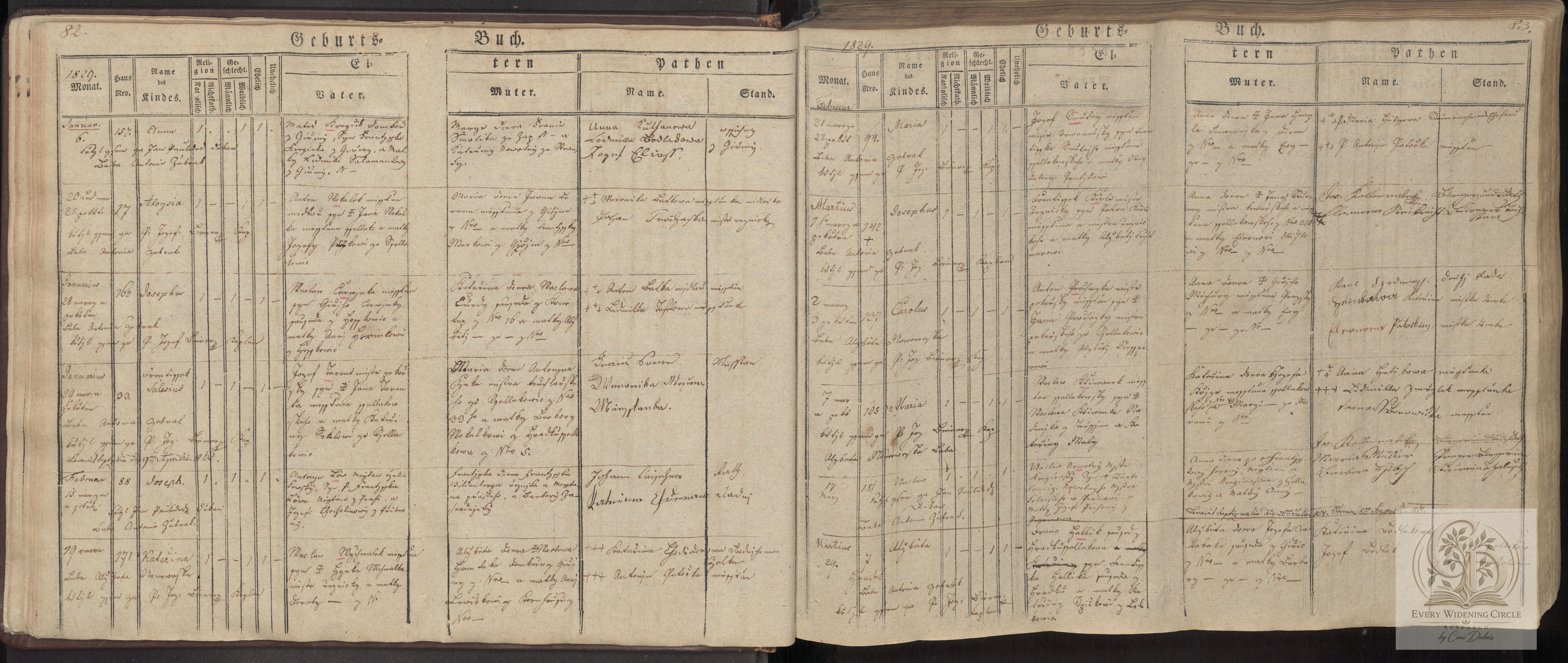
Hours after the post went up, we went back into the Čelákovice birth register — the same book, read a second time with new eyes — and there he was, spelled the way the clerk heard it that day: Tarand.
František Salesius Tarand, baptized 29 January 1829, at house No. 33 — legitimate son of Josef Tarand, master baker, and Maria, daughter of Antonín Žák, master soap-boiler, of house No. 18.
House No. 33 is the very house his 1859 Prague marriage record gives as his birthplace. And the age fits to the week: he turned 30 three weeks before his wedding, exactly what the marriage clerk wrote. The 1838 birth year my book has carried for years came from a single census line — and that line was wrong. Frank was born in 1829.
The same book held a sorrow first. Fifteen months before Frank, his parents baptized another son and gave him the same name: František, baptized 4 October 1827. The parish index carries the rest of his story in one small column — he died 5 October 1827, one day old. When their next son came, Josef and Maria gave him their lost boy’s name again, with Salesius added to it. That was Frank.
Baptism of František Tarant, 4 October 1827 — Čelákovice 13, image 030
And the finds didn’t stop with Frank. His father’s own baptism surfaced in the older register: Josef Lukáš Tarant, born 21 May 1801, son of Jan Tarand, a master glazier, and Kateřina Sobolová. From Jan the glazier the line steps back to Jan the weaver, born 1752 — and then to the furthest Tarant we have yet found in Čelákovice: Václav Tarant, born about 1715, who died there in 1782. Two hundred and fourteen years before Frank’s great-granddaughter would come looking for him.
Baptism of Josef Lukáš Tarant, 21 May 1801 — Čelákovice 11, image 046
I am correcting this morning’s post in place, and I’m leaving this follow-up standing beside it, because this is how the work really goes: you publish what the records prove today, and tomorrow the records prove a little more. The wall doesn’t always fall all at once. Sometimes it falls on a Wednesday — and then keeps falling.
Some ancestors hide in plain sight, behind nothing more than the sound of their own name.
Dorman J. Cortright was born on Monday, October 31, 1825 — Halloween day — in Butler, Wayne County, New York, a son of Lt. Simeon Emerson Cortright and Margaret Haines. Sit with that a moment. Two hundred years ago this month, in a farming town in upstate New York, a Halloween baby opened his eyes — and nobody in that house could have guessed that his great-great-great-granddaughter would one day come looking for him in October, and find him by the sound of his name.
Because the name would not sit still. In the records he is Cortright, and he is Courtright. In other papers the clerks wrote it the way their ears heard it, and our family grew up saying it — “Cartright.” I grew up hearing it sounded out just that way. He was the same man every time: a farmer, a husband, a father. The spelling changed with whoever held the pen. That is how an ancestor gets lost — not because he left no trace, but because his trace is filed under three different names.
On Tuesday, October 23, 1849, Dorman married Elizabeth Egbert — “Eliza” — a daughter of John L. Egbert and Lydia Crandall, born May 12, 1829, in Tompkins, Delaware County, New York. The newlyweds began their life under her father’s roof: the 1850 census finds them in Veteran, Chemung County, New York, in John L. Egbert’s household, Dorman listed at 24, a married son-in-law, Eliza beside him at 22.
Then the family did what so many New York families did — they went west. By the fall of 1860 the census taker found them in Clarence, Calhoun County, Michigan: Dorman — written down as Courtright — 35 years old and farming, Eliza keeping house, and their little girl Emma five years old, with baby Doy just arrived. There had been a first son, Ferdinand, born in Clarence on March 18, 1851 — and lost on July 10, 1853, “a lil over 2 yrs old,” as the family’s own note says. Some griefs this family carried quietly for a very long time.
Eliza did not get to grow old. She died in Clarence on October 16, 1864, at only 35, and was laid to rest in Clarence Center Cemetery — Section B, Row 5. Dorman married again, to Elizabeth Bennett of Erie (born April 2, 1833), and they had a daughter, Ella, born in 1868. In the 1870 census Dorman is still in Clarence, 44 years old, working by then as a house carpenter, with Emma, 15, at school.
His own time ran out on June 15, 1872. The county death record gives his age as 47 and the cause: consumption — the record’s word for TB. His gravestone, carved by the family who buried him, says June 16 and gives his age to the day — 46 years, 7 months, 16 days, counted from his Halloween birthday. The record and the stone stand one day apart, and I go with the record — but both are here for you to see. He was buried in Clarence Center Cemetery, Plot B05.10 — back in Section B, in the same ground as Eliza. That fall, on October 29, 1872, his estate went through the Calhoun County probate court — Case No. 2184, a sixteen-page packet of petitions and administration papers, the whole paperwork of a life being settled by the people he left behind.
Calhoun County Return of Deaths, 1872, p. 128 — record No. 335: Dorman J. Cortright, died June 15, 1872.
The facing page of the same return — cause of death: consumption; born New York; farmer.
His gravestone, Clarence Center Cemetery — it reads June 16, 1872, aged 46 yrs 7 mos 16 ds.
But here is where Dorman stops being just a name I found, and becomes mine.
His daughter Emma Estelle Cortright — born Friday, June 8, 1855, in Chemung, New York — grew up and married D Elton Mathye Griffith on Friday, July 4, 1873, in Lansing, Michigan, he 23 and she 18. (The marriage record spells her Courtright one more time, for good measure.) Emma lived to 84, dying in Rochester, Michigan, on October 22, 1939 — and her Michigan death certificate, filled out in a new century, names her parents one final time: father, Dorman Courtright; mother, Eliza Egbert. Among Emma and Elton’s ten children was a son named Ernest Emmit Griffith — the young father some of you met here as our Ancestor of the Day on September 26, lost in the dynamite explosion of 1915. Ernest’s daughter Marion was my grandmother. Her son Rex was my dad.
So the Halloween baby of 1825 is my great-great-great-grandfather — and the line from his New York cradle to a porch in Louisiana runs straight and documented, census by census, record by record.
This week, two hundred years after he was born on Halloween, we light his candle first.
Welcome home, Grandpa Dorman. We found you — under every name they ever wrote you down with. 🕯️
— Coni Dubois
The records behind this story
Every claim above rests on one of these, from my own research files.
1850 United States Federal Census — Veteran, Chemung County, New York (Sept 30, 1850); Dorman Cortright, 24, in the household of his father-in-law John L. Egbert. NARA M432_486, p. 120.
1860 United States Federal Census — Clarence, Calhoun County, Michigan (Sept 11, 1860); “Dorman Courtright,” 35, farmer; Eliza; Emma, 5; Doy, 1. NARA M653_539.
1870 United States Federal Census — Clarence, Calhoun County, Michigan (July 13, 1870); Dorman J. Courtright, 44, house carpenter; Emma, 15, at school. Roll 666, p. 519.
Michigan, Wills and Probate Records, 1784–1980 — Dorman J. Cortright, probate Oct 29, 1872, Calhoun County; Case No. 2184; Probate Packets 2153-2201 (16 images: petitions, orders, administration papers). Michigan Probate Court (Calhoun County).
Michigan, Marriage Records, 1867–1952 — Dorman’s second marriage (Elizabeth Bennett); and daughter Emma’s marriage to D. Elton Griffiths, July 4, 1873, Lansing, Ingham County, Record No. 2168; witnesses Ida M. Griffith & Charles M. Braduer; performed by J. W. Robinson.
Michigan Death Certificates, 1921–1952 — Emma Estelle Griffith, d. Oct 22, 1939, Rochester, Oakland County; parents named: Dorman Courtright & Eliza Egbert. GS Film 001973061, Image 00262.
Michigan, Death Records, 1867–1950 / Deaths and Burials Index, 1867–1995 — incl. the Calhoun County Return of Deaths, 1872 (p. 128, record No. 335): Dorman J. Cortright, died June 15, 1872, Clarence; age 47, married; cause: consumption; born New York; farmer; parents unknown — and Emma Estelle Griffith.
Find A Grave — Dorman J. Cortright #11133561 (Clarence Center Cemetery, Plot B05.10; his stone reads June 16, 1872, aged 46 yrs 7 mos 16 ds); Elizabeth “Eliza” Egbert Cortright #20160553 (Section B, Row 5); Emma Estelle Cortright Griffith #61105532 (Mount Avon Cemetery, Rochester, Addition 3, Plot 644, Space 8).
County histories on the Internet Archive — Peirce, History of Calhoun County, Michigan (L. H. Everts & Co.); Biographical Review of Calhoun County, Michigan (Hobart & Mather / Benson).
U.S., Indexed County Land Ownership Maps, 1860–1918 — Cortright, Clarence, Calhoun County (1894).
From my own notes (Dec 10, 2010): I called the Rochester clerk’s office and spoke with Toni — five Griffiths rest at Mount Avon; Emma lies in Addition 3, Plot 644, Space 8, and her son Dill in Space 4.
A note on the name: the surname appears across the records as Cortright, Courtright, and in family speech as “Cartright.” These are the same family — clerks writing what they heard. This post uses the spelling carried in my family file: Cortright.
This morning, in the first part of Frank Tarant’s story, the wall came down on the Bohemia side. We found Frank’s baptism in Čelákovice, his parents the master baker Josef and Maria Žák, his wife Theresia Bechyň of Sadská, and the road that carried their son Josef all the way to a hospital in Logansport, Indiana — where his 1928 death certificate listed the informant as the hospital itself, because the institution didn’t know who his people were.
This afternoon, the wall came down a second time — and this time, the papers were in the family’s hands all along.
Going back through my own files today, I found the rest of Josef’s story: the family’s own paperwork, kept for nearly a hundred years.
A daughter goes to court
In July 1927, Josef’s daughter Marie — my great-grandmother — went to the Circuit Court of Marshall County, Indiana, and petitioned for her father’s care. The application is in her own handwriting. Joseph, she wrote, had come to Indiana in 1909 from Chicago, and to Marshall County in March 1927. He was a farmer, retired, but he had worked on the farm up to 1927. And she set down, plainly and gently, what the family had been living with: for about two years he had been failing. He would run away from home. He did not know where he was, or why he had left — except that he was going back to his old home. In his last two weeks at home, the family had to watch him, and see that he ate. Marie believed the trouble began with a land deal: he had sold his farm, she wrote, and “did not realize as much as he expected”; it seemed to prey on his mind. The doctor who examined him in Plymouth wrote that Josef was “very talkative, constantly referring to a land deal he made,” and did not know where he was.
Marie’s application to the Marshall County court for her father’s care, July 1927 — in her own hand (family papers)
The court granted the petition, and Josef was received at Logansport State Hospital on July 23, 1927 — the very date his death certificate gives as the start of his doctor’s attendance. The discharge papers in the file were never filled in. He was never discharged. He died there on November 2, 1928.
Let me be as plain about this as Marie was. Josef’s death certificate gives his cause of death as arteriosclerosis and states no other diagnosis, and I will not invent one for him here, either. What the court file shows is not a scandal. It is a daughter doing what a family did in 1927 for someone they loved who was no longer safe in his own mind: she went to court, answered every question honestly, and got him care. On that application, his emergency contact is written in her hand: “Mrs. Marie Gilbert (daughter), Plymouth, Ind.”
Accepted at Logansport State Hospital, July 23, 1927 — and the sheriff’s return, the same day (family papers)
What Marie knew about Frank and Theresia
The family-history page of that same file, sworn to by Marie, also gives us the first death information we have ever had for Frank and Theresia. It is family knowledge, written down by a granddaughter who never knew them — not a death record — and I label it exactly that way. It says Frank died of tuberculosis, “about 36”; and that Theresia died of old age, at 82. If Theresia was 82, she died about 1915–1916, most likely in Indiana — which means there is a death record out there to hunt, and the hunt is on. Frank’s “about 36” does not sit comfortably beside his appearance in the 1870 census, and I won’t pretend it does. But the family’s memory that consumption took him is new, and it is theirs, and it is recorded here as what it is.
The family-history page, sworn by Marie Gilbert, July 11, 1927 — Frank, dead of tuberculosis at about 36; Theresa, dead of old age at 82 (family papers)
The estate, and a daughter we couldn’t place
Five weeks after Josef’s death, on December 6, 1928, Marie was back in court for the Letters of Administration of his estate. Josef left personal property of $666 and real estate of $800, and the paper names his heirs with their ages and addresses: Anna Runik, 48, of South Trumbull Avenue, Chicago — a daughter whose married name we did not have until this paper surfaced; Anton Tarant, 35, of Cicero, Illinois; and Marie Gilbert, 33, of Plymouth. The paper also leaves us one honest puzzle: Josef’s son Frank, born in 1886, is not named among the heirs. We don’t know why yet. It goes on the still-hunting list, exactly as it stands.
Letters of Administration for Josef’s estate, Marshall County, December 6, 1928 — his three heirs named, with addresses (family papers)
Marie, and George, come home
The files held two more answers. Marie’s own Indiana death certificate shows she was born April 8, 1896, in Wisconsin, and died May 16, 1985, at Pilgrim Manor Nursing Home in Plymouth, and rests in New Oak Hill Cemetery there.
Death certificate of Marie Tarant Gilbert, Plymouth, Indiana, May 16, 1985 (family papers)
And a newspaper clipping closes a question this family has carried since 1944: Marie’s nephew George Tarant, the B-24 waist gunner shot down over Denmark, was brought home. His funeral was held in Plymouth, and he lies in New Oak Hill Cemetery — the same ground as his Aunt Marie. The grave in Denmark was a wartime resting place. Plymouth is his home.
George Tarant, brought home to Plymouth — the funeral clipping, with his portrait (family papers)Marie Tarant’s school picture (family collection, donated by Jean (Belt) Gilbert)
Where these treasures came from
A note on where these photographs and papers come from, because credit matters: the family’s photographs that travel with these papers — Joseph and Antonie together, the old Joseph Tarant farm, Marie’s school picture, the Gilbert family home on South Plum Street, and many more — were gathered and shared by Violet Jean (Belt) Gilbert (1929–2011), Marie’s daughter-in-law, whose name stands as donor on dozens of photographs in our family files. Several others, including Marie with little Jimmy, came from Nancy (Gilbert) Allen. The story of the Catholic picture — the painting at the top of this post — came from Clifford Berger, Marie’s grandson, who sent it in 2009 with a handwritten note (you’ll find it in the album below). The picture, he wrote, was “brought over from Bohemia by Joseph Tarnut” [his spelling], one of three or four that hung in Grandma Marie’s bedroom when the grandchildren were small. The others were donated to a Catholic church in the South Bend, Indiana area; this one came to Cliff through his mother, Lauretta Gilbert Berger — Marie’s daughter. This post exists because they kept these things, and passed them on.
Marie (Tarant) Gilbert with Jimmy (family collection, donated by Nancy (Gilbert) Allen)
The family, in photographs
The photographs in this section have been tidied very gently — a little contrast, a little sharpness, nothing more. No face has been redrawn and nothing has been added or taken away; they are the same photographs, just a touch easier to see. The originals, exactly as they came down to us, are in the album at the end of this post, so anyone can compare them.
From the family’s collection — an elderly Tarant couple, kept with Joseph and Antonie’s photographsAt the farm, with the team (family collection)James Madison and Marie (Tarant) Gilbert (family collection)Anton ‘Tony’ Tarant — the family’s own label on the back of the photographA family home, kept in the family’s photographs
Still hunting
Theresia’s Indiana death record, about 1915–1916 — the family-history page says she died of old age at 82.
Why Josef’s son Frank (b. 1886) is not among his father’s 1928 heirs.
Frank’s own arrival in America, and his grave — the family’s memory says tuberculosis took him young; the 1870 census says he was in Kewaunee, Wisconsin. Both things are on the table until a record settles it.
The wall came down twice in one day — once in the Bohemian registers this morning, and once this afternoon, in papers my own family kept. If you are sitting on a box of family papers, go look in it. You may already be holding your brick wall’s other side.
The album — the originals, untouched
These are the photographs exactly as they were handed down and scanned — no tidying of any kind; the only addition is our small monogram watermark. This is the family’s album, as it came to us.
The Catholic picture, brought over from Bohemia — original scanClifford Berger’s handwritten note about the picture, July 23, 2009 — it hung in Grandma Marie’s bedroomThe elderly couple — originalAt the farm, with the team — originalJames and Marie Gilbert — originalMarie with Jimmy — originalMarie’s school picture — original
Sources
Application and commitment file for Joseph Tarant, Circuit Court of Marshall County, Indiana, July 1927 — the family’s own papers, including the family-history page sworn by Marie Gilbert.
Letters of Administration, estate of Joseph Tarant, Marshall County, Indiana, December 6, 1928 — the family’s own papers.
Death certificate of Marie Tarant Gilbert, Indiana, State No. 85-018813, May 16, 1985 — the family’s own papers.
Descendants of Frank and Theressa Tarant, compiled family report and photograph collection (Coni Dubois, 2026) — photograph donor credits as noted in the text.
Handwritten note of Clifford Berger, July 23, 2009, accompanying the Catholic picture — the family’s own papers.
For the Bohemia side — Frank’s baptism, the Prague marriage, Josef’s baptism, and the rest — see the sources in Part 1 of this story.
UPDATE — the same day, a few hours later (October 14, 2026): The wall kept falling. After this post went up, we found Frank’s baptism — he was in Čelákovice all along, spelled ‘Tarand’ in a book we had already read once and missed. He is František Salesius Tarant, baptized January 29, 1829, at house No. 33 — the very house his marriage record names. His father’s baptism turned up too, and the line now runs two generations deeper, to Václav Tarant, born about 1715. The passages below that say his baptism wasn’t found and his birth year was unsettled were true when I wrote them that morning — I’ve corrected them in place, because around here the records get the last word. — Coni Dubois Follow-up: “The Wall Kept Falling — Frank Tarant, Found”
The Tarant journey: from Čelákovice and Sadská in Bohemia to Kewaunee, Chicago, Marathon, and Indiana
By Coni Marie
Some brick walls stand for thirty years. This one stood in my files for most of my researching life — and then, in one long night of work, it came down.
Meet my second great-grandfather, Frank Tarant. When this week began, here is everything I could prove about him: he was born in Bohemia. He married a woman named Theressa, whose maiden name I did not know. They had a son, Josef, born about March 1858 in Sadská, Bohemia. And Frank appears in exactly one American record — the 1870 census of Kewaunee, Kewaunee County, Wisconsin, written down as “Frank Trant,” age 32. After 1870, nothing. No death record. No grave. No second census. His parents were listed in my files as unknown, because they were.
That was the wall. Here is the night it broke.
A baptism in Sadská
The first crack came from the parish registers of Sadská, a small town in the Elbe lowland of Central Bohemia. In the Roman Catholic birth register for 1853–1858 (Sadská 18, image 131), there is my great-grandfather’s baptism: Josef Tarant, born in Sadská in March 1858, son of František Tarant of Sadská.
Written in Latin in the margin of that entry is the sentence that opened everything:
“Proles hæc, Josef, per subsequens matrimonium inter parentes quod Pragæ, ad Sct. Petrum die 22 Februarii 1859 contractum legitimata est.”
In plain English: This child, Josef, was legitimized by the subsequent marriage of his parents, contracted at Prague, at St. Peter’s, on 22 February 1859. The entry also notes that a duplicate of Josef’s baptismal certificate was issued on September 22, 1880 — right before his own marriage, when he would have needed it.
Josef came into this world eleven months before his parents could marry. That was not a scandal to hide; it was written right into his baptism record, because the Church and the Empire both ran on paper. And that paper pointed straight to Prague.
Josef Tarant’s baptism, Sadská, March 1858 (Sadská 18, image 131)
A wedding in Prague
At the City Archive of Prague, in the marriage register of St. Peter na Poříčí (PE O10), the index carries one line: Tarant, 1859, 22. Februar. The entry itself, on February 22, 1859, gave me in one stroke what thirty years of files could not:
The groom: Franz Tarant, a soldier, born at Čelákovice No. 33, in the district of Brandýs — the legitimate son of Josef Tarant, master baker, and Maria, née Žák.
The bride: Theresia Bechyň — there was Theressa’s maiden name at last — born at Sadská No. 278, the legitimate daughter of Josef Bechyň, citizen and weaver, and Marie, née Charvát.
The wedding house was Prague No. 1177/2. The witnesses were Joseph Buchenbaum, a master cooper, and Franz Mitzschli, an innkeeper.
So now I can tell you where they were coming from. Frank was a master baker’s son from Čelákovice, a town on the Elbe east of Prague. Theresia was a weaver’s daughter from Sadská, some twenty kilometers east of there — the same flat, rich Elbe lowland, a half-day’s walk apart. Their son was born in her hometown, as was the custom, and Sadská stayed the family’s anchor for the rest of the century.
The marriage of Franz Tarant and Theresia Bechyň, St. Peter na Poříčí, Prague, 22 February 1859 (PE O10, scan 199)
The soldier
Frank was not free to marry when Josef was born, and the register tells us exactly why. He was a serving soldier of the Austrian Empire, and an Austrian soldier could not marry without his regiment’s written permission — the Ehebewilligung. The remarks column of the marriage entry reads like the paper trail of a young man’s whole life in 1858:
Marriage permission from the Regimental Command at Zara (Zadar, on the Dalmatian coast), July 3, 1858, No. 709 — issued four months after Josef’s birth, which is why the wedding waited until February 1859.
An announcement and discharge certificate from the Regimental Chaplaincy at Zara, July 1858, No. 284.
Both baptismal certificates filed as enclosures — his from Čelákovice, hers from Sadská.
The banns read February 2, 6, and 13, 1859, in Prague and in the regimental chapel at Zara, an empire apart.
A margin note at Frank’s name ties him to a regiment numbered 23, and published army histories list Infantry Regiment 23’s colonel-in-chief in those years as Baron Airoldi — the regiment was known by his name. (We have since checked the army almanac, the Militär-Schematismus, for both 1858 and 1859: Airoldi checks out — but the regiment recruited in Lombardy, its district seat at Lodi, and the almanacs do not station it at Zara. It is Frank’s own marriage file that puts him at Zara — his battalion was posted there, whatever the regiment’s paper home. A Bohemian baker’s son in a Lombard regiment looks like a specialist posting, which fits the butcher reading below.) A word beside his name appears to read Regiments-Fleischergeselle — a regimental butcher’s journeyman — which would fit a baker’s son: a man who knew his way around provisions. That reading is tentative, and I label it so.
Think about what that means. It was not the family’s memory that preserved who Frank Tarant was. It was the Austrian Army’s paperwork — permission slips, chaplaincy certificates, banns read in two chapels a thousand kilometers apart. A working man’s life, saved by bureaucracy.
One generation deeper — found the same night
The Prague record named Frank’s parents. Before the night was over, we found them too.
In the marriage register of Čelákovice (Čelákovice 17), on September 21, 1824, Jozef Tarant, age 24, a bachelor, married Maria Žák, age 25. The entry names the generation behind them: Jozef was the son of Jan Tarant, a master craftsman of Čelákovice, and his wife, née Sobolová (her first name reads Rozina). Maria was the daughter of Antonín Žák of Čelákovice, house No. 18.
Frank’s parents. His grandparents. Names that were “Unknown” in my files on Tuesday are a matter of record on Wednesday.
The marriage of Jozef Tarant and Maria Žák, Čelákovice, 21 September 1824 (Čelákovice 17, image 008)
Update — later the same day: the wall had one more stone to fall
After this post went up, the hunt kept going — and the Čelákovice parish index handed us the answer. Josef and Maria Tarant had two sons named František. The first, baptized 4 October 1827 at house 137, died the very next day, 5 October 1827 — the index says so plainly. Fifteen months later they gave the name again: František Salesius, baptized 29 January 1829 at house No. 33 — the same house his marriage record names as his birthplace, and he turned 30 just three weeks before his wedding, exactly the age that record gives. That is our Frank. He was in Čelákovice all along, spelled “Tarand,” hiding in the long handwriting of his own baptism.
The baptism of František Salesius Tarand, Čelákovice, 29 January 1829, house No. 33 (Čelákovice 13, image 038) — this is Frank Tarant
The same index carried us further back: Frank’s father, Josef the master baker, was baptized Josef Lukáš Tarant on 21 May 1801, son of Jan Tarant, master glazier, and Kateřina Sobolová — and behind Jan stand his father Jan the weaver (b. 1752) and Václav Tarant (b. ~1715). Five generations of Tarants in one small Elbe town, standing in a row at last.
The Čelákovice parish surname index — the Tarant lines that settled Frank’s identity (Čelákovice 21, image 285)
And the bride’s side of the wall fell too. Theresia Bechyň’s baptism is found: 16 September 1833, Sadská house No. 278 — daughter of Josef Bechyň, citizen of Sadská and master weaver, and Marie née Charvát, just as the Prague marriage record names them. She was 25 years and 5 months old on her wedding day — the “25” in that register is exact, the same way Frank’s “30” was. Written in the margin of her baptism, years later, is the loveliest detail of all: on 14 April 1858 the parish issued her a copy of that very baptism — the certificate she carried into her marriage file, months before the regiment at Zara gave its permission. Her own baptism entry even gives us her mother’s parents: Marie Charvát was the daughter of a Jozef, of house No. 78, and an Alžběta — one more generation standing where we had only a name.
The baptism of Theresia Bechyň, Sadská, 16 September 1833, house No. 278 (Sadská 14, image 107)
And Frank’s mother has her beginning back, too. Maria Žák’s baptism is found: Marie Josefa Žáková, baptized 24 October 1797 at Čelákovice house No. 46 — daughter of Antonín Žák, a master craftsman, and Barbora, née Vokálková, whose name the 1824 marriage register gives outright once you read the bride’s entry at full size. We had hunted Maria in the wrong years and under a shortened name; she was in the Čelákovice birth book all along, under her full double name. She was 26 on her wedding day, not 25 as the register states — the same small drift this family’s ages always show, and the reason we trust baptisms over wedding-day arithmetic.
The baptism of Marie Josefa Žáková, Čelákovice, 24 October 1797, house No. 46 (Čelákovice 11, image 037)
A daughter history almost left out — Veronika
Maria Žák had a daughter before Frank. On 6 January 1824, at house No. 18 in Čelákovice, a little girl named Veronika was baptized. The register names her mother — Maria, daughter of Antonín Žák and Barbora Vokálková — and leaves the father’s column empty; the clerk ticked the column for a child born outside marriage. Eight and a half months later, that September, Maria married Josef Tarant in the same parish.
Was Josef her father? The register does not say, and I won’t say it for him — no record names Veronika’s father, and timing is not proof. She is not carried here as Josef’s child. But she is Maria’s daughter, which makes her Frank’s elder half-sister — and kin is kin. She belongs in this story by name.
Baptism of Veronika Žáková, Čelákovice, 6 January 1824 — the first entry on the page; her father’s column stands empty (Čelákovice 13, p. 28)
One honest footnote: the parish index gives her birth month as July. The register itself says January, and the register governs. What became of Veronika — whether she married, where she lies — is still an open thread, and we will follow her forward from here.
What the wall still holds
A broken wall is not a finished story, and I won’t pretend otherwise. Two honest loose ends:
Frank’s baptism IS in Čelákovice — we had read right past it. He is František Salesius Tarand, baptized 29 January 1829 at house No. 33 (Čelákovice birth register 13, image 038), legitimate son of Josef Tarand, master baker, and Maria, daughter of Antonín Žák. The clerk spelled the name Tarand, inside a dense, long-form entry — and an earlier pass over this very book simply missed it. There was a second trap in the same book: an elder brother, also named František, baptized 4 October 1827 at house 137. The parish index tells his short story — he died 5 October 1827, the day after his baptism — which is why his parents gave the name again, fifteen months later, to the son who lived to become Frank.
His birth year is settled now: 1829. The baptism (29 January 1829) and the marriage record agree — he turned 30 three weeks before his wedding on 22 February 1859, exactly the age the Prague clerk wrote down. The 1838 year my book has always carried came from one line, his age of 32 in the 1870 census, and that line was simply wrong. Marriage record: right all along. Census: the outlier.
One parent’s baptism held out the longest: Maria Žák’s. Josef’s turned up the same afternoon — Josef Lukáš Tarant, baptized 21 May 1801, in the very spread of the Čelákovice birth book an earlier read had called empty. Maria’s took one more pass through that same book — Marie Josefa Žáková, baptized 24 October 1797 — hiding under her full double name. This family’s names hide mid-sentence in long register entries, and we have learned to trust the parish index over a quick scan.
The vanishing
And then there is America, where the wall still stands.
Frank crossed the Atlantic sometime before 1870 — no passenger list has ever been found for him — and surfaced in Kewaunee County, Wisconsin, one of the great Bohemian settlements of the Midwest: Czech families had been arriving there since 1854, some five thousand strong by the 1880s, with their own Bohemian Hall raised in 1870, the very year Frank appears. Men of Frank’s generation had one more reason to cross: the Austrian Army’s long conscription, the same army whose permission he had once needed to marry. That is context, not proof — but it is the world he moved through.
In 1870 he is “Frank Trant,” and then the record simply stops. No 1880 census. No land, no naturalization, no probate, no grave that we have found. His family did not sail until 1888 — the ship Gellert, Hamburg to New York, August 15–28, 1888 — when the passenger list carries a Therese Tarant with Josef and little Frank, Josef’s son. Her age is written as 32; Theresia would have been about 52, and I have believed for years that a clerk’s 5 was misread as a 3. I still believe that is the best reading, but I hold it as a reading, not a fact. Eighteen years separate Frank’s Wisconsin appearance from his family’s crossing, and every explanation — he came ahead and died before they followed; he went back and forth; the family story compressed two journeys into one — is still on the table.
What we know is how Theresia ended: in 1910 she was living with Josef in Oregon Township, Starke County, Indiana, age 77 — and where the census asked her marital status, she said “Single.” Not widowed. Single. After all those years, that one word may be the most Frank ever told us about what happened — or it may just be a widow who no longer counted herself married. The record doesn’t say, and neither will I.
Josef’s road, and the “Unknowns”
Josef’s own American road is fully documented: Chicago by 1888, naturalized in Cook County on September 21, 1892, a mason; then Marathon, Wisconsin; then Starke County, Indiana. His wife Antonie (née Holem) crossed separately in 1892 on the Scandia — chain migration, one ticket at a time. Antonie died in Plymouth, Indiana, in 1927.
Josef died on November 2, 1928, at Logansport State Hospital in Indiana, where he had been a patient for his last fifteen months. His death certificate names the cause plainly: arteriosclerosis. It states no mental diagnosis, and I will not invent one for him. What that certificate does show is a row of “Unknowns” where his father’s name, his mother’s name, and his wife’s name should be — because the informant was not his family. It was the hospital: “LONGCLIFF HOSPITAL RECORDS.” The institution didn’t know who his people were. His family did. And now, a century later, so do we: his father was Frank Tarant of Čelákovice, his mother Theresia Bechyň of Sadská, and the paper trail runs unbroken from a Prague altar in 1859 to a hospital ledger in 1928.
Indiana death certificate of Joseph Tarant, No. 32979 — Logansport State Hospital, 2 November 1928
Why Marie matters
This line comes down to me through Josef’s daughter, and her name is the thread I want to leave you with.
Marie Tarant (1896–1985), born in Marathon, Wisconsin, married James Madison Gilbert. Their son was Robert James Gilbert; his daughter is my mother, Nancy; and then there is me. Marie is my great-grandmother, and she is why this Bohemian soldier and his baker father are family and not just a puzzle.
And look at her name. Both of Josef’s grandmothers were Maries — Maria Žák of Čelákovice and Marie Charvát of Sadská. Marie Tarant carried their name to Wisconsin. My grandmother, Mildred Marie Gilbert, carried it too. And it is my own middle name too: Marie — “Coni Marie” is the name I sign my work with. Four generations of women, one name, handed down from two Bohemian villages I had never seen — until a register page in Prague gave them back to me.
Still hunting — maybe you hold a piece
The baptism of Kateřina, Jan the glazier’s wife (about 1778–1781) — her own page should settle how her maiden name was truly spelled; the registers write it two ways, and neither is proven yet.
Frank’s army personnel sheet — the Grundbuchblatt — which would rest at the Kriegsarchiv in Vienna; his regiment is settled (the 23rd, Airoldi’s), and the sheet is the next military stone.
Kewaunee County court and naturalization records, 1858–1950, at the UW–Green Bay Area Research Center — the likeliest place Frank’s American ending is written down.
Josef’s Logansport admission index card, through the Indiana State Archives.
Register-page verification of the index lines still flagged: daughter Kateřina (b. 26 Jul 1826) and the cousin branch of Antonín the master shoemaker.
Any record of Frank after 1870 — arrival, death, or grave still unfound.
If you are a Tarant, a Bechyň, a Žák, or a Charvát descendant — or a Kewaunee Bohemian family with a Frank who vanishes from your tree around 1870 — I would love to hear from you.
Sources
We source everything. Every fact above traces to one of these:
Baptism of Josef Tarant, Sadská Roman Catholic birth register, Sadská 18 (births 1853–1858), image 131 — Státní oblastní archiv v Praze, eBadatelna: https://ebadatelna.soapraha.cz/d/11466/131
Marriage of Jozef Tarant & Maria Žák, Čelákovice Roman Catholic marriage register, Čelákovice 17 (1821–1854), image 008 — SOA Praha, eBadatelna: https://ebadatelna.soapraha.cz/d/4731/8
Death certificate of Joseph Tarant, Indiana Death Certificates 1899–2011, Certificate No. 32979, Cass County (Logansport State Hospital, November 2, 1928).
1870 U.S. Census, “Frank Trant,” Kewaunee, Kewaunee County, Wisconsin — NARA M593.
Ship Gellert, Hamburg departure August 15, 1888, New York arrival August 28, 1888 — Staatsarchiv Hamburg, 373-7 I, VIII A 1 Band 062 A, p. 1374; NARA M237, Roll 524, List 1179; also Leo Baca, Czech Immigration Passenger Lists, Vol. VII, p. 209.
Naturalization of Josef Tarant, Cook County, Illinois, September 21, 1892 — NARA M1285, Roll 170.
1910 U.S. Census, Oregon Township, Starke County, Indiana (Josef’s household, incl. Theressa, age 77).
Ancestors of Coni Allen by Coni Dubois (2026) — the compiled family record this research started from.
Baptism of Marie Josefa Žáková (Frank’s mother), Čelákovice Roman Catholic birth register, Čelákovice 11, image 037 (printed p. 67) — SOA Praha, eBadatelna: https://ebadatelna.soapraha.cz/d/4725/37
Marriage of Jan Tarant & Kateřina, Čelákovice Roman Catholic marriage register, Čelákovice 15, image 009 (printed p. 13), 31 May 1797 — SOA Praha, eBadatelna: https://ebadatelna.soapraha.cz/d/4729/9
🎃 Somebody stole the candy at Mamaw & Pawpaw’s house… and the suspects are our own grandkids!
It all started with a Halloween mystery game I wanted to make for my grandkids — Madelaine, Adalina, Kali-Anna, Rowan, Kasen, and Charlie. Well, you know how things go around here. The game grew a storybook. The storybook grew three whole mysteries. And before I knew it, we had a whole book — and I love it so much I want to share it with YOUR family too, just in time for Halloween.
Inside The Halloween Candy Caper you’ll find:
🕵️ Three mysteries to solve — the Case of the Great Candy Caper, Mamaw’s Detective Notebook, and the Case of the Vanishing Pumpkin Pie. (Detectives, be warned: one culprit has four legs and a very guilty face. Her name is Sassy.)
👻 A storybook starring Glowbert — that’s him in the photo below, our real porch ghost! He glows on our porch every Halloween, and now he has his very own story about the night he danced in the wind.
Glowbert, our real porch ghost!And here’s our storybook Glowbert — the porch ghost, recreated cute!
🎨 11 coloring pages — including one drawn from our actual haunted porch, so the kids can color Glowbert himself.
✂️ Crafts made from things around the house — toilet paper roll bats, a milk-jug Glowbert lantern, ghost lollipops, and more.
And on every single page, there’s one little thing left black-and-white on purpose — because every young detective should get to color something on every page.
📖 The Grandkids’ Book (32 pages) — the full book: all three mysteries, the whole storybook, every coloring page and craft. 🎃 The Handout Edition (11 pages) — a slim version made for printing a stack. We’ll be handing these out with little crayon packs to our trick-or-treaters this Halloween — feel free to do the same!
You’ll also find both editions on our brand-new Holiday shelf in the Crayon Corner — a special corner of the Book Nook where our holiday books and crafts will live from now on. Halloween is just the beginning!
Happy Halloween, detectives. Keep your eyes on the candy bowl… and if it goes missing, check the dog first. 🐾