Posted in Coni Dubois, Coni's Stuff, Ken Feder, Travel, Tribal

Ancestor of the Day #5: Clorenda Rose Short Barber Porter — “They Go Together”

Yesterday I told you about Theodore — the 27-year-old corporal who never came home from Chancellorsville. Today I’m telling you about the woman who waited for him, buried him in her heart, and went on living for forty-nine more years.

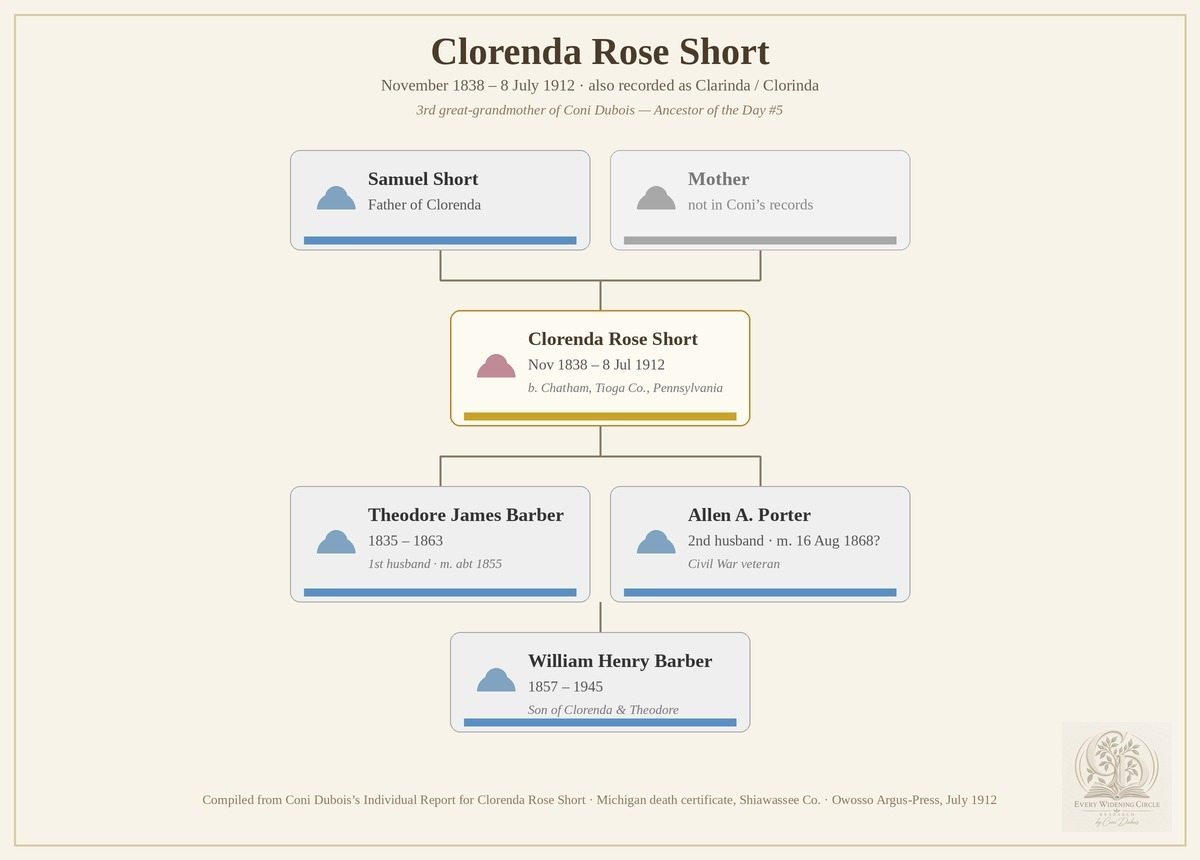
Family tree chart showing Clorenda Rose Short Barber Porter (1838–1912), her first husband Theodore James Barber, their son William Henry Barber, her father Samuel Short, and her second husband Allen A. Porter

Her name was Clorenda Rose Short. The records spell it three different ways — Clorenda, Clarinda, Clorinda — so you can pick your favorite, but she was my 3rd great-grandmother, and this is her story.

She was born in November 1838 in Chatham, Tioga County, Pennsylvania, the daughter of Samuel Short. Somewhere around 1855 she married Theodore James Barber, and in 1857 their son William Henry was born. Then came the war, and in May 1863 Theodore died at Chancellorsville. Clorenda was about twenty-four years old, a widow with a little boy.

She did what widows did — she kept going. And years later she married again, to another Civil War veteran: Allen A. Porter. (My records say August 16, 1868 — but there’s a question mark beside it in my own files, so I’m giving it to you with the question mark still on. The pledge is the pledge.)

They built a life together near Henderson, Michigan. Decades of it. And then came Monday, July 8, 1912.

Cabinet-card photograph of Clarinda Short and Allen A. Porter, Coni's 3rd great-grandparents

That evening, at about nine o’clock, Allen Porter died.

And about two hours later, according to the Owosso Argus-Press, Clarinda walked out onto the porch, cried out — and fell dead in the farmhand’s arms.

The coroner, Guy A. Cole of Owosso, wrote her cause of death on the Michigan death certificate in words I’ll never forget: “a shock occasioned by the death of her husband.” Her heart, the certificate says, had been troubled for years. Her son Frank gave the information. She was buried at Henderson Cemetery on July 11th.

Michigan Certificate of Death for Clarinda Short Porter, July 8, 1912 — cause of death 'a shock occasioned by the death of her husband'

The newspaper ran the story under a headline that says everything: “THEY GO TOGETHER — Wife Succumbs To Heart Trouble Two Hours After Husband’s Death.” And it described the funeral this way: “The two sombre caskets were placed side by side… At the cemetery they were both lowered into one large grave, where the departed will sleep the long sleep together, as they went through the greater portion of their lives.”

Owosso Argus-Press headline from July 1912: 'THEY GO TOGETHER — Wife Succumbs To Heart Trouble Two Hours After Husband's Death'

One large grave. Together. As they went through the greater portion of their lives.

Now follow her line forward, the way I showed you Theodore’s yesterday: Clorenda’s son William Henry grew up, married, and had a daughter named Ada May. Ada May married George Arthur Allen. Their son Alvin married Marion — my grandmother. Their son Rex was my father.

So the woman who died of a broken heart on a Michigan porch in 1912 is the reason I’m here telling you about it. That’s how this works. That’s the ever widening circle.

I wrote about this couple years ago — They Go Together (2013) — and I keep a whole chapter on Clarinda in my files. But today she gets her Ancestor of the Day, because a love like that deserves its afternoon.

Who do you want to see next? Tell me below. 💛

Family tree chart for Clorenda Rose Short Barber Porter

— Coni

Sources: Michigan Certificate of Death for Clarinda Short Porter, Shiawassee Co., Rush Twp., July 8, 1912 (written copy in Coni’s files; Coroner Guy A. Cole) · Owosso Argus-Press, July 9/10/11, 1912 — “THEY GO TOGETHER” (clippings collected by Pauline Goodwin, 2013; in Coni’s files) · Individual Report for Clorenda Rose Short, by Coni Dubois · Find A Grave #566602325 · Chapter 16, Clarinda Short Porter (Coni’s files).

#AncestorOfTheDay #EverWideningCircle

© 2026 Ever Widening Circle Research by Coni Dubois LLC. All rights reserved.

Posted in Coni Dubois, Coni's Stuff, Ken Feder, Travel, Tribal

Ancestor of the Day #4: Theodore James Barber — The Soldier Who Never Came Home From Chancellorsville

Yesterday was Lucy, the dynamite widow with three husbands. Today we go further back — past Michigan, past the lumber mills — all the way to Virginia, 1863, and a 27-year-old corporal in a blue uniform who never came home.

Watch the Ancestor of the Day short film:

If you want the deep file first, I wrote about him years ago: American Civil War Soldier: Theodore Barber (2012). Today’s telling is the family version — the records on screen, the way I do it.

Theodore James Barber was born in August 1835 in Catlin, Chemung County, New York — the son of Grant Barber, a farmer, and Elizabeth Cummins. The 1850 census finds him at 15 in Caton, New York, one of eight children in a farmhouse: Harriet, Eli, Mary, Charles, Amanda, Nancy, baby Caroline — and Theodore. By 1860 he’d crossed into Tioga County, Pennsylvania. Somewhere around 1855 he married Clarinda Rose Short. Their son William Henry was born in 1857.

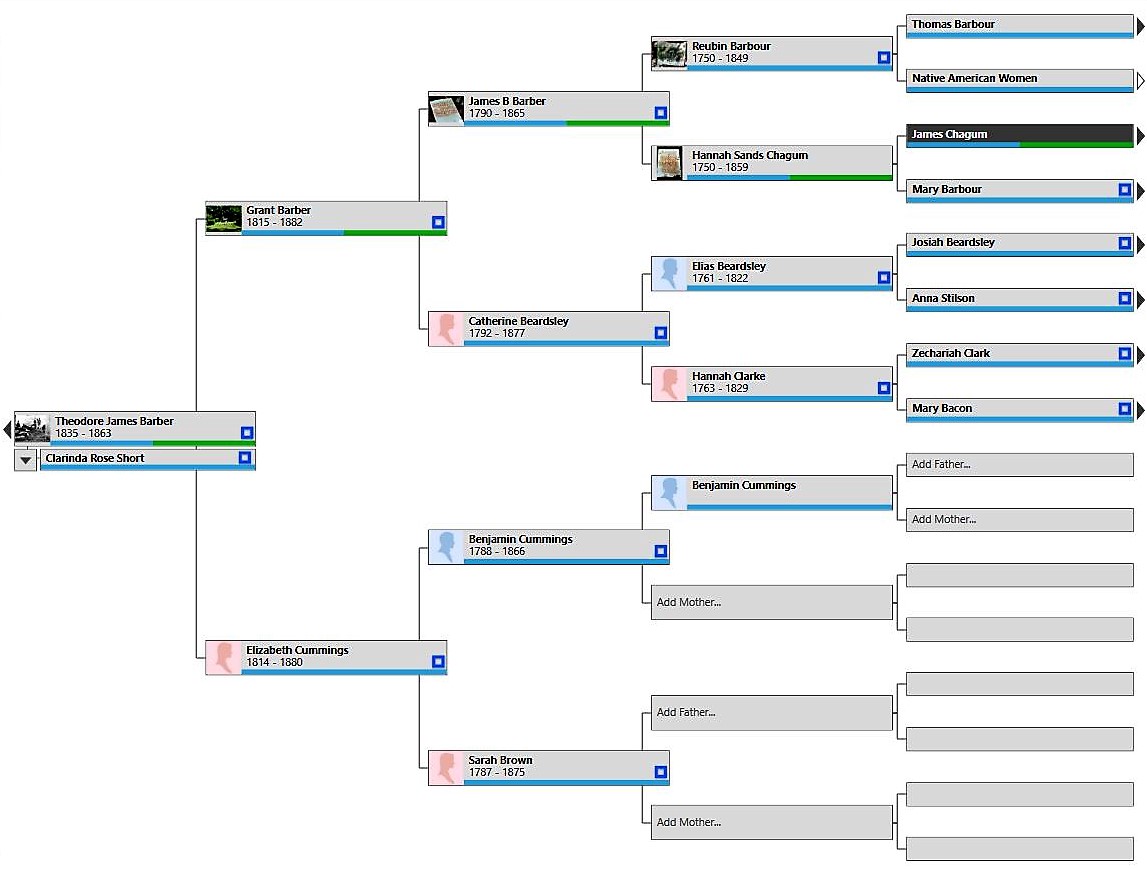
Now look at the family chart above — really look at it. Follow Theodore’s line back: his great-grandparents were Reuben Barber/Barbour and Hannah Sands Chagum. Hannah Sands — the daughter of James Chagum and Mary “Molly” Barber. The founding couple of the Barkhamsted Light House Village. My people.

So when Theodore James Barber marched off to war, he carried Lighthouse blood in a Union uniform.

On November 1, 1861, at Titusville, Pennsylvania, he enlisted as a Private in Company K of the 57th Pennsylvania Infantry, under Captain Cornelius S. Chase. He was 26. He rose to Corporal. And for the next eighteen months the 57th carried him through the whole hard road of the Army of the Potomac: the Peninsula, Yorktown, Williamsburg, Fair Oaks, the Seven Days, Second Bull Run, Fredericksburg in December 1862, the Mud March.

Then came Chancellorsville.

The 57th belonged to the 1st Brigade, 1st Division, 3rd Corps. On May 1st, 1863, they marched and countermarched along the Plank Road and bivouacked near the Chancellor House. On May 2nd they took position on the extreme right flank of the corps — and at dusk, Stonewall Jackson’s flank attack fell on the Union line to their right and rear like a hammer. The division was marched to the rear in the chaos.

At dawn on May 3rd, the Confederates attacked. The regiment was moved at the double-quick and deployed near the Chancellor House. They counter-charged the enemy — and were driven back with heavy casualties. The brigade fell back about a mile and held its line for two more days.

Theodore James Barber died that day: May 3, 1863. My records say the death was gangrene from a foot/leg wound — that’s what the family papers hold, and I give it to you as the family holds it. He was 27 years old. He rests now in Fredericksburg National Cemetery.

Wounded Union soldiers being tended in a field hospital near Fredericksburg, photographed May 2, 1863, the day before Theodore James Barber died at Chancellorsville

I want to tell you one more thing, honestly, because the pledge is the pledge. In my 2012 post I shared a famous photograph — wounded Union soldiers being tended in a field hospital near Fredericksburg, taken May 2, 1863, the day before Theodore died. And I wrote what I still believe: I believe the gentleman laying down is my 3rd great-grandfather. Believe — not prove. I can’t prove it. But I’ve looked at that photograph a hundred times, and a granddaughter knows.

He left behind Clarinda — about 24 years old, with six-year-old William Henry. She would marry again, years later, to another Civil War veteran, Allen Porter — and if that name rings a bell, it should: they’re the “They Go Together” couple, the pair who died two hours apart in 1912 and were buried in a single grave. I told their story here in 2013. But that’s her story. This one’s his.

William Henry grew up, married, had a daughter named Ada May. Ada May married George Arthur Allen. Their son Alvin married Marion — my grandmother. Their son Rex was my father.

That’s the chain. That’s how a corporal who fell at Chancellorsville in 1863 reaches all the way to me, typing this in Louisiana in 2026.

Theodore James Barber. The soldier who never came home. Remembered.

Family tree chart for Theodore James Barber

Your turn: Who do you want to see next? Tell me below — I read every suggestion.

One Ancestor of the Day each week is YOUR ancestor. Brick wall? Send it through my contact form at https://conidubois.fyi/contact.

— Coni

Sources: Individual Report for Theodore James Barber, by Coni Dubois (service record: Private enlisted 1 Nov 1861, Co. K 57th PA Infantry; rank Corporal; died 3 May 1863 Chancellorsville VA; burial Fredericksburg National Cemetery; Find A Grave #6831641126) · Coni’s “Ancestors of Coni Dubois” research manuscript (birth Aug 1835 Catlin NY; 1850 census Caton NY; 1860 census Tioga PA) · American Civil War Soldier: Theodore Barber (this blog, 2012 — service record, Bates’ History of Pennsylvania Volunteers regimental excerpt, Chancellorsville field-hospital photograph) · 57th Pennsylvania Infantry regimental timeline, civilwarintheeast.com · Family tree chart, Coni’s own tree (theodore-chart.jpg) · Clarenda (Short, Barber) Porter death records — “They Go Together” (this blog, 2013)

#AncestorOfTheDay #EverWideningCircle

Posted in Coni Dubois, Coni's Stuff, Ken Feder, Travel, Tribal

Ancestor of the Day #3: Lucy Genevieve Amo — The Dynamite Widow With Three Husbands

Yesterday I told you about Ernest Emmit Griffith — my great-grandfather, killed by dynamite on September 23, 1915. He was 26. If you missed it, the full story with the records is here: https://conidubois.com/2026/09/26/ancestor-of-the-day-2-ernest-emmit-griffith-the-morning-the-dynamite-went-off/

Watch the Ancestor of the Day short film:

Today is about the woman he left behind.

Lucy Genevieve Amo was born April 22, 1882, in Berlin — that’s Rockwood — in Monroe County, Michigan, to Samuel Amo and Mary Campeau. I have her birth record in my files, certified copy and all: Lucy J. Amo, female, white. By 1900 the family was up in Whitney Township, Arenac County — Lucy 18, still her father’s daughter.

Certified copy of Michigan birth record for Lucy J. Amo, born April 22, 1882, in Berlin, Monroe County, to Samuel and Mary Amo

On March 29, 1909, in Au Gres, she married Ernest Griffith. The license says he was 19 and she was 26. The witnesses were Albert and Katherine Amo — her people, standing up for her. The 1910 census finds them in Whitney Township: Emmit 20, a farmer; Lucy 27; and a one-month-old baby girl.

Then the hard years came, the way they came for everybody then. They buried a baby boy, Murther, who died of cholera at five months and ten days in August 1911 — and it was Ernest himself who stood informant on that death certificate. Read that again: the grieving father signed the paper. Then September 1915, the dynamite. Lucy was 33 years old, a widow with small children. Five weeks before Ernest died, she’d given birth to a daughter, Marion — the baby who grew up to be my grandmother.

Here is what the records say next, and I want you to sit with the timeline the way I did.

Eleven months after the dynamite, on August 4, 1916, in East Tawas, the widow Lucy Griffith married Francis C. Baker. The marriage return is in my files — Iosco County, record number 33, and you can read it yourself in the photos. He was 69. She was listed as 40. (Her birth record says 1882, which would make her 34 — I report the record’s words as written, and I keep my own count beside them. That’s the pledge.)

1916 Iosco County, Michigan marriage return, record number 33, showing Francis C. Baker, 69, and Mrs. Lucy Griffith, 40, married August 4, 1916, in East Tawas

Now here’s the part that stopped me cold. Francis C. Baker was a Civil War veteran — Company 91 of the New York Infantry and Company A of the 147th. He’d filed his own invalid pension back in 1889. And in my files there’s his pension index card, plain as day: soldier Baker, Francis C. — dependent, widow, Baker, Lucy — widow’s filing, August 19, 1918, from Michigan.

U.S. Civil War pension index card for soldier Francis C. Baker, showing his widow Lucy Baker’s filing dated August 19, 1918

So Lucy married a Civil War veteran nearly thirty years her senior, and within two years she was a widow again — drawing a Union widow’s pension. The 1920 census finds her back in Whitney Township in her father’s house, and next to her name the record might as well say what it says: Francis Baker, deceased.

She married a third time on November 10, 1924, in Standish — William Wesley Nicholas. The record calls him William W. Nichols; my files say Nicholas. He was 58, a farmer, a widower with four previous marriages. Lucy — listed as “Mrs. Lucy Baker,” 42, keeping house, twice married before — became his fifth wife.

The censuses carry her forward: Paradise in Chippewa County in 1930, Mackinac in 1940. And then the last record, the one that undid me.

Lucy died February 25, 1947, at 10:55 in the morning at the Newberry Clinic — pulmonary embolism, age 64. She’s buried at Forest Home Cemetery in Newberry. And on her death certificate, in the box marked “Name of husband,” the clerk wrote two words:

Emmett Griffith.

Michigan certificate of death for Lucy Genevieve Griffith, died February 25, 1947 — the ‘name of husband’ line reads ‘Emmett Griffith’

Not Baker. Not Nicholas. Emmett Griffith — the 26-year-old farmer blown apart by dynamite thirty-two years earlier, the father of her children. After two more marriages, after a Civil War widow’s pension, after a fifth-wife wedding in Standish — when they asked her, or asked for her, who her husband was, the answer was Emmett.

The informant on that certificate was Mrs. Alvin Allen of Germfask. My grandmother Marion — Lucy’s own daughter — reporting her mother’s death. My own family, holding the pen at the end.

She had a hard life — that’s what I was always told, and the records don’t argue. Widowed at 33 with babies. Married again at 34 to a 69-year-old veteran. Widowed again. Married a third time to a man who’d already buried four wives. And at the end of it all, her heart’s answer never changed.

That’s Lucy Genevieve Amo. The dynamite widow with three husbands. My great-grandmother.

Sepia group photograph of the Amo family — parents Samuel and Mary Amo seated with their seven children standing around them, outdoors

🔍 MINI CONI HUNT: I hid my little Mini Coni somewhere in the Amo family photo above — first one to spot her and tell me in the comments gets a shoutout in tomorrow’s Ancestor of the Day!

🗳️ YOU PICK ANCESTOR #4: The last vote came up empty, so I’m trying again — and this time I’m counting on you! Here are your three choices:

  1. Clorenda Rose Short Barber Porter (1838–1912) — my 3rd great-grandmother. In July 1912 her husband, a Civil War veteran, died at 9 PM — and two hours later, shattered by the shock, she walked onto the porch, cried out, and fell dead in the farmhand’s arms. The coroner wrote her cause of death as “a shock occasioned by the death of her husband.” They were buried in a single grave.
  2. Theodore James Barber (1835–1863) — he marched off with the Union’s 57th Pennsylvania at 28 and never came home from Chancellorsville.
  3. Murther Richard Griffith (1911–1911) — Lucy’s baby boy. He lived five months and ten days, died of cholera — and his grieving father signed the death certificate himself.

Your turn: What does your family’s death certificates say in the “name of husband/wife” box — and does it match the life they actually lived? Tell me in the comments.

Tomorrow afternoon: another ancestor, another record. And remember — one Ancestor of the Day each week is YOUR ancestor. Brick wall? Send it through my contact form at https://conidubois.fyi/contact.

— Coni

Sources: Individual Report for Lucy Genevieve Amo, by Coni Dubois (U.S. Federal Censuses 1900–1940; Michigan Marriage Records; Michigan Death Records) · Certified copy of birth record, Lucy J. Amo, Monroe County #160 Book C-77 (Coni’s files) · Iosco County Return of Marriages, quarter ending Sept 30, 1916, Record No. 33 (Coni’s files) · U.S. Civil War Pension Index, General Index to Pension Files

1861–1934 — Baker, Francis C., widow Lucy Baker, filed Aug 19, 1918 (Coni’s files) · State of Michigan Certificate of Death, Luce County, State File No. 1677, Feb 25, 1947 (Coni’s files) · Ancestor of the Day #2: Ernest Emmit Griffith (this blog, 2026)

Posted in Coni Dubois, Coni's Stuff, Ken Feder, Travel, Tribal

Ancestor of the Day #2: Ernest Emmit Griffith — The Morning the Dynamite Went Off

Oval studio portrait of Emmett Griffith, a young man in a suit and tie, circa 1910s

He was 26 years old, a farmer in Whitney Township, Michigan, and he died at 11:30 on a Thursday morning — September 23, 1915. His death certificate says it in handwriting I can read plain as day: “Dynamite Shot (accidental).”

Watch the Ancestor of the Day short film:

Michigan certificate of death for Emmet Griffith, died September 23, 1915 — cause of death written as 'Dynamite Shot (accidental)'

Ernest Emmit Griffith was my great-grandfather. The newspaper called him Emmett. The death certificate calls him Emmet. My own research files say Ernest Emmit. I believe they’re all the same man — records spell names the way ears heard them — and his mother’s name wobbles the same way: Cortright, Courtright, Cartnight. I grew up hearing “Cartright.” That’s how family history really sounds.

Here’s what happened that morning, from the Arenac County Independent, September 23, 1915 — “EXPLOSION KILLS TWO MEN”:

Emmett Griffith and 19-year-old Robert Smith were blowing up stumps, clearing farmland the way everybody did it then. They sat down on a log to rest a moment. Beside them sat a pail holding 20 sticks of dynamite, a quantity of dynamite caps, and fuse. Both men were smoking, and the supposition is that a spark from one of their pipes fell into the pail. The explosion came a few minutes after they sat down.

Griffith had both legs blown off near the thigh and was otherwise mangled. He lived two to three hours. Smith lost a leg and an arm and died about five o’clock that afternoon. Both men regained consciousness before they died, and both told the same story. The funerals were held Saturday and Sunday.

Here is the article itself, word for word:

“Explosion Kills Two Men: Two Delano Farmers, Robert Smith and Emmett Griffith, Have Fatal Accident with dynamite. As a result of a premature explosion of 20 sticks of dynamite, the lives of two well known Delano farmers were snuffed out last Thursday. Emmett Griffith and Robert Smith were blowing up stumps and had set down on a log to rest a moment. Near them was a pail containing 20 sticks of dynamite, a quantity of dynamite caps and fuse. They both were smoking and the supposition is that a spark from one of their pipes fell into the pail and caused the explosion which occurred a few minutes after they had seated themselves. Griffith had both legs off near the thigh and otherwise mangled. He lived for only two or three hours after the accident. Smith had one leg and one arm blown off and suffered other severe injuries. He died about 5 o’clock that afternoon. Both men regained consciousness before they died and told the same story as to how the accident occurred. The funerals were held Saturday and Sunday. Griffith was 26 years old and leaves a widow and one child. Smith was 19 years old and single. The sympathy of the entire community is extended to the bereaved relatives.”

— Arenac County Independent, September 23, 1915 (transcription contributed by Penny Bliss, MIGenWeb Arenac County; the clipping in Coni’s research files is credited to researcher Penny Carney)

He was buried September 25, 1915, at Sims-Whitney Cemetery in Au Gres — the same Griffith family plot I wrote about here on the blog back in 2014: http://conidubois.com/2014/07/08/griffith-family-plot-sims-whitney-cemetery-also-known-as-point-lookout-cemetery/

Now here is what the newspaper didn’t know, or didn’t print. Ernest had married Lucy Genevieve Amo on March 29, 1909 — he was 19, she was 26. They’d already buried a baby boy, Murther, who died of cholera at five months in 1911. And five weeks before that dynamite went off, on August 19, 1915, Lucy gave birth to a daughter. That baby grew up to be my grandmother.

The paper said he left “a widow and one child.” My records say more than that. I report the paper’s words as written — and I keep my own count beside them. That’s the pledge: the record, honestly, even when the records argue with each other.

He was 26. A farmer. A husband. A father who never got to watch his youngest grow up. The clerk wrote “Dynamite Shot (accidental)” and moved on to the next certificate. I don’t move on. He’s mine.

Outdoor photograph of Emmett Griffith standing beside his seated wife Lucy Amo Griffith, who holds their small child on her lap, circa early 1910s

🔍 LOGO HUNT: I hid my Ever Widening Circle logo somewhere in the family photo above — first one to spot it and tell me in the comments gets a shoutout in tomorrow’s Ancestor of the Day!

🗳️ YOU PICK ANCESTOR #3: Starting today, YOU vote who I feature next! Here are your three choices:

  1. Lucy Genevieve Amo (1882–1947) — Ernest’s widow. She buried her dynamite-killed husband in September 1915… and was married again by the next August. Then married a third time. The dynamite widow with three husbands.
  2. Clorenda Rose Short Barber Porter (1838–1912) — my 3rd great-grandmother. In July 1912 her husband, a Civil War veteran, died at 9 PM — and two hours later, shattered by the shock, she walked onto the porch, cried out, and fell dead in the farmhand’s arms. The coroner wrote her cause of death as “a shock occasioned by the death of her husband.” They were buried in a single grave.
  3. Theodore James Barber (1835–1863) — he marched off with the Union’s 57th Pennsylvania at 28 and never came home from Chancellorsville.

Vote in the comments below (or in the Facebook group poll) — winner gets featured next, and I’ll read out the results in tomorrow’s post. Get your people voting!

Your turn: Has a sudden death ever rewritten your family tree in a single day? Tell me in the comments.

Tomorrow afternoon: another ancestor, another record. And remember — one Ancestor of the Day each week is YOUR ancestor. Brick wall? Send it through my contact form at https://conidubois.fyi/contact.

— Coni

Sources: State of Michigan Certificate of Death, Arenac County, Whitney Township (Sept 23, 1915 — Coni’s files) · “EXPLOSION KILLS TWO MEN,” Arenac County Independent, Sept 23, 1915 (transcription at MIGenWeb Arenac County https://migenweb.org/arenac/wp-content/uploads/2023/04/d-explosion-kills-griffith-smith-bliss.pdf, contributed by Penny Bliss; the clipping in Coni’s research files is credited to researcher Penny Carney) · Individual Report for Ernest Emmit Griffith, by Coni Dubois (1900 & 1910 U.S. Federal Census; Michigan Marriage Records; Michigan Deaths and Burials Index; Find A Grave #62841351) · Griffith Family Plot @ Sims-Whitney Cemetery http://conidubois.com/2014/07/08/griffith-family-plot-sims-whitney-cemetery-also-known-as-point-lookout-cemetery/ (this blog, 2014)

#AncestorOfTheDay #EverWideningCircle

Posted in Coni Dubois, Coni's Stuff, Ken Feder, Travel, Tribal

Ancestor of the Day #1: Mary “Molly” Barber Chagum

Ancestor Story mascot

Every village has a founding couple. Ours has a legend — and a record. Today I’m giving you both, honestly, because that’s the pledge I made yesterday.

Watch the Ancestor of the Day short film:


The legend goes like this. Around 1740, Molly Barber of Wethersfield was forbidden by her parents from marrying the man of her choice. She declared she would marry the first man who offered himself. That man was James Chaugham, a Narragansett man from Block Island. They married — some versions say in secret — and left Wethersfield for the wilderness of Barkhamsted, where they raised a family and founded a community. The poet Lewis Sprague Mills put it in verse in 1932, and a thousand retellings followed.

That’s the story. Here is what I can tell you with a document in my hand.

I cannot find Molly’s birth record. I cannot find her marriage record. No one can — the historical sources say so plainly. What I CAN show you is the end of her life, itemized in a clerk’s handwriting.

In January 1821, the estate of “Mary Chogum, late of Barkhamsted” was inventoried: one iron kettle, $1.25. One small kettle, fifty cents. One old chest of drawers, fifty cents. Fourteen acres of land at ten dollars an acre. Total: $142.25. That was her whole world, appraised.


Her estate couldn’t cover her debts — the town of Barkhamsted itself held a claim of about $272 for the support she had needed in her old age. Her 14 acres were sold to her son-in-law, William Wilson, for $100, and the town took the loss. I’ve transcribed the whole probate packet on this blog — the administrator’s bond, the inventory, the final settlement of January 1822 — and you can read it here: https://conidubois.com/2026/07/23/unlocking-history-the-1821-estate-of-mary-chogum/

So the legend gives me a defiant young woman of Wethersfield, and the record gives me an old woman whose kettles and chest of drawers were worth two dollars and twenty-five cents. Both of them are Molly. Both of them are mine. She was one of the two people who founded the Barkhamsted Lighthouse community — the white wife and the Narragansett husband, about 1740 — and her descendants, in the hundreds, are still here. I’m one of them.

That’s the thing about ancestors. The story tells you who they were to the world. The record tells you what they had when they left it. I want both.

Your turn: What legend lives in YOUR family tree — and what record backs it up, or breaks it? Tell me in the comments. I want to hear it.

Tomorrow afternoon: another ancestor, another record. And remember — once a week, one of YOUR ancestors takes this spotlight. Got a brick wall? Send it through my contact form at https://conidubois.fyi/contact.

— Coni

Sources: [Barkhamsted Lighthouse](https://en.wikipedia.org/wiki/Barkhamsted_Lighthouse) (Wikipedia) · [The Oddest Lighthouse](https://www.ctmq.org/the-oddest-lighthouse/) (CTMQ / CT Freedom Trail) · [Barkhamsted Lighthouse — Bringing Light to the Connecticut Hills](https://newenglandhistoricalsociety.com/barkhamsted-lighthouse-bringing-light-connecticut-hills/) (New England Historical Society) · [Chaugham Family of Barkhamsted CT](https://www.rockvillemama.com/chaugham.htm) (Town of Barkhamsted Family Outlines / USGenWeb) · [Unlocking History: The 1821 Estate of Mary Chogum](https://conidubois.com/2026/07/23/unlocking-history-the-1821-estate-of-mary-chogum/) (this blog) · Lewis S. Mills, The Story of Connecticut (1932), quoted at [conidubois.com](http://conidubois.com/2019/01/14/what-is-the-true-name-of-the-chief-of-the-barkhamsted-lighthouse-chaugham-vs-chogam-chagum-part-1-land-transactions/)

#AncestorOfTheDay #EverWideningCircle

Posted in Travel

Butch & Sheryl Robinson was on a 2 week genealogy trip – Travel Journal Shared Part 2


Entry # 4 Our Vacation

When Butch and I tell people about our research quest and our attraction to northwestern Connecticut, I tell them that Butch descends from the Pequot and I descend from the Puritans of the same place and that my ancestor, William Phelps was on the Windsor Governing Council of eight who declared the Pequot War in 1637. Then Butch quips, “And the battles still go on!”  (We squabble a lot…but don’t tell anyone!)

I had never been to Windsor.  William Phelps, along with many of my ancestors was a founder of Mass. Bay Colony in 1630, then Windsor and later Simsbury.

Butch, Scruffy and I took to the highway and went over Talcott Mountain and into Windsor to the Historical Society there. Greeting us at the town green was a statue of John Mason.  John Mason was the Englishman who led the Pequot Massacre at their Indian fort in Mystic Connecticut.  It is a sad story, one that turns my guts inside out.  Mason and his men attacked the fort at Mystic. The warriors were gone, only women, children and elders remained. Mason set fire to their wigwams at the break of day. Some accounts relate that up to 700 perished in the blaze and 700 escaped only to be killed by Mohegan and Narragansett Indians waiting in the woods surrounding the fort.

John Mason’s statue had been erected first in Mystic. The descendants of the slain Pequot wanted it removed. Finally they got their wish and it was hauled off to Windsor and placed in the green.  Shortly thereafter, someone tossed a can of blood-red paint onto it in protest.  Mason’s statue still stands, but it is a grim reminder of the cruelty of mankind and the near extinction of the Pequot people.

Saturday morning I met up with Patrick Casey and his wife at the New Hartford Historical Society. They were excited to meet me when I told them that I was researching James Chagum’s presence in New Hartford.  They had been trying to gather information for an “Indians of New Hartford” display but had little information.  When they saw me come in with my thick, 3-ring notebook on “Chagum”, they lit up!

A nicer couple I have never met!  They showed me where the first known Indian property owner’s land was , (Kasceton) and where James Chagum’s land, bought from Cornelius Indian was located. They gave me a pile of maps to use as locators and copied off several articles on the New Hartford Indian settlements and Satan’s Kingdom.  Satan’s Kingdom was one of the Indian settlements, possibly called “Sachem’s Kingdom” originally, but because of the fear it festered into the hearts of the white town’s people in New Hartford, the name changed through time.

When we talked about James Chagum having originally come from Block Island, the Caseys remarked that they were quite familiar with the place.  They had been there many times diving for shipwrecks. Mrs. Casey prided herself in saying that she descended from one of the original white families who settled on the Island in the 1660’s.  “Oh really”’ I said……….”Which family was that?”

“Rathbun.”

“Well, do you know that the original Rathbun family had a slave named “Bette Chagum”, who they indentured from her parents, Great James and Janey Chagum, and payment for her was in blankets and rum????”

Needless to say, she gasped and her eyes shot down to the floor. Amazing the connections you can make, if you dig deep enough!

Later, Butch, Scruffy and I had lunch at “Chatterlys” in the town center.  If you are ever there, try their “crispy goat cheese salad”. It’s delightful!

Entry # 5 Our Vacation

Our next excursion  from our campground was to Hartford, CT to visit the State Library and the State Historical Society.

We had two missions: In our possession is a copy of a “Pequot Captive List” with the name “CHAGUM”  on the list along with about 128 others. Some are identified as Pawcatuck Pequots and Chagum is on the list of Wequepage Pequots. It was a list coming from Major John Mason and Robert C. Winthrop taken at Pawcatuck, listing Pequots “subscribing themselves under the government of the English”.

The problem with this document was that there was no date.  The document was on microfilm at the state library.  Butch and I were hoping to find more information on this document and a date.

Our second mission was to meet with Diane Lee at the State Historical Society to see the oldest piece of furniture in their possession, William Phelps’ storage chest. You may remember the name. William Phelps came to America in 1630 with the John Winthrop Fleet and then moved on to establish the first English town in the wilderness of Connecticut AND in the midst of Pequot territory.

While at the State Library I located the “Pequot Captive List” that I had a copy of, on the microfilm. (Note from Coni – this list is the one previously donated by Sheryl)

There was no additional information except what I already had in my possession. I decided to move on to the next document and noticed that many of the same names were on that one as well. This document had a date and an explanation with a subtitle, “Ninegrett’s Pequots”.  Upon further study, I counted a possible 47 names on the original list that were also listed there, plus many more…………….. but no Chagum.  Possibly there was another page missing or Chagum had gone into hiding.  Once home, I found information pertaining to the same date that was on the document…..October 10, 1654. John Mason, who was now recently addressed as “Major Mason” rather than his former title, “Captain Mason”, had arrived at Pawcatuck with 40 horsemen and 270 infantry and rendezvoused at Thomas Stanton’s trading post on an expedition to “impress” Ninegret who was threatening war on Uncas, Chief of the Mohegan and an ally of the English. Most of the Pequot, assigned to the Narragansett after the Pequot War of 1637, ended up living with Ninegret, Chief of the Eastern Niantic.  The latter document stated that those undersigned would not go to war without the permission of the English and that if the English assigned them to other places, they would comply without resistance.

Then we were off to the State Historical Society. Once we arrived, we were taken back to “storage” to take a look at William Phelps’ chest…not the hairy one, but the wooden piece that was quite possibly crafted by Thomas Barber, the joiner. We got to examine it, inside and out, and take many pictures.

What a wonderful day! We plan to return next year to conduct further research.

Entry # 6 Our Vacation – Last Entry

There are threads running through us that we do not quite understand; threads of the people who lived before us, the threads of our ancestors.  Some threads are stronger than others, some threads interweave.  Scientists may call it our DNA, but what they do not understand is the spiritual component of these threads.

Anyone who has spent time uncovering the mysteries of those who have lived before them, opening themselves to see, listen and feel with their hearts, can receive signs from these spirits.  We find lost treasures through the help of those who want us to discover truths about their former existence.  No life should be lived and then totally lost in the annals of time.  It is by these “messengers” that we receive information about their lives.  If permitted, these characters can come alive within us and use us as their instruments of discovery and recovery.

This last entry is concerned with the spiritual component of our trip, that I truly feel was led by our ancestors yearning for their story to be told.

The first time we went to Barkhamsted and Simsbury, Connecticut to discover our roots it was August of 2005.

Meanwhile back at the home front, I was having a struggle with my religion, and even though I continued praying, God was not at the center of my heart.  I had doubts; I had feelings  that just would not step aside. At my church I volunteered as a chaperone at a teen girls’ conference.  I found out later that the conference was at the Civic Center in Hartford, Connecticut’s capital.  There were 12 of us who were going.  One was an Elmira College freshman, who had become involved with the church through its college outreach program. She had a great idea…. she would ask her parents if we all could stay at her house outside of Hartford instead of doing the hotel routine.  They agreed to house and feed us as long as we agreed to go to Sunday service at their church.  It was a deal!

We arrived in Hartford for the Revolve Conference.  10,000 females filled the center’s seats.  Live Christian rock music shook the Center and lights were flashing around us.  I didn’t know what to think, being in the same place with 10,000 other females and I had never heard this kind of music before.  Then it was time to find our way to the agreed upon accommodations.  It was dark and we had quite a way to go.  In traveling, I saw a sign, Simsbury, 5 miles, then a little later, Simsbury, 3 miles, and then, Simsbury, 1 mile.  We turned into the driveway and as we entered the house I asked, “Am I in Simsbury?”  Yes, dear, why?  I couldn’t believe I was back just a short two months later!

On Sunday we went to the Barn Church, otherwise known as the Covenant Presbyterian Church, for its non-traditional service.  We began the service singing in praise of God. I could sing the melody of songs I had never heard before.  I began to feel a change overcome me.  Suddenly I felt centered.  God had answered my prayers to be able to accept him into my heart. In an instance I received an unexpected gift, God’s gift of love and acceptance.  This weekend was not supposed to be about me, yet I felt something I had never expected to feel that day.  Strong feelings overwhelmed me and I broke into tears.

It all came together.  God got my attention through what I obsessed with most….genealogy!  Here I was in Simsbury, Connecticut feeling renewed and praising God, the same place where my Christian forefathers and my husband’s Indian ancestors praised their new God.  The feeling was incredible, one I had never felt before.  I knew in a moment that when I returned home, everything would make sense.  It was an experience where all my loose ends, all the confusion that I could not sort out myself had finally woven together into place, making sense of life and God’s love for me.  God had made his way into the center of my heart and into my life that day.

I could not wait to attend that church again and have Butch along for the experience. This trip was the third time at the church. Butch and I were again, overwhelmed with emotion as we sang along with the praise band. The Lord enlivened and energized every molecule of our beings.

We know that James Chagum was a Christian. He was friends with the Reverend Samson Occom, the first Native American minister, ordained by the Presbyteriam Church.  Occom spoke of Chagum at least twice in his journal and even lodged with him.

There are many disagreements about religion , but most do agree that there is One Creator. We often look for symbols of his presence in our lives. One symbol of the Native American is the White Buffalo; a symbol of hope, rebirth and peace on earth for all people.

This last June a white bison calf  was born on a farm in Goshen, Connecticut. A large number of Native Americans gathered there to celebrate the birth and to name the calf; “Yellow Medicine Dancing Boy”.

the last day of our vacation Butch, Scruffy and I went in search of the calf. With our GPS we found Goshen. I had the farmer’s name but not his address. We passed by a little library, turned around and went back. I walked inside and asked for their telephone directory and found the address there. (a regular sleuth, I am!) Re-programing our GPS we found the farm. Signs were everywhere. “No Trespassing!!!”, “No Parking!!!”, so we slowly moved on and turned down a road adjacent to the farm………more signs, “No Parking!!!”. We pulled over where the signs ended and there in the corner of the field, next to the road, was the white calf frolicking in the high grasses! Butch took many pictures. When we turned around to find our way back, across from the farm was a house for sale with a sign that read, “Buy this house and you can LIVE next to the White Buffalo!”

So there ends our wonderful vacation to our favorite little piece of heaven in Connecticut.
 

Posted in Travel

Similar names found on both Pequot Lists

From: “It’s About Time; Colonial History Timeline”, by Bill DeCoursey      (Stonington, Connecticut)

1654 –    In August 1654, NINIGRET attacked the friendly Long Island Indians, and Major John MASON with the Connecticut Militia was sent to their aid.
  “Prior to 1654 the highest military office in the colony of Connecticut was captain, and John MASON of Pequot fame was the only one who bore this title.  When in after-years he visited the militia of the different towns, bearing the insignia of his rank as major, he was gazed at by the boys and girls of the settlement with eyes of wide wonder, as a man to be reverenced, but not approached.” – Elias B. Sanford’s A HISTORY OF CONNECTICUT (1888), p.123.

1654 –   On 1 September 1654, the settlers of Stonington first petitioned the General Court for the formation of a separate town and church.  The Stonington settlers, 15 miles from New London with 2 big rivers to cross, could hardly attend church and they objected to paying taxes to support the Rev. Mr. BLINNMAN.  This was the beginning of the famous dispute over jurisdiction of the land between the Mystic and Pawcatuck Rivers.

1654 –    Thomas MINER’s son John, on 14 September 1654, was named by the General Council to go to Hartford at public expense to be trained as a missionary to the Indians. –   Williams Haynes, STONINGTON CHRONOLOGY (1976), p.12.

1654 –    John STANTON (1641-1713) was a pupil of the famous old school teacher of the Puritans, Elijah CORLET.  In 1654 he and John MINER, son of Thomas MINER, were selected by the Court of Commissioners to be educated as Indian interpreters and teachers of the Gospel to the Indians.  Both young men, however, ultimately left their studies, and devoted themselves to other pursuits.

1654 –    On 10 October 1654, under Major John MASON, 40 horsemen and 270 infantry rendezvoused at Thomas STANTON’s trading post on the Pawcatuck for an expedition to impress  NINIGRET who was threatening war on UNCAS. –  Williams Haynes, STONINGTON CHRONOLOGY (1976), p.13.