Native American genealogist and researcher for 30+ years — I've traced over 64,000 people, specializing in colonial families and tribes across MI, IN, CT, NY, RI, PA, MA, VA, VT, NJ, OH, KY, Block Island & Long Island. Barkhamsted Lighthouse descendant, author of The True Story of the Barkhamsted Light House Village, and developer of Heirloomie, my genealogy app. I run Ever Widening Circle research at conidubois.com.
This morning I published the story of the night the wall came down on Frank Tarant — my great-great-grandfather who vanished after one census line in Wisconsin in 1870, leaving no parents, no baptism, no grave.
I told you in that post that his baptism was not in Čelákovice, the town his marriage record names as his birthplace. I told you his birth year was unsettled. Both of those things were true when I wrote them.
They are not true anymore. The wall kept falling.
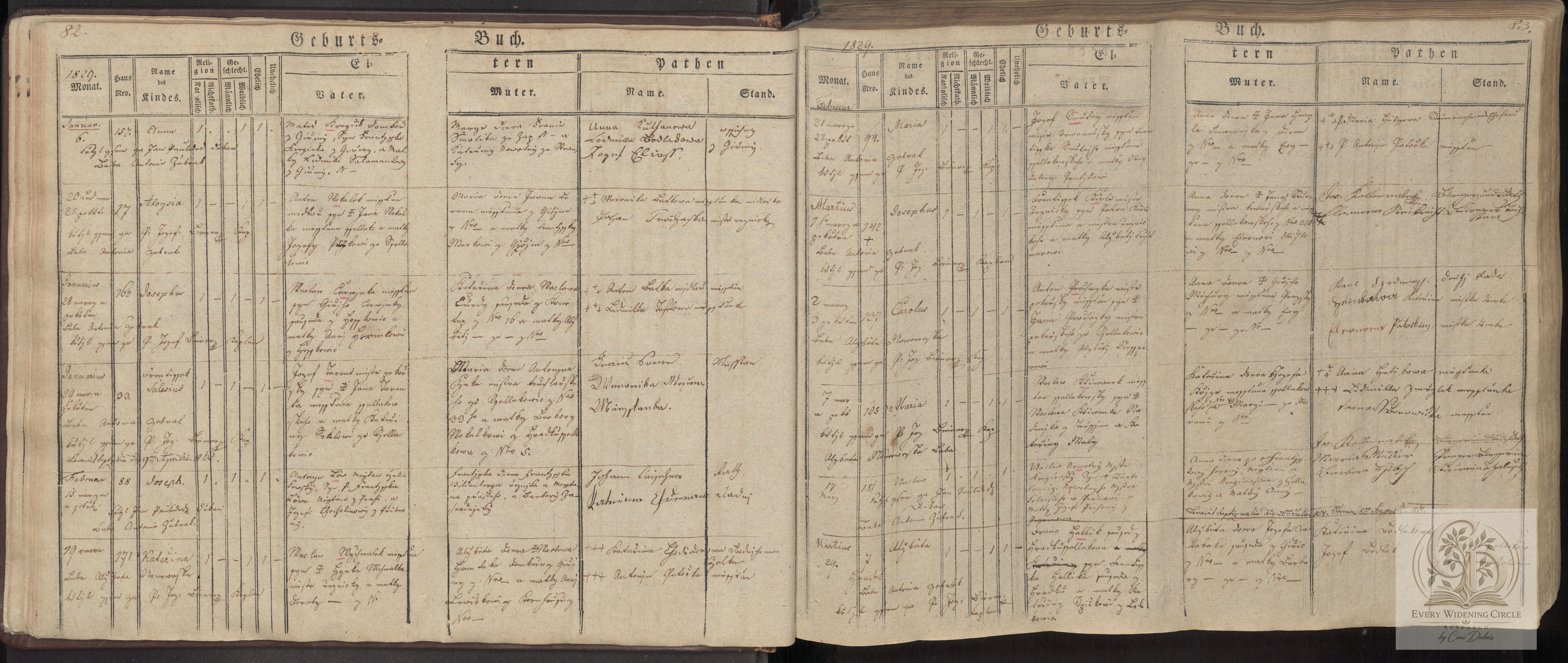
Hours after the post went up, we went back into the Čelákovice birth register — the same book, read a second time with new eyes — and there he was, spelled the way the clerk heard it that day: Tarand.
František Salesius Tarand, baptized 29 January 1829, at house No. 33 — legitimate son of Josef Tarand, master baker, and Maria, daughter of Antonín Žák, master soap-boiler, of house No. 18.
House No. 33 is the very house his 1859 Prague marriage record gives as his birthplace. And the age fits to the week: he turned 30 three weeks before his wedding, exactly what the marriage clerk wrote. The 1838 birth year my book has carried for years came from a single census line — and that line was wrong. Frank was born in 1829.
The same book held a sorrow first. Fifteen months before Frank, his parents baptized another son and gave him the same name: František, baptized 4 October 1827. The parish index carries the rest of his story in one small column — he died 5 October 1827, one day old. When their next son came, Josef and Maria gave him their lost boy’s name again, with Salesius added to it. That was Frank.
Baptism of František Tarant, 4 October 1827 — Čelákovice 13, image 030
And the finds didn’t stop with Frank. His father’s own baptism surfaced in the older register: Josef Lukáš Tarant, born 21 May 1801, son of Jan Tarand, a master glazier, and Kateřina Sobolová. From Jan the glazier the line steps back to Jan the weaver, born 1752 — and then to the furthest Tarant we have yet found in Čelákovice: Václav Tarant, born about 1715, who died there in 1782. Two hundred and fourteen years before Frank’s great-granddaughter would come looking for him.
Baptism of Josef Lukáš Tarant, 21 May 1801 — Čelákovice 11, image 046
I am correcting this morning’s post in place, and I’m leaving this follow-up standing beside it, because this is how the work really goes: you publish what the records prove today, and tomorrow the records prove a little more. The wall doesn’t always fall all at once. Sometimes it falls on a Wednesday — and then keeps falling.
Some ancestors hide in plain sight, behind nothing more than the sound of their own name.
Dorman J. Cortright was born on Monday, October 31, 1825 — Halloween day — in Butler, Wayne County, New York, a son of Lt. Simeon Emerson Cortright and Margaret Haines. Sit with that a moment. Two hundred years ago this month, in a farming town in upstate New York, a Halloween baby opened his eyes — and nobody in that house could have guessed that his great-great-great-granddaughter would one day come looking for him in October, and find him by the sound of his name.
Because the name would not sit still. In the records he is Cortright, and he is Courtright. In other papers the clerks wrote it the way their ears heard it, and our family grew up saying it — “Cartright.” I grew up hearing it sounded out just that way. He was the same man every time: a farmer, a husband, a father. The spelling changed with whoever held the pen. That is how an ancestor gets lost — not because he left no trace, but because his trace is filed under three different names.
On Tuesday, October 23, 1849, Dorman married Elizabeth Egbert — “Eliza” — a daughter of John L. Egbert and Lydia Crandall, born May 12, 1829, in Tompkins, Delaware County, New York. The newlyweds began their life under her father’s roof: the 1850 census finds them in Veteran, Chemung County, New York, in John L. Egbert’s household, Dorman listed at 24, a married son-in-law, Eliza beside him at 22.
Then the family did what so many New York families did — they went west. By the fall of 1860 the census taker found them in Clarence, Calhoun County, Michigan: Dorman — written down as Courtright — 35 years old and farming, Eliza keeping house, and their little girl Emma five years old, with baby Doy just arrived. There had been a first son, Ferdinand, born in Clarence on March 18, 1851 — and lost on July 10, 1853, “a lil over 2 yrs old,” as the family’s own note says. Some griefs this family carried quietly for a very long time.
Eliza did not get to grow old. She died in Clarence on October 16, 1864, at only 35, and was laid to rest in Clarence Center Cemetery — Section B, Row 5. Dorman married again, to Elizabeth Bennett of Erie (born April 2, 1833), and they had a daughter, Ella, born in 1868. In the 1870 census Dorman is still in Clarence, 44 years old, working by then as a house carpenter, with Emma, 15, at school.
His own time ran out on June 15, 1872. The county death record gives his age as 47 and the cause: consumption — the record’s word for TB. His gravestone, carved by the family who buried him, says June 16 and gives his age to the day — 46 years, 7 months, 16 days, counted from his Halloween birthday. The record and the stone stand one day apart, and I go with the record — but both are here for you to see. He was buried in Clarence Center Cemetery, Plot B05.10 — back in Section B, in the same ground as Eliza. That fall, on October 29, 1872, his estate went through the Calhoun County probate court — Case No. 2184, a sixteen-page packet of petitions and administration papers, the whole paperwork of a life being settled by the people he left behind.
Calhoun County Return of Deaths, 1872, p. 128 — record No. 335: Dorman J. Cortright, died June 15, 1872.
The facing page of the same return — cause of death: consumption; born New York; farmer.
His gravestone, Clarence Center Cemetery — it reads June 16, 1872, aged 46 yrs 7 mos 16 ds.
But here is where Dorman stops being just a name I found, and becomes mine.
His daughter Emma Estelle Cortright — born Friday, June 8, 1855, in Chemung, New York — grew up and married D Elton Mathye Griffith on Friday, July 4, 1873, in Lansing, Michigan, he 23 and she 18. (The marriage record spells her Courtright one more time, for good measure.) Emma lived to 84, dying in Rochester, Michigan, on October 22, 1939 — and her Michigan death certificate, filled out in a new century, names her parents one final time: father, Dorman Courtright; mother, Eliza Egbert. Among Emma and Elton’s ten children was a son named Ernest Emmit Griffith — the young father some of you met here as our Ancestor of the Day on September 26, lost in the dynamite explosion of 1915. Ernest’s daughter Marion was my grandmother. Her son Rex was my dad.
So the Halloween baby of 1825 is my great-great-great-grandfather — and the line from his New York cradle to a porch in Louisiana runs straight and documented, census by census, record by record.
This week, two hundred years after he was born on Halloween, we light his candle first.
Welcome home, Grandpa Dorman. We found you — under every name they ever wrote you down with. 🕯️
— Coni Dubois
The records behind this story
Every claim above rests on one of these, from my own research files.
1850 United States Federal Census — Veteran, Chemung County, New York (Sept 30, 1850); Dorman Cortright, 24, in the household of his father-in-law John L. Egbert. NARA M432_486, p. 120.
1860 United States Federal Census — Clarence, Calhoun County, Michigan (Sept 11, 1860); “Dorman Courtright,” 35, farmer; Eliza; Emma, 5; Doy, 1. NARA M653_539.
1870 United States Federal Census — Clarence, Calhoun County, Michigan (July 13, 1870); Dorman J. Courtright, 44, house carpenter; Emma, 15, at school. Roll 666, p. 519.
Michigan, Wills and Probate Records, 1784–1980 — Dorman J. Cortright, probate Oct 29, 1872, Calhoun County; Case No. 2184; Probate Packets 2153-2201 (16 images: petitions, orders, administration papers). Michigan Probate Court (Calhoun County).
Michigan, Marriage Records, 1867–1952 — Dorman’s second marriage (Elizabeth Bennett); and daughter Emma’s marriage to D. Elton Griffiths, July 4, 1873, Lansing, Ingham County, Record No. 2168; witnesses Ida M. Griffith & Charles M. Braduer; performed by J. W. Robinson.
Michigan Death Certificates, 1921–1952 — Emma Estelle Griffith, d. Oct 22, 1939, Rochester, Oakland County; parents named: Dorman Courtright & Eliza Egbert. GS Film 001973061, Image 00262.
Michigan, Death Records, 1867–1950 / Deaths and Burials Index, 1867–1995 — incl. the Calhoun County Return of Deaths, 1872 (p. 128, record No. 335): Dorman J. Cortright, died June 15, 1872, Clarence; age 47, married; cause: consumption; born New York; farmer; parents unknown — and Emma Estelle Griffith.
Find A Grave — Dorman J. Cortright #11133561 (Clarence Center Cemetery, Plot B05.10; his stone reads June 16, 1872, aged 46 yrs 7 mos 16 ds); Elizabeth “Eliza” Egbert Cortright #20160553 (Section B, Row 5); Emma Estelle Cortright Griffith #61105532 (Mount Avon Cemetery, Rochester, Addition 3, Plot 644, Space 8).
County histories on the Internet Archive — Peirce, History of Calhoun County, Michigan (L. H. Everts & Co.); Biographical Review of Calhoun County, Michigan (Hobart & Mather / Benson).
U.S., Indexed County Land Ownership Maps, 1860–1918 — Cortright, Clarence, Calhoun County (1894).
From my own notes (Dec 10, 2010): I called the Rochester clerk’s office and spoke with Toni — five Griffiths rest at Mount Avon; Emma lies in Addition 3, Plot 644, Space 8, and her son Dill in Space 4.
A note on the name: the surname appears across the records as Cortright, Courtright, and in family speech as “Cartright.” These are the same family — clerks writing what they heard. This post uses the spelling carried in my family file: Cortright.
Who do you want to see next? Tell me below.
🕯️ Dorman’s candle burns in our Memorial Chapel — visit his candle. Sign his guest book below — leave a message in his honor, and it will be read and kept.
This morning, in the first part of Frank Tarant’s story, the wall came down on the Bohemia side. We found Frank’s baptism in Čelákovice, his parents the master baker Josef and Maria Žák, his wife Theresia Bechyň of Sadská, and the road that carried their son Josef all the way to a hospital in Logansport, Indiana — where his 1928 death certificate listed the informant as the hospital itself, because the institution didn’t know who his people were.
This afternoon, the wall came down a second time — and this time, the papers were in the family’s hands all along.
Going back through my own files today, I found the rest of Josef’s story: the family’s own paperwork, kept for nearly a hundred years.
A daughter goes to court
In July 1927, Josef’s daughter Marie — my great-grandmother — went to the Circuit Court of Marshall County, Indiana, and petitioned for her father’s care. The application is in her own handwriting. Joseph, she wrote, had come to Indiana in 1909 from Chicago, and to Marshall County in March 1927. He was a farmer, retired, but he had worked on the farm up to 1927. And she set down, plainly and gently, what the family had been living with: for about two years he had been failing. He would run away from home. He did not know where he was, or why he had left — except that he was going back to his old home. In his last two weeks at home, the family had to watch him, and see that he ate. Marie believed the trouble began with a land deal: he had sold his farm, she wrote, and “did not realize as much as he expected”; it seemed to prey on his mind. The doctor who examined him in Plymouth wrote that Josef was “very talkative, constantly referring to a land deal he made,” and did not know where he was.
Marie’s application to the Marshall County court for her father’s care, July 1927 — in her own hand (family papers)
The court granted the petition, and Josef was received at Logansport State Hospital on July 23, 1927 — the very date his death certificate gives as the start of his doctor’s attendance. The discharge papers in the file were never filled in. He was never discharged. He died there on November 2, 1928.
Let me be as plain about this as Marie was. Josef’s death certificate gives his cause of death as arteriosclerosis and states no other diagnosis, and I will not invent one for him here, either. What the court file shows is not a scandal. It is a daughter doing what a family did in 1927 for someone they loved who was no longer safe in his own mind: she went to court, answered every question honestly, and got him care. On that application, his emergency contact is written in her hand: “Mrs. Marie Gilbert (daughter), Plymouth, Ind.”
Accepted at Logansport State Hospital, July 23, 1927 — and the sheriff’s return, the same day (family papers)
What Marie knew about Frank and Theresia
The family-history page of that same file, sworn to by Marie, also gives us the first death information we have ever had for Frank and Theresia. It is family knowledge, written down by a granddaughter who never knew them — not a death record — and I label it exactly that way. It says Frank died of tuberculosis, “about 36”; and that Theresia died of old age, at 82. If Theresia was 82, she died about 1915–1916, most likely in Indiana — which means there is a death record out there to hunt, and the hunt is on. Frank’s “about 36” does not sit comfortably beside his appearance in the 1870 census, and I won’t pretend it does. But the family’s memory that consumption took him is new, and it is theirs, and it is recorded here as what it is.
The family-history page, sworn by Marie Gilbert, July 11, 1927 — Frank, dead of tuberculosis at about 36; Theresa, dead of old age at 82 (family papers)
The estate, and a daughter we couldn’t place
Five weeks after Josef’s death, on December 6, 1928, Marie was back in court for the Letters of Administration of his estate. Josef left personal property of $666 and real estate of $800, and the paper names his heirs with their ages and addresses: Anna Runik, 48, of South Trumbull Avenue, Chicago — a daughter whose married name we did not have until this paper surfaced; Anton Tarant, 35, of Cicero, Illinois; and Marie Gilbert, 33, of Plymouth. The paper also leaves us one honest puzzle: Josef’s son Frank, born in 1886, is not named among the heirs. We don’t know why yet. It goes on the still-hunting list, exactly as it stands.
Letters of Administration for Josef’s estate, Marshall County, December 6, 1928 — his three heirs named, with addresses (family papers)
Marie, and George, come home
The files held two more answers. Marie’s own Indiana death certificate shows she was born April 8, 1896, in Wisconsin, and died May 16, 1985, at Pilgrim Manor Nursing Home in Plymouth, and rests in New Oak Hill Cemetery there.
Death certificate of Marie Tarant Gilbert, Plymouth, Indiana, May 16, 1985 (family papers)
And a newspaper clipping closes a question this family has carried since 1944: Marie’s nephew George Tarant, the B-24 waist gunner shot down over Denmark, was brought home. His funeral was held in Plymouth, and he lies in New Oak Hill Cemetery — the same ground as his Aunt Marie. The grave in Denmark was a wartime resting place. Plymouth is his home.
George Tarant, brought home to Plymouth — the funeral clipping, with his portrait (family papers)Marie Tarant’s school picture (family collection, donated by Jean (Belt) Gilbert)
Where these treasures came from
A note on where these photographs and papers come from, because credit matters: the family’s photographs that travel with these papers — Joseph and Antonie together, the old Joseph Tarant farm, Marie’s school picture, the Gilbert family home on South Plum Street, and many more — were gathered and shared by Violet Jean (Belt) Gilbert (1929–2011), Marie’s daughter-in-law, whose name stands as donor on dozens of photographs in our family files. Several others, including Marie with little Jimmy, came from Nancy (Gilbert) Allen. The story of the Catholic picture — the painting at the top of this post — came from Clifford Berger, Marie’s grandson, who sent it in 2009 with a handwritten note (you’ll find it in the album below). The picture, he wrote, was “brought over from Bohemia by Joseph Tarnut” [his spelling], one of three or four that hung in Grandma Marie’s bedroom when the grandchildren were small. The others were donated to a Catholic church in the South Bend, Indiana area; this one came to Cliff through his mother, Lauretta Gilbert Berger — Marie’s daughter. This post exists because they kept these things, and passed them on.
Marie (Tarant) Gilbert with Jimmy (family collection, donated by Nancy (Gilbert) Allen)
The family, in photographs
The photographs in this section have been tidied very gently — a little contrast, a little sharpness, nothing more. No face has been redrawn and nothing has been added or taken away; they are the same photographs, just a touch easier to see. The originals, exactly as they came down to us, are in the album at the end of this post, so anyone can compare them.
From the family’s collection — an elderly Tarant couple, kept with Joseph and Antonie’s photographsAt the farm, with the team (family collection)James Madison and Marie (Tarant) Gilbert (family collection)Anton ‘Tony’ Tarant — the family’s own label on the back of the photographA family home, kept in the family’s photographs
Still hunting
Theresia’s Indiana death record, about 1915–1916 — the family-history page says she died of old age at 82.
Why Josef’s son Frank (b. 1886) is not among his father’s 1928 heirs.
Frank’s own arrival in America, and his grave — the family’s memory says tuberculosis took him young; the 1870 census says he was in Kewaunee, Wisconsin. Both things are on the table until a record settles it.
The wall came down twice in one day — once in the Bohemian registers this morning, and once this afternoon, in papers my own family kept. If you are sitting on a box of family papers, go look in it. You may already be holding your brick wall’s other side.
The album — the originals, untouched
These are the photographs exactly as they were handed down and scanned — no tidying of any kind; the only addition is our small monogram watermark. This is the family’s album, as it came to us.
The Catholic picture, brought over from Bohemia — original scanClifford Berger’s handwritten note about the picture, July 23, 2009 — it hung in Grandma Marie’s bedroomThe elderly couple — originalAt the farm, with the team — originalJames and Marie Gilbert — originalMarie with Jimmy — originalMarie’s school picture — original
Sources
Application and commitment file for Joseph Tarant, Circuit Court of Marshall County, Indiana, July 1927 — the family’s own papers, including the family-history page sworn by Marie Gilbert.
Letters of Administration, estate of Joseph Tarant, Marshall County, Indiana, December 6, 1928 — the family’s own papers.
Death certificate of Marie Tarant Gilbert, Indiana, State No. 85-018813, May 16, 1985 — the family’s own papers.
Descendants of Frank and Theressa Tarant, compiled family report and photograph collection (Coni Dubois, 2026) — photograph donor credits as noted in the text.
Handwritten note of Clifford Berger, July 23, 2009, accompanying the Catholic picture — the family’s own papers.
For the Bohemia side — Frank’s baptism, the Prague marriage, Josef’s baptism, and the rest — see the sources in Part 1 of this story.
UPDATE — the same day, a few hours later (October 14, 2026): The wall kept falling. After this post went up, we found Frank’s baptism — he was in Čelákovice all along, spelled ‘Tarand’ in a book we had already read once and missed. He is František Salesius Tarant, baptized January 29, 1829, at house No. 33 — the very house his marriage record names. His father’s baptism turned up too, and the line now runs two generations deeper, to Václav Tarant, born about 1715. The passages below that say his baptism wasn’t found and his birth year was unsettled were true when I wrote them that morning — I’ve corrected them in place, because around here the records get the last word. — Coni Dubois Follow-up: “The Wall Kept Falling — Frank Tarant, Found”
The Tarant journey: from Čelákovice and Sadská in Bohemia to Kewaunee, Chicago, Marathon, and Indiana
By Coni Marie
Some brick walls stand for thirty years. This one stood in my files for most of my researching life — and then, in one long night of work, it came down.
Meet my second great-grandfather, Frank Tarant. When this week began, here is everything I could prove about him: he was born in Bohemia. He married a woman named Theressa, whose maiden name I did not know. They had a son, Josef, born about March 1858 in Sadská, Bohemia. And Frank appears in exactly one American record — the 1870 census of Kewaunee, Kewaunee County, Wisconsin, written down as “Frank Trant,” age 32. After 1870, nothing. No death record. No grave. No second census. His parents were listed in my files as unknown, because they were.
That was the wall. Here is the night it broke.
A baptism in Sadská
The first crack came from the parish registers of Sadská, a small town in the Elbe lowland of Central Bohemia. In the Roman Catholic birth register for 1853–1858 (Sadská 18, image 131), there is my great-grandfather’s baptism: Josef Tarant, born in Sadská in March 1858, son of František Tarant of Sadská.
Written in Latin in the margin of that entry is the sentence that opened everything:
“Proles hæc, Josef, per subsequens matrimonium inter parentes quod Pragæ, ad Sct. Petrum die 22 Februarii 1859 contractum legitimata est.”
In plain English: This child, Josef, was legitimized by the subsequent marriage of his parents, contracted at Prague, at St. Peter’s, on 22 February 1859. The entry also notes that a duplicate of Josef’s baptismal certificate was issued on September 22, 1880 — right before his own marriage, when he would have needed it.
Josef came into this world eleven months before his parents could marry. That was not a scandal to hide; it was written right into his baptism record, because the Church and the Empire both ran on paper. And that paper pointed straight to Prague.
Josef Tarant’s baptism, Sadská, March 1858 (Sadská 18, image 131)
A wedding in Prague
At the City Archive of Prague, in the marriage register of St. Peter na Poříčí (PE O10), the index carries one line: Tarant, 1859, 22. Februar. The entry itself, on February 22, 1859, gave me in one stroke what thirty years of files could not:
The groom: Franz Tarant, a soldier, born at Čelákovice No. 33, in the district of Brandýs — the legitimate son of Josef Tarant, master baker, and Maria, née Žák.
The bride: Theresia Bechyň — there was Theressa’s maiden name at last — born at Sadská No. 278, the legitimate daughter of Josef Bechyň, citizen and weaver, and Marie, née Charvát.
The wedding house was Prague No. 1177/2. The witnesses were Joseph Buchenbaum, a master cooper, and Franz Mitzschli, an innkeeper.
So now I can tell you where they were coming from. Frank was a master baker’s son from Čelákovice, a town on the Elbe east of Prague. Theresia was a weaver’s daughter from Sadská, some twenty kilometers east of there — the same flat, rich Elbe lowland, a half-day’s walk apart. Their son was born in her hometown, as was the custom, and Sadská stayed the family’s anchor for the rest of the century.
The marriage of Franz Tarant and Theresia Bechyň, St. Peter na Poříčí, Prague, 22 February 1859 (PE O10, scan 199)
The soldier
Frank was not free to marry when Josef was born, and the register tells us exactly why. He was a serving soldier of the Austrian Empire, and an Austrian soldier could not marry without his regiment’s written permission — the Ehebewilligung. The remarks column of the marriage entry reads like the paper trail of a young man’s whole life in 1858:
Marriage permission from the Regimental Command at Zara (Zadar, on the Dalmatian coast), July 3, 1858, No. 709 — issued four months after Josef’s birth, which is why the wedding waited until February 1859.
An announcement and discharge certificate from the Regimental Chaplaincy at Zara, July 1858, No. 284.
Both baptismal certificates filed as enclosures — his from Čelákovice, hers from Sadská.
The banns read February 2, 6, and 13, 1859, in Prague and in the regimental chapel at Zara, an empire apart.
A margin note at Frank’s name ties him to a regiment numbered 23, and published army histories list Infantry Regiment 23’s colonel-in-chief in those years as Baron Airoldi — the regiment was known by his name. (We have since checked the army almanac, the Militär-Schematismus, for both 1858 and 1859: Airoldi checks out — but the regiment recruited in Lombardy, its district seat at Lodi, and the almanacs do not station it at Zara. It is Frank’s own marriage file that puts him at Zara — his battalion was posted there, whatever the regiment’s paper home. A Bohemian baker’s son in a Lombard regiment looks like a specialist posting, which fits the butcher reading below.) A word beside his name appears to read Regiments-Fleischergeselle — a regimental butcher’s journeyman — which would fit a baker’s son: a man who knew his way around provisions. That reading is tentative, and I label it so.
Think about what that means. It was not the family’s memory that preserved who Frank Tarant was. It was the Austrian Army’s paperwork — permission slips, chaplaincy certificates, banns read in two chapels a thousand kilometers apart. A working man’s life, saved by bureaucracy.
One generation deeper — found the same night
The Prague record named Frank’s parents. Before the night was over, we found them too.
In the marriage register of Čelákovice (Čelákovice 17), on September 21, 1824, Jozef Tarant, age 24, a bachelor, married Maria Žák, age 25. The entry names the generation behind them: Jozef was the son of Jan Tarant, a master craftsman of Čelákovice, and his wife, née Sobolová (her first name reads Rozina). Maria was the daughter of Antonín Žák of Čelákovice, house No. 18.
Frank’s parents. His grandparents. Names that were “Unknown” in my files on Tuesday are a matter of record on Wednesday.
The marriage of Jozef Tarant and Maria Žák, Čelákovice, 21 September 1824 (Čelákovice 17, image 008)
Update — later the same day: the wall had one more stone to fall
After this post went up, the hunt kept going — and the Čelákovice parish index handed us the answer. Josef and Maria Tarant had two sons named František. The first, baptized 4 October 1827 at house 137, died the very next day, 5 October 1827 — the index says so plainly. Fifteen months later they gave the name again: František Salesius, baptized 29 January 1829 at house No. 33 — the same house his marriage record names as his birthplace, and he turned 30 just three weeks before his wedding, exactly the age that record gives. That is our Frank. He was in Čelákovice all along, spelled “Tarand,” hiding in the long handwriting of his own baptism.
The baptism of František Salesius Tarand, Čelákovice, 29 January 1829, house No. 33 (Čelákovice 13, image 038) — this is Frank Tarant
The same index carried us further back: Frank’s father, Josef the master baker, was baptized Josef Lukáš Tarant on 21 May 1801, son of Jan Tarant, master glazier, and Kateřina Sobolová — and behind Jan stand his father Jan the weaver (b. 1752) and Václav Tarant (b. ~1715). Five generations of Tarants in one small Elbe town, standing in a row at last.
The Čelákovice parish surname index — the Tarant lines that settled Frank’s identity (Čelákovice 21, image 285)
And the bride’s side of the wall fell too. Theresia Bechyň’s baptism is found: 16 September 1833, Sadská house No. 278 — daughter of Josef Bechyň, citizen of Sadská and master weaver, and Marie née Charvát, just as the Prague marriage record names them. She was 25 years and 5 months old on her wedding day — the “25” in that register is exact, the same way Frank’s “30” was. Written in the margin of her baptism, years later, is the loveliest detail of all: on 14 April 1858 the parish issued her a copy of that very baptism — the certificate she carried into her marriage file, months before the regiment at Zara gave its permission. Her own baptism entry even gives us her mother’s parents: Marie Charvát was the daughter of a Jozef, of house No. 78, and an Alžběta — one more generation standing where we had only a name.
The baptism of Theresia Bechyň, Sadská, 16 September 1833, house No. 278 (Sadská 14, image 107)
And Frank’s mother has her beginning back, too. Maria Žák’s baptism is found: Marie Josefa Žáková, baptized 24 October 1797 at Čelákovice house No. 46 — daughter of Antonín Žák, a master craftsman, and Barbora, née Vokálková, whose name the 1824 marriage register gives outright once you read the bride’s entry at full size. We had hunted Maria in the wrong years and under a shortened name; she was in the Čelákovice birth book all along, under her full double name. She was 26 on her wedding day, not 25 as the register states — the same small drift this family’s ages always show, and the reason we trust baptisms over wedding-day arithmetic.
The baptism of Marie Josefa Žáková, Čelákovice, 24 October 1797, house No. 46 (Čelákovice 11, image 037)
A daughter history almost left out — Veronika
Maria Žák had a daughter before Frank. On 6 January 1824, at house No. 18 in Čelákovice, a little girl named Veronika was baptized. The register names her mother — Maria, daughter of Antonín Žák and Barbora Vokálková — and leaves the father’s column empty; the clerk ticked the column for a child born outside marriage. Eight and a half months later, that September, Maria married Josef Tarant in the same parish.
Was Josef her father? The register does not say, and I won’t say it for him — no record names Veronika’s father, and timing is not proof. She is not carried here as Josef’s child. But she is Maria’s daughter, which makes her Frank’s elder half-sister — and kin is kin. She belongs in this story by name.
Baptism of Veronika Žáková, Čelákovice, 6 January 1824 — the first entry on the page; her father’s column stands empty (Čelákovice 13, p. 28)
One honest footnote: the parish index gives her birth month as July. The register itself says January, and the register governs. What became of Veronika — whether she married, where she lies — is still an open thread, and we will follow her forward from here.
What the wall still holds
A broken wall is not a finished story, and I won’t pretend otherwise. Two honest loose ends:
Frank’s baptism IS in Čelákovice — we had read right past it. He is František Salesius Tarand, baptized 29 January 1829 at house No. 33 (Čelákovice birth register 13, image 038), legitimate son of Josef Tarand, master baker, and Maria, daughter of Antonín Žák. The clerk spelled the name Tarand, inside a dense, long-form entry — and an earlier pass over this very book simply missed it. There was a second trap in the same book: an elder brother, also named František, baptized 4 October 1827 at house 137. The parish index tells his short story — he died 5 October 1827, the day after his baptism — which is why his parents gave the name again, fifteen months later, to the son who lived to become Frank.
His birth year is settled now: 1829. The baptism (29 January 1829) and the marriage record agree — he turned 30 three weeks before his wedding on 22 February 1859, exactly the age the Prague clerk wrote down. The 1838 year my book has always carried came from one line, his age of 32 in the 1870 census, and that line was simply wrong. Marriage record: right all along. Census: the outlier.
One parent’s baptism held out the longest: Maria Žák’s. Josef’s turned up the same afternoon — Josef Lukáš Tarant, baptized 21 May 1801, in the very spread of the Čelákovice birth book an earlier read had called empty. Maria’s took one more pass through that same book — Marie Josefa Žáková, baptized 24 October 1797 — hiding under her full double name. This family’s names hide mid-sentence in long register entries, and we have learned to trust the parish index over a quick scan.
The vanishing
And then there is America, where the wall still stands.
Frank crossed the Atlantic sometime before 1870 — no passenger list has ever been found for him — and surfaced in Kewaunee County, Wisconsin, one of the great Bohemian settlements of the Midwest: Czech families had been arriving there since 1854, some five thousand strong by the 1880s, with their own Bohemian Hall raised in 1870, the very year Frank appears. Men of Frank’s generation had one more reason to cross: the Austrian Army’s long conscription, the same army whose permission he had once needed to marry. That is context, not proof — but it is the world he moved through.
In 1870 he is “Frank Trant,” and then the record simply stops. No 1880 census. No land, no naturalization, no probate, no grave that we have found. His family did not sail until 1888 — the ship Gellert, Hamburg to New York, August 15–28, 1888 — when the passenger list carries a Therese Tarant with Josef and little Frank, Josef’s son. Her age is written as 32; Theresia would have been about 52, and I have believed for years that a clerk’s 5 was misread as a 3. I still believe that is the best reading, but I hold it as a reading, not a fact. Eighteen years separate Frank’s Wisconsin appearance from his family’s crossing, and every explanation — he came ahead and died before they followed; he went back and forth; the family story compressed two journeys into one — is still on the table.
What we know is how Theresia ended: in 1910 she was living with Josef in Oregon Township, Starke County, Indiana, age 77 — and where the census asked her marital status, she said “Single.” Not widowed. Single. After all those years, that one word may be the most Frank ever told us about what happened — or it may just be a widow who no longer counted herself married. The record doesn’t say, and neither will I.
Josef’s road, and the “Unknowns”
Josef’s own American road is fully documented: Chicago by 1888, naturalized in Cook County on September 21, 1892, a mason; then Marathon, Wisconsin; then Starke County, Indiana. His wife Antonie (née Holem) crossed separately in 1892 on the Scandia — chain migration, one ticket at a time. Antonie died in Plymouth, Indiana, in 1927.
Josef died on November 2, 1928, at Logansport State Hospital in Indiana, where he had been a patient for his last fifteen months. His death certificate names the cause plainly: arteriosclerosis. It states no mental diagnosis, and I will not invent one for him. What that certificate does show is a row of “Unknowns” where his father’s name, his mother’s name, and his wife’s name should be — because the informant was not his family. It was the hospital: “LONGCLIFF HOSPITAL RECORDS.” The institution didn’t know who his people were. His family did. And now, a century later, so do we: his father was Frank Tarant of Čelákovice, his mother Theresia Bechyň of Sadská, and the paper trail runs unbroken from a Prague altar in 1859 to a hospital ledger in 1928.
Indiana death certificate of Joseph Tarant, No. 32979 — Logansport State Hospital, 2 November 1928
Why Marie matters
This line comes down to me through Josef’s daughter, and her name is the thread I want to leave you with.
Marie Tarant (1896–1985), born in Marathon, Wisconsin, married James Madison Gilbert. Their son was Robert James Gilbert; his daughter is my mother, Nancy; and then there is me. Marie is my great-grandmother, and she is why this Bohemian soldier and his baker father are family and not just a puzzle.
And look at her name. Both of Josef’s grandmothers were Maries — Maria Žák of Čelákovice and Marie Charvát of Sadská. Marie Tarant carried their name to Wisconsin. My grandmother, Mildred Marie Gilbert, carried it too. And it is my own middle name too: Marie — “Coni Marie” is the name I sign my work with. Four generations of women, one name, handed down from two Bohemian villages I had never seen — until a register page in Prague gave them back to me.
Still hunting — maybe you hold a piece
The baptism of Kateřina, Jan the glazier’s wife (about 1778–1781) — her own page should settle how her maiden name was truly spelled; the registers write it two ways, and neither is proven yet.
Frank’s army personnel sheet — the Grundbuchblatt — which would rest at the Kriegsarchiv in Vienna; his regiment is settled (the 23rd, Airoldi’s), and the sheet is the next military stone.
Kewaunee County court and naturalization records, 1858–1950, at the UW–Green Bay Area Research Center — the likeliest place Frank’s American ending is written down.
Josef’s Logansport admission index card, through the Indiana State Archives.
Register-page verification of the index lines still flagged: daughter Kateřina (b. 26 Jul 1826) and the cousin branch of Antonín the master shoemaker.
Any record of Frank after 1870 — arrival, death, or grave still unfound.
If you are a Tarant, a Bechyň, a Žák, or a Charvát descendant — or a Kewaunee Bohemian family with a Frank who vanishes from your tree around 1870 — I would love to hear from you.
Sources
We source everything. Every fact above traces to one of these:
Baptism of Josef Tarant, Sadská Roman Catholic birth register, Sadská 18 (births 1853–1858), image 131 — Státní oblastní archiv v Praze, eBadatelna: https://ebadatelna.soapraha.cz/d/11466/131
Marriage of Jozef Tarant & Maria Žák, Čelákovice Roman Catholic marriage register, Čelákovice 17 (1821–1854), image 008 — SOA Praha, eBadatelna: https://ebadatelna.soapraha.cz/d/4731/8
Death certificate of Joseph Tarant, Indiana Death Certificates 1899–2011, Certificate No. 32979, Cass County (Logansport State Hospital, November 2, 1928).
1870 U.S. Census, “Frank Trant,” Kewaunee, Kewaunee County, Wisconsin — NARA M593.
Ship Gellert, Hamburg departure August 15, 1888, New York arrival August 28, 1888 — Staatsarchiv Hamburg, 373-7 I, VIII A 1 Band 062 A, p. 1374; NARA M237, Roll 524, List 1179; also Leo Baca, Czech Immigration Passenger Lists, Vol. VII, p. 209.
Naturalization of Josef Tarant, Cook County, Illinois, September 21, 1892 — NARA M1285, Roll 170.
1910 U.S. Census, Oregon Township, Starke County, Indiana (Josef’s household, incl. Theressa, age 77).
Ancestors of Coni Allen by Coni Dubois (2026) — the compiled family record this research started from.
Baptism of Marie Josefa Žáková (Frank’s mother), Čelákovice Roman Catholic birth register, Čelákovice 11, image 037 (printed p. 67) — SOA Praha, eBadatelna: https://ebadatelna.soapraha.cz/d/4725/37
Marriage of Jan Tarant & Kateřina, Čelákovice Roman Catholic marriage register, Čelákovice 15, image 009 (printed p. 13), 31 May 1797 — SOA Praha, eBadatelna: https://ebadatelna.soapraha.cz/d/4729/9
🎃 Somebody stole the candy at Mamaw & Pawpaw’s house… and the suspects are our own grandkids!
It all started with a Halloween mystery game I wanted to make for my grandkids — Madelaine, Adalina, Kali-Anna, Rowan, Kasen, and Charlie. Well, you know how things go around here. The game grew a storybook. The storybook grew three whole mysteries. And before I knew it, we had a whole book — and I love it so much I want to share it with YOUR family too, just in time for Halloween.
Inside The Halloween Candy Caper you’ll find:
🕵️ Three mysteries to solve — the Case of the Great Candy Caper, Mamaw’s Detective Notebook, and the Case of the Vanishing Pumpkin Pie. (Detectives, be warned: one culprit has four legs and a very guilty face. Her name is Sassy.)
👻 A storybook starring Glowbert — that’s him in the photo below, our real porch ghost! He glows on our porch every Halloween, and now he has his very own story about the night he danced in the wind.
Glowbert, our real porch ghost!And here’s our storybook Glowbert — the porch ghost, recreated cute!
🎨 11 coloring pages — including one drawn from our actual haunted porch, so the kids can color Glowbert himself.
✂️ Crafts made from things around the house — toilet paper roll bats, a milk-jug Glowbert lantern, ghost lollipops, and more.
And on every single page, there’s one little thing left black-and-white on purpose — because every young detective should get to color something on every page.
📖 The Grandkids’ Book (32 pages) — the full book: all three mysteries, the whole storybook, every coloring page and craft. 🎃 The Handout Edition (11 pages) — a slim version made for printing a stack. We’ll be handing these out with little crayon packs to our trick-or-treaters this Halloween — feel free to do the same!
You’ll also find both editions on our brand-new Holiday shelf in the Crayon Corner — a special corner of the Book Nook where our holiday books and crafts will live from now on. Halloween is just the beginning!
Happy Halloween, detectives. Keep your eyes on the candy bowl… and if it goes missing, check the dog first. 🐾
He was the law in Hancock County, Tennessee. He laid out roads, settled disputes, collected taxes, and owned 830 acres of East Tennessee farmland. He married three times, fathered children with each wife, and when he died around August of 1860, they buried him in the family cemetery in Sneedville.
This is my 4th great-grandfather — Zachariah Green Trent. And if Matilda, his third wife, is the mystery of my mother’s line, Zachariah is the anchor. He left a paper trail a mile long, and today I’m walking every inch of it with you.
The chain, so you can follow it home: me → my mom, Nancy Lee Gilbert → my grandma Mildred Marie Scheetz → Viola Beatrice Nickerson → Nancy Pratt → Caroline Trent Pratt → Matilda, Zachariah’s wife. Every step mother to daughter, and Zachariah stands right there beside Matilda at the far end of it.
The Offices He Held
Zachariah wasn’t just a farmer who happened to live in Tennessee. The records show a man his community trusted with real authority.
Justice of the Peace — appointed June 11, 1832, in Hawkins County, Tennessee. In frontier Tennessee, a justice of the peace wasn’t a ceremonial title. He married people, settled small disputes, witnessed documents, and kept the peace in a county that was still rough around the edges. When your neighbors pick you for that job, it says something about who you were.
Zachariah Trent appointed justice of the peace for Hawkins County — National Banner and Nashville Whig, November 7, 1829, p. 3. (Newspapers.com clipping.)
3rd Sheriff of Hancock County, Tennessee — serving 1849–1850. The third man to hold that office in a young county. He would have served papers, collected taxes, kept order, and ridden out to wherever he was needed. Hancock County in 1849 was mountain country — Sneedville, the Clinch River valley, farms carved out of ridges. Being sheriff there meant knowing every hollow and every family.
Now, I want to address something directly, because that’s how we do this. There’s a family story that Zachariah was killed in the line of duty as sheriff. I love that story — what genealogist wouldn’t? But his sheriff service ended in 1850, and he died around 1860. Ten years later. I have no record, no newspaper account, no county document confirming how he died. Until I find proof, it stays out of the fact column. It might even be a different ancestor entirely. Facts only. Always the facts.
The Land
On April 30, 1830, Zachariah acquired 830 acres from Samuel Nicholson. Then on March 18, 1833, he acquired additional land from William D. Trent and Alexander Trent.
Eight hundred and thirty acres. Let that number sit with you for a minute. In 1830 East Tennessee, that wasn’t a farm — that was an estate. That was a man building something meant to last, meant to pass down.
He shows up in the Hawkins County court minutes too: on juries laying out roads in 1831, 1836, and 1837. Present at court in August 1831. Involved in a writ for money owed in July 1838. On the 1836 Hawkins County tax list and the early Tennessee tax records. This is a man woven into the civic fabric of his county — not passing through, but planted.
The Census Trail — Every Decade I Can Find Him
Here’s Zachariah walking through the federal census, decade by decade:
1830 — Hawkins, Tennessee. Seven people in the household. He’s a young man building a family. (NARA Series M19, Roll 178, Page 83.)
1840 — Knox, Kentucky. Just two in the household this time. The family was in transition — and if you’ve followed my Brick Wall Wednesday on Matilda, you know these were complicated years. (NARA M704, Roll 116, Page 315.)
1850 — Sneedville, Hancock County, Tennessee. He’s here with Matilda now, listed as his wife. (Subdivision 32, Roll M432_881, Page 25B.)
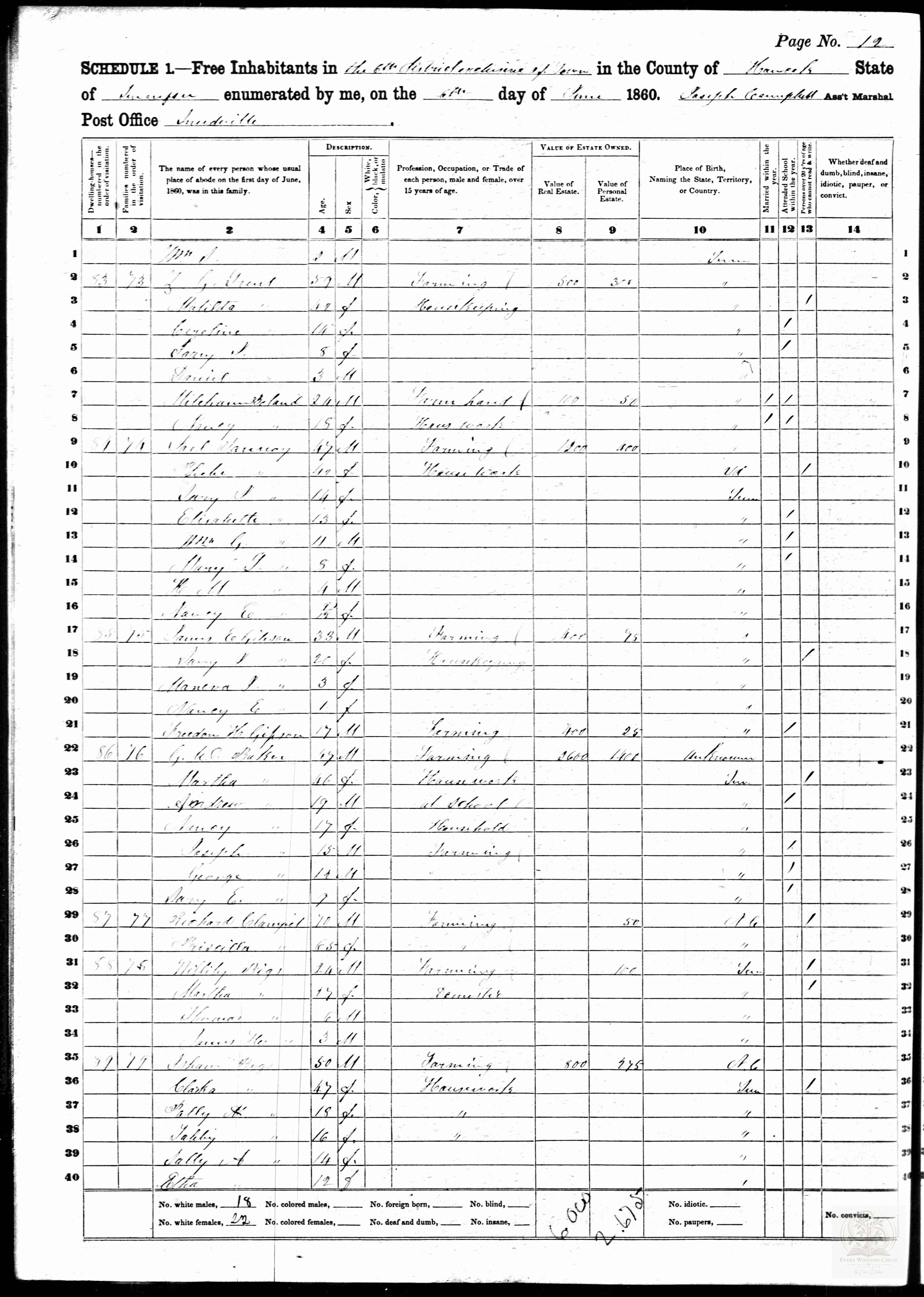
1860 — Sneedville, Hancock County, Tennessee. Age 59, farming, with Matilda. And here’s the part that makes every genealogist smile: the enumerator mangled the surname as “Z G Lunt.” Lunt! If you’re searching for this family and can’t find them, try the mangled versions. Enumerators, bless them.
That 1860 census is the last time anyone sees Zachariah on paper. He died about August 1860, in Sneedville. He’s buried in the Trent Cemetery there — Find a Grave Memorial #130592796.
About His Name
You’ll find him as Zachary, Zachariah, and Zechariah Green Trent — and in the records themselves as Zachari, Little Zack, Zak, Zackie, “Z G Trent,” even “Zackasi Trent” and “Fackariah Trent.” I’m mentioning it once so you can find him when you search. That’s just genealogy — names shift like sand, and his is no exception.
Three Marriages
Zachariah was married three times that I can document. Here’s each one, honestly laid out:
1. Naomi Taylor Greene — married 1818, Hawkins, Tennessee. Naomi was born January 7, 1801, in Rowan County, North Carolina, daughter of Jeremiah and Anne (Hartley) Greene. Her maiden name was Taylor — she’d married a Greene first, and was known as Naomi Greene when she married Zachariah. She died December 26, 1877, in Morristown, Hamblen County, Tennessee, and she’s buried in the old city cemetery there.
Seven children I can document: Nancy Trent, John Hicks Trent, James William Trent, Stokely Donaldson Trent, Manila Trent, Cinthea Greene Trent, and Mary Jane Trent. Manila married Jefferson Baker, and their descendants carry this line forward.
2. Myra Singleton — “partners” about 1832, Hawkins, Tennessee. I want to be careful here: the record doesn’t call this a marriage. It says “partners.” Myra (also recorded as Mira, Miriah, Miry) Singleton was born between 1812 and 1814 in Lee Valley, Hawkins, Tennessee. Their children carried “Singleton” as a middle name: Frances “Frankie” Singleton Trent and Lucinda Singleton Trent. There may have been a third girl, Rhoda. Myra later appears as Myra Lawson — she married a Lawson after Zachariah. The records give me “partners, 1832,” and that’s what I’m reporting.
3. Matilda — wife by the 1850 census. My Matilda. She appears as Zachariah’s wife in the 1850 and 1860 censuses. I have no confirmed marriage date for them. Four children I can document: Sarah Jane Trent, Caroline M. Trent, Nancy Trent, and Daniel Lewis Trent.
Now here’s a confusion I want to flag for fellow researchers, because it will trip you up: Zachariah had two daughters named Nancy — one by Naomi (the elder) and one by Matilda. As descendant Caroline Tassey wrote to me: “the two Nancy Trents has caused much confusion.” She’s right. When you’re researching this family, always check which Nancy.
Caroline’s Obituary — The Daughter Who Carried the Line
Caroline Trent Pratt — Zachariah and Matilda’s daughter, my 3rd great-grandmother — got a beautiful sendoff in The Argos Reflector on November 13, 1919. Born June 12, 1845, in Hancock County, Tennessee, she married William Harrison Pratt in 1865, and the paper called their marriage “one long happy and harmonious experience.” Ten children, twenty-nine grandchildren living, four great-grandchildren. She died November 5, 1919, at 74, a faithful member of the Church of Christ at Francesville, Indiana. Through Caroline, Zachariah’s blood runs straight down to my mother, my grandmother, and me.
Her death notice ran in the Weekly Republican the same week (November 13, 1919, p. 5) — and it spells her name “Tratt.” Another variant for the search files. It notes she died Wednesday at 2:45 at her daughter Mrs. Jesse Tomlinson’s home in Argos, suffered a stroke the Saturday before, and her body was shipped Friday to Francesville, Indiana for funeral services.
William Pratt and Caroline Trent Pratt with Orville Nickerson (center). Caroline was Zachariah and Matilda’s daughter — my 3rd great-grandmother. (Family photo, identifications handwritten on the back.)
Pictured left to right: William Harrison Pratt (my 3rd great-grandfather), Orville Nickerson (center), and Caroline Trent Pratt (my 3rd great-grandmother, Zachariah and Matilda’s daughter). The identifications are handwritten on the back of the original — it’s a real photo postcard from the early 1900s, the kind families mailed to each other.
The DNA Backs the Paper
My files carry a research note: “3 Trent lines and their DNA.” A Family Tree DNA Trent Project participant descends from William D. Trent Sr. and Charity Burton — and also from Zachariah G. Trent and Naomi Greene. The Y-DNA results show the William D. Trent line matches the Trent lines of Campbell County, Virginia, including the lines of Alexander Trent.
Zachariah was the son of Alexander Trent, who served in the War of 1812 — and Zachariah was Alexander’s heir, with a War Bounty Land Warrant in his name as Alexander’s heir. The Trent Y-DNA results fall into three distinct groups, and the East Tennessee/Campbell County group — which includes Zachariah’s line — all match each other.
What that means: the DNA supports the paper trail connecting Zachariah to Alexander Trent to the Campbell County, Virginia Trents. The paternal side is solid.
A Same-Name Warning
Fellow researchers, heed this one. In my files there are two Confederate Civil War records for a “Zachariah Trent” — a private in Capt. Patteson’s Company, Virginia Heavy Artillery (Campbell Battery), enlisted March 5, 1862.
That is not our Zachariah. He died about August 1860 — two years before that young man enlisted. This is a different, younger Zachariah Trent, and it’s exactly the kind of same-name trap that can send your research sideways for months. As Caroline Tassey warned me: “there were two Zachariah Trents at that time.” Always check the dates. Always.
What I Still Don’t Know (The Honest List)
How he died. The killed-in-service story is unproven — no record, no newspaper, nothing. It stays out of the fact column until I find proof.
Whether the Native ancestry claim holds. Family tradition says Zachariah was reported to have Native ancestry, and the Bolin line connects to Saponi tradition. But it’s a family/research claim, not a proven fact. I’m still digging.
His exact birth year and place. Between 1801 and 1803, Grayson County, Virginia — though one source says Hawkins, Tennessee. Census ages wander, as we all know.
Why He Matters
Zachariah Green Trent is my 4th great-grandfather, and he’s the reason the Trent line has a paper trail at all. Matilda may be the mystery — but Zachariah is the proof that the family was real, rooted, and respected. A justice of the peace. A sheriff. A landowner. A man whose name shows up in court minutes, tax lists, land deeds, and census rolls across three decades.
And through his daughter Caroline — my 3rd great-grandmother, who married William Harrison Pratt and carried the family from Tennessee to Kentucky to Indiana — his blood runs straight down to my mother, my grandmother, and me.
He left a paper trail a mile long. I just walked it with you.
#ad — My Temu Pick for This Week
LED magnifying glass for reading old records — If you’re squinting at census images like the “Z G Lunt” mangling above, or trying to read 1830s handwriting on a land deed, this is the tool that saves your eyes. Bright LED light, large lens, and it makes those faded enumerator scribbles actually readable. I use mine constantly.
(Affiliate link — I earn a small commission if you buy, at no extra cost to you. Thank you for supporting the research!)
#ad
Sources
Justice of the Peace appointment, June 11, 1832, Hawkins County, Tennessee
Justice of the Peace appointment — National Banner and Nashville Whig (Nashville, TN), November 7, 1829, p. 3 (Newspapers.com)
3rd Sheriff of Hancock County, Tennessee, 1849–1850
Land acquisition: 830 acres from Samuel Nicholson, April 30, 1830; additional land from William D. Trent and Alexander Trent, March 18, 1833
Hawkins County court minutes: road juries (1831, 1836, 1837); present at court (August 1831); writ for money owed (July 1838)
1836 Hawkins County tax list; Tennessee early tax records
U.S. Federal Census: 1830 Hawkins, TN (NARA M19, Roll 178, Page 83); 1840 Knox, KY (NARA M704, Roll 116, Page 315); 1850 Hancock, TN (Roll M432_881, Page 25B); 1860 Hancock, TN (NARA M653, Page 462 — enumerated as “Z G Lunt”)
US Selected Federal Census Non-Population Schedules, 1850–1880 — Zachariah G. Trent
War Bounty Land Warrant — Zachariah Green Trent, heir of Alexander Trent (War of 1812)
Find a Grave Memorial #130592796 — Zachariah Green Trent, Trent Cemetery, Sneedville, Hancock County, Tennessee
Tennessee State Marriages, 1780–2002 — Caroline M. Trent marriage record
Obituary of Mrs. Caroline Pratt, The Argos Reflector, November 13, 1919, p. 1 (courtesy Marshall County Historical Society, Plymouth, Indiana — researched by Judy McCollough, Historical Archive Manager, April 2003)
Death notice of Mrs. Caroline Tratt, Weekly Republican, November 13, 1919, p. 5 (courtesy Marshall County Historical Society, Plymouth, Indiana)
Caroline Trent Pratt death certificate, Marshall County, Indiana, Certificate #307 (father “Zachari Trent”)
Family Tree DNA Trent Project — Y-DNA results, East Tennessee/Campbell County group
Brick Wall Wednesday #1: Matilda — Who Was She Before She Married Zachariah Green Trent? (conidubois.com) — companion piece on Matilda
Personal correspondence: Douglas Trent to Rhonda Yamauchi, June 2003; Caroline Tassey to Coni Dubois, May and September 2013
Welcome to something new. I’ve decided to set Wednesdays aside for my brick walls — the ancestors I can’t break through no matter how hard I try. Every genealogist has them. This is mine.
Her name was Matilda Coffman/Kauffman/Kaufman, possibly also Matilda Scalf? I don’t know. That’s the problem.
She’s my 4th great-grandmother on my mother’s side — the maternal line. The chain goes: me → my mom (Nancy Lee Gilbert) → my grandma Mildred Marie Scheetz → Viola Beatrice Nickerson → Nancy Pratt → Caroline Trent Pratt → Matilda. And she is the key to the Native American heritage on my mother’s side of the family. My Barkhamsted Lighthouse heritage comes through my father’s people, the Barber and Chagum lines. But Matilda? She’s the other half of the story, and I can’t find her.
So here’s the question at the heart of all of this, in my own words: Who was she before she married Zachariah Green Trent? We don’t know.
What I Know About Matilda (Facts Only)
I’m going to lay out everything I can prove, and I’m going to be honest about what I can’t. That’s how we do this.
Matilda was born about 1818 in Knoxville, Knox County, Tennessee. I say “about” because that date comes from census records, not a birth certificate. There is no birth certificate. I’ve searched. There isn’t one.
Here’s her trail through the federal census:
1850 — Age 32, wife of Zachariah, living in Sneedville, Hancock County, Tennessee.
1860 — Age 42, wife of Zachariah, Sneedville, Hancock County, Tennessee. (The enumerator mangled the surname as “Z G Lunt” — one of those transcription headaches we all know.)
1870 — Age 53, listed as “keeping house,” head of her own household in Irvine, Estill County, Kentucky. A nine-year-old named Julia C. Bowlin is living with her.
1880 — Age 62, widowed, living with her daughter Caroline Pratt in Station Camp, Estill County, Kentucky.
Source: 1880 U.S. Federal Census, NARA microfilm publication T9
That 1880 census is the last time anyone sees Matilda on paper. After that — nothing. No death certificate. No obituary. No burial record I’ve been able to find. I’ve searched, and I keep searching.
Her Name — Every Spelling I’ve Found
If you’ve done genealogy for any length of time, you know that names shift like sand. Matilda’s is one of the worst cases I’ve ever worked. Here’s every spelling I’ve found, all in one place: Coffman, Kauffman, Kaufman, Coffmen (C-O-F-F-M-E-N), Scalf, Scelf, Hoffman, Koffman, and Trent (her married name).
Where each one comes from:
Coffman — Family tradition, and the spelling I lean toward. More on that below.
Kaufman — This one matters. It appears on a primary record: daughter Caroline’s death certificate lists her mother as “Matilda Kaufman.”
Kauffman — A variant spelling in my research files.
Scalf / Scelf — A Tennessee marriage record lists a “Matilda Scelf.” ⚠️ Flagged as uncertain. I don’t know if this is her marriage to Zachariah, a different marriage, or a different Matilda altogether.
Hoffman, Koffman — Alternate names in my family tree database.
Source: Marshall County Board of Health, Plymouth, Indiana; copy obtained by Coni Dubois, May 14, 2014
Zachariah Green Trent — The Husband With Records
If Matilda is the mystery, her husband Zachariah is the anchor. He left a paper trail. Here’s what the records show:
Zachariah Green Trent was born between 1801 and 1803 in Grayson County, Virginia (one source says Hawkins, Tennessee — census ages wander, as we all know). He was the son of Alexander Trent, who served in the War of 1812. Zachariah was Alexander’s heir.
He went by several names in the records: Zachari Green Trent, Little Zack, Zak, Zachariah, Zackie, “Z G Trent.” If you’re searching for him, try them all.
What the records prove:
Justice of the Peace in 1832
3rd Sheriff of Hancock County, Tennessee, serving 1849–1850
Landowner — he acquired 830 acres from Samuel Nicholson in 1830, plus additional land from William D. Trent and Alexander Trent in 1833
Appears in the 1830 census (Hawkins, Tennessee), 1840 census (Knox, Kentucky), 1850 and 1860 censuses (Hancock, Tennessee)
Died about August 1860 in Sneedville, Hancock County, Tennessee
Buried in Trent Cemetery, Sneedville, Hancock County, Tennessee
[IMAGE: Find a Grave memorial for Zachariah Green Trent, Trent Cemetery, Sneedville, Hancock County, Tennessee — Source: Find a Grave, Memorial #130592796]
Now, I want to address something directly. There’s a family story that Zachariah was killed in the line of duty as sheriff. I love that story. But his sheriff service ended in 1850, and he died around 1860 — ten years later. I have no record, no newspaper account, no county document confirming how he died. Until I find proof, it stays out of the fact column. It might even be a different ancestor entirely. Facts only. Always the facts.
Zachariah was married three times that I can document. Matilda was one of his wives.
The Key Link: Caroline Trent Pratt
The reason I can connect Matilda to Zachariah with confidence is their daughter Caroline.
Caroline Trent was born June 12, 1845, in Hancock County, Tennessee. On May 7, 1865, she married William Harrison Pratt. They had ten children, seven of whom were living when Caroline died.
Caroline died November 5, 1919, in Argos, Marshall County, Indiana, of a stroke. She was 74 years, 4 months, and 23 days old. Her obituary ran in The Argos Reflectors on November 13, 1919, and it names her plainly: “Caroline, the daughter of Zachariah and Matilda Trent.”
Source: The Argos Reflectors, Argos, Indiana
But the single most important document I hold is Caroline’s death certificate. Marshall County, Indiana, Board of Health, Certificate #307, Book Argos2, Page 122. I bought a copy myself in Plymouth, Indiana, on May 14, 2014. It names her father as “Zachari Trent,” born in Tennessee, and her mother as “Matilda Kaufman,” born in Tennessee. The informant was Mr. Jesse Tomlinson.
That death certificate is a primary record, and it’s the strongest proof I have of Matilda’s married identity and her maiden-name spelling as “Kaufman.”
The Kentucky to Indiana Move — Where I Lost Her
Here’s the timeline as I understand it:
The Pratt family — William Harrison Pratt, Caroline, and their children — lived in Estill County, Kentucky through the 1880 census. Matilda was with them, 62 years old, widowed.
Between 1880 and 1900, the family moved to Indiana. William’s census trail goes: 1850 Tennessee → 1870 Estill County, Kentucky → 1880 Estill County, Kentucky → 1900 Pulaski County, Indiana → 1910 Miami County, Indiana.
But Matilda? She doesn’t appear in any Indiana record I’ve found. She would have been about 82 in 1900 if she’d lived that long. Did she make the trip? Did she die in Kentucky before they left? Did she stay behind? I don’t know. The 1880 census in Estill County, Kentucky, is the last time I can put my finger on her.
Somewhere between Kentucky and Indiana — somewhere in that move — I lost Matilda.
The Tassey Emails: Family Tradition
In 2013, I heard from a descendant named Caroline Tassey. She wrote to me twice, and what she told me was significant.
Her mitochondrial DNA matches mine through Zachariah Green Trent and his wife Matilda — that’s the maternal line, mother to daughter to daughter, all the way down.
According to Tassey, the family tradition — passed down from Julia and Rosie, who were Nancy’s daughters and Matilda’s granddaughters — is that Matilda’s maiden name was Coffman, and that she was the daughter of Daniel Coffman. Julia and Rosie both knew their grandmother’s maiden name. That’s about as close to the source as family tradition gets.
Tassey also noted that the Bolin family (Nancy, Matilda’s daughter, married Milem Bolin) were originally Saponi, and that Zachariah Green Trent was reported to also have Native ancestry.
[IMAGE: Excerpt from email correspondence, Caroline Tassey to Coni Dubois, May 17, 2013 and September 14, 2013 — Source: Personal correspondence, shared with permission]
I want to be clear about what this is and isn’t. This is family tradition from direct descendants, backed by a mitochondrial DNA match. It’s a strong lead — one of the strongest I have. But “daughter of Daniel Coffman” is not yet proven by primary records. It’s in the “promising but unproven” column, and that’s exactly where it stays until I find the documents.
What I Still Don’t Have (The Honest List)
Matilda’s birth record. No birth certificate. The “about 1818, Knoxville, Tennessee” is census-derived only.
Matilda’s death record. No death certificate. No burial location confirmed. (One note in my files says “more than likely the Nauvoo Cemetery” in Francesville, Indiana — but that’s flagged as a guess, not a fact.)
Matilda’s obituary. None found.
Proof of her maiden name. Kaufman (death certificate), Coffman (family tradition), Scalf/Scelf (uncertain marriage record) — I can’t definitively close this.
Proof of her parents. “Daughter of Daniel Coffman” is tradition, not documentation.
Proof of Native ancestry. The Saponi connection through the Bolin line and the reported Native ancestry for Zachariah are family claims supported by DNA patterns, not primary documents.
Whether she went to Indiana. The trail ends in Kentucky in 1880.
This is why I’m doing Brick Wall Wednesday. I can’t break through this one alone.
Do you have Coffman, Kauffman, or Kaufman records from East Tennessee — Hawkins, Hancock, Knox, or Greene County — from the early 1800s?
Have you run into a Matilda born around 1818 who married a Trent?
Do you have Daniel Coffman in your files?
Have you hit this same wall?
If any of this rings a bell, I’d love to hear from you. Sometimes it takes another researcher’s eyes to see what I’ve been missing. You can reach me through the contact page here on the blog.
I’ll keep digging. That’s what we do.
— Coni
Brick Wall Wednesday is a weekly series spotlighting the ancestors I can’t break through. New one every Wednesday.
Matilda’s parents are still unknown in every record found so far. These are the live leads — if any of them rings a bell for you, I would love to hear from you.
Clay County, Kentucky. After the Civil War, Matilda took her granddaughter Julia to Clay County “where she had kin” — her own people’s county. She was living next door in Estill County by 1870. The Coffman families of Clay County, and any record of Matilda herself there, are the first place to look now.
Daniel Coffman — a name carried by tradition, not yet by records. Matilda’s granddaughters Julia and Rosie knew her maiden name as Coffman, and family tradition names her father as Daniel Coffman. That is a lead to test, not a fact: the Daniel Coffman households of Knox and Hawkins Counties, Tennessee — censuses, deeds, probate — need reading for a daughter Matilda, born about 1818.
Knox County, Tennessee, 1820–1840. Her daughter Nancy’s death certificate gives Matilda’s birthplace as Knox County. Coffman households there with a daughter of Matilda’s age are the ground her family should stand on.
Her death and burial. Last seen in 1880 in Estill County, Kentucky — 62, widowed, in her daughter Caroline’s home. Estill and Clay County death and cemetery records, 1880–1900, are unsearched in full. One note in my files guesses the Nauvoo Cemetery at Francesville, Indiana, where the Pratts later settled — it is a guess, labeled as one, and Pulaski County, Indiana, records can settle it.
The marriage record. A Tennessee record names a “Matilda Scelf,” and a Claiborne County listing reads “Zach Trent md Matilda Scalf.” If either one is her marriage to Zachariah, the original record’s bondsmen and witnesses — family more often than not — are still unread.
Her other children’s records. Daughters Caroline and Nancy left death certificates that answered the mother’s-maiden-name box two ways: “Kaufman” (Caroline’s) and “Coffman” (Nancy’s). The records of her other children — Sarah Jane Trent and Daniel Lewis Trent — and their lines may answer it again, with a birthplace besides.
Julia C. Bowlin, age 9, living in Matilda’s own household in 1870 — whose child was she? A granddaughter, a niece, a neighbor’s girl? Her people may be Matilda’s people.
The open questions: Which Coffman family was hers — and did she die in Kentucky, or make the move to Indiana with Caroline’s family? The records stop in 1880. The leads above are where they start again.
Big news, friends — The True Story of the Barkhamsted Light House Village is on its way beyond Amazon!
🎉 Big update, friends — as of October 6, 2026, my book is now ON SALE at Barnes & Noble Press! The paperback edition is 50 pages and $19.99 (ISBN 9798179043492). I’ve also submitted to IngramSpark, and once they give the green light, it’ll be available to bookstores and libraries everywhere — not just online.
And if you haven’t seen the new 50-page edition yet — it’s packed with new fun for the little ones! Counting activities on every page, five coloring pages, hidden stars to find throughout the book, ‘Try this!’ prompts, ‘Did you know?’ facts, and ‘Wonder with me’ questions. It’s not just a story anymore — it’s an adventure!
This little book about the Barkhamsted Lighthouse Village — about community, family, and the real history of the people who lived there — it’s reaching more readers than I ever dreamed. Fifty pages of history, heart, and heritage.
I’ll let you know the moment it’s official. Thank you for being part of this journey with me! 💛