
Every family has a web — brothers and sisters, in-laws and neighbors, the same names turning up in each other’s wills, the same families marrying each other twice over. My Allen web has two ends of it proven solid, and one break in the middle. This week, I want to show you the web — and show you exactly where it breaks.
The question is one name: who was Henry Allen’s father?
Henry Allen is my 4th great-grandfather, born November 28, 1756, in Somerset County, New Jersey — he says so himself, under oath, in his Revolutionary War pension declaration. My conclusion: his father was Henry B. Allen of Morris Township, New Jersey. Let me introduce you to the two families Henry stands between, and you will see the break for yourself.
The Morristown Allens — the family above the wall
Start on the Passaic River, in Morris Township, New Jersey, with Jacob Allen, a weaver. Jacob bought his land from John Holloway, and by 1765 his lot was a landmark — a neighbor’s deed survey that year begins “at a stake corner of Jacob Allens Land by Passaick River ninety five links from the Bridge.”
Jacob’s will, written May 24, 1774, is the family in one document. His wife was Naomi. His sons: Henry, Gilbert, John, and Moses — and a fifth son, Aaron, already dead, whose boy Samuel the will remembers. His daughters: Susannah, and Hannah, who had married into the Hartheway family. Henry, Gilbert, John, Susannah, and young Samuel each got five shillings — the token grown children received. Moses, the youngest, still at home, got the land itself, and he and his mother Naomi were the executors.
From the record — Jacob Allen’s will, May 24, 1774:
“Item I will & bequeath after my Just debts and funeral Charges [are] all paid unto my beloved Son Henry Allen Five Shillings Current money of the province… Item I give and bequeath unto my well beloved Son Moses Allen all my Estate Lands which I now live on which I bought of John Holloway… And I do make Constitute and Ordain my well beloved Wife Naoma Allen and my Son Moses Allen to be my lawful Executors of this my Last Will and Testament.”

These were church people. The First Presbyterian Church of Morristown buried Jacob on March 29, 1779. His son Gilbert Allen served that church as elder and deacon from 1777 until his death on January 6, 1816, aged 80 — his wife Elizabeth followed him four days later. His son Moses Allen was a deacon too, dying near Green Village in 1823, aged 70. And Jacob’s son Henry — Henry B. Allen, born about 1732 — was buried from that church on June 4, 1803.
Above Jacob, this family’s line is proven on its own records, every step: Jacob’s father Henry Allen of Shrewsbury (1679–1748), whose marriage to Hannah Corlies in 1702 and whose son Jacob’s birth in 1704 stand in the Shrewsbury Quaker register; his father Jedediah Allen, whose will of 1711 names son Henry and leaves him the largest cash legacy of all twelve children — £45, and one of twelve silver spoons; and Jedediah’s father Ralph Allen of Sandwich, Massachusetts, in the Sandwich town register itself: “Jediah Allen the sone of Ralfe Allen was borne the 3d of January 1646.”


From the record — Jedediah Allen’s will, September 15, 1711 (the cash legacies to his eight sons):
“Ephraim Allen, forty pounds… Elisha Allen, forty pounds… Nathan Allen, forty pounds… Judah Allen, forty pounds… Ralph Allen, forty pounds… Henry Allen, forty five pounds… Jonathan Allen, forty pounds… David Allen, the like sum of forty pounds.”
The Minisink Allens — the family below the wall
Now cross to Orange County, New York, two generations later, and meet the other end of the web: the children of Henry Allen the pensioner, and his brother and sister, farming the Wawayanda Patent country around Minisink.
Henry’s brother David Allen wrote his will on December 7, 1840, and it is the whole family on one page. His wife Abigail got, over and above what the law gave her, one choice cow. His son Joseph S. Allen got the farm — about ninety acres — and out of it paid every legacy: $750 to his brother William P., $750 and a good feather bed to his brother Henry B. (yes — David named a son Henry B. too; this family reused its names until the records tangle, and part of this work is keeping the same-name men apart), $400 and a feather bed to his sister Maria, $500 to his sister Phebe, who had married into the Van Duzer family, and $150 to his sister Irena, married into the Lanes. David’s executors were Jonathan Mather and Hulet Clark — remember that name.

Henry’s sister Martha, by then Martha Racket, a widow, wrote her will on December 8, 1843. She asked only to be buried beside her first husband, without pomp. She left $50 to David’s son William and $50 to David’s daughter Phebe Van Duzer; $50 apiece to Anthony Allen and Sopherine Allen, sons of Henry Allen — Henry’s boys, named as his in their aunt’s will; and everything else to her niece Mariah Allen, David’s daughter. And who wrote Martha’s will for her, witnessed it, kept it safe, and later served the court’s papers on the family? Hulet Clark — David’s executor, now Martha’s scribe. The same trusted neighbor stands in both estates, because these families lived in each other’s pockets.
When Martha’s will went to probate in 1845, the court’s citation had to find every next of kin — and that one document is a map of the whole web, town by town. In Minisink: Maria, Joseph S., Henry, and Susan Allen. In Warwick: David Allen, Mary C. who had married Thomas V. Allison, John B. Allen, and Margaret who had married Robert Wells. In Hamptonburgh: Safarine Allen. In Wantage, New Jersey: Anthony Allen — and over in Vernon, Sarah Jane, married to Elijah Hunt. In Luzerne County, Pennsylvania: William Allen. In Yates County: Samuel Allen. In Ohio: Gideon and David Allen. A widow Martha Allen in Detroit. And in Bradford, Steuben County, New York: Henry Allen — Henry Jefferson Allen, Henry the pensioner’s son, Martha’s nephew, counted in her kin by the court itself.
From the record — Martha Racket’s will, December 8, 1843:
“I give & bequeath to Anthony Allen and Sopherine Allen, sons of Henry Allen dec’d, each fifty dollars apiece.”

Henry himself — and the wall
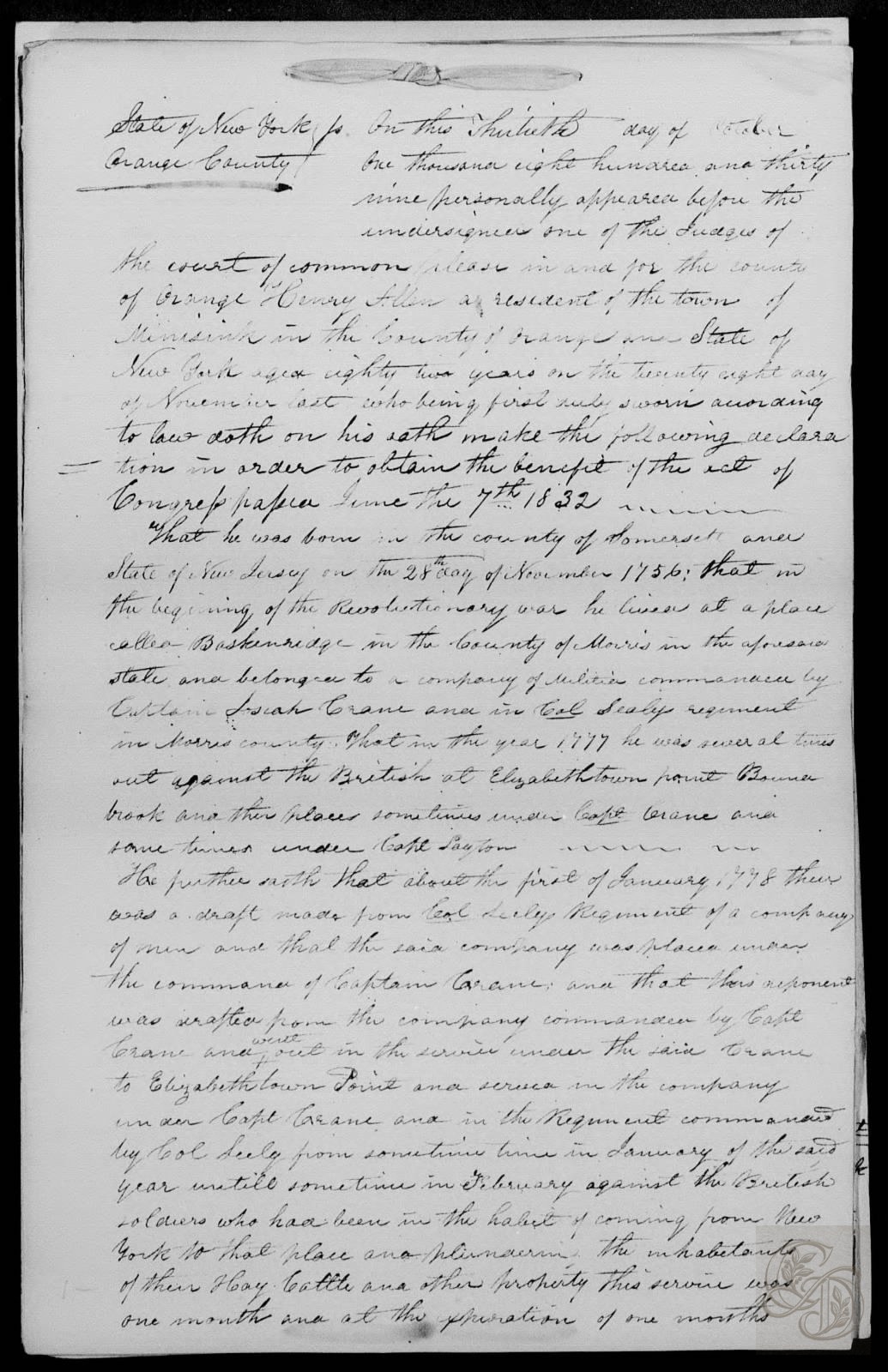
And Henry the pensioner stands between these two families, belonging to both. His declaration tells his story: born in Somerset County in 1756, at Basking Ridge as a young man — ten miles from Jacob’s Passaic River land. He served under Capt. Josiah Crane and Capt. Piatt of the 1st Jersey, fought at the Battle of Springfield, and was discharged in February 1782 for the “white swelling” in his knee. His congressman wrote to the Pension Office that he was a cripple from a disease contracted in the service of his country, and a very poor man. He signed by mark — he never was learnt to write — and he said the record of his age stood in his family bible at home. He died by December 1842. His widow Catharine — Catharine Fisher — signed her widow’s papers by her mark as late as 1851, and in 1853 their son David L. Allen swore in those same pension papers, “he is the Son of Henry Allen.”
From the record — Henry Allen’s pension declaration, October 30, 1839: Henry swore he was “aged eighty two years on the twenty eight day of November last” — a man of 82, counting his age from a family bible he no longer held, asking his country for a pension for the knee that had crippled him in its service.

So here is the family line, whole — and here is the break in it:
Ralph Allen of Sandwich → Jedediah → Henry (1679) → Jacob (1704) → Henry B. (abt 1732–1803)
— THE BRICK WALL —
Henry (1756–by 1842) → Henry Jefferson (1807) → Zelotus (1827) → George (1866)
Everything above the wall is proven, record by record, back to 1646. Everything below it is proven, record by record, down to my own family. The wall is the one joint between Henry B. Allen of Morris Township and Henry Allen of Basking Ridge and Minisink: no record in hand says, in so many words, that Henry B. was Henry’s father. No baptism. No deed from father to son. No estate paper naming him. Henry B.’s own will or estate has never been found — the Morris County probate books for 1803 sit behind FamilySearch Center walls, and those pages need to be pulled. The Morris tax lists carry a Henry Allen in Morris Township through the years of Henry B.’s life, and those full pages need to be pulled and read year by year. The Basking Ridge Presbyterian Church holds its own early records — pew rents from 1764, membership scraps from 1765 — and a baptism for a Henry born in 1756 would end this hunt on the spot.

How I come to this conclusion
Why Henry B., and not some other man? Five reasons, every one on a record:
1. Jacob’s will names his son Henry, a grown son in 1774, and that Henry — Henry B. — is buried at Morristown in 1803. He is the only Henry of his generation in that ground.
2. Henry the pensioner grew up at Basking Ridge, ten miles from where Henry B. lived and died. A boy is usually raised within walking distance of his father’s land.
3. The ages fit father and son exactly, and no other way. Henry B., born about 1732, was about twenty-four in 1756. The pensioner was seventeen when Jacob wrote his will — he cannot be the grown son the will names, and the will’s Henry died in 1803 while the pensioner lived until about 1842. Two men, one generation apart.
4. The cluster fits. Henry B.’s brothers Gilbert and Moses were rooted Morristown church men; Henry’s own ground — Basking Ridge, Bernards Town, where a Henry Allen was still buying small parcels in 1802 — is that family’s country.
5. There is no rival. The New Jersey marriage bonds hold no Henry Allen groom at all; the State Archives’ land records and the Somerset deed books hold no other Henry Allen of the right age in that ground.
That is my conclusion, with the reasoning on the table for anyone to test: Henry B. Allen was Henry Allen’s father. The hunt now is for the one record that says it in so many words.
Below the wall — the generations filled in
Henry Jefferson Allen (1807–1849) and Elizabeth Paddock. Henry’s son, counted in his aunt Martha’s kin in 1845, settled in Bradford, Steuben County. The Sussex County marriage register wrote his bride as “Eliza Podei” — the Paddock name as the clerk heard it; I carry Podei as the alternative spelling. Their daughter Louisa Minerva (Allen) Hall’s 1922 Pennsylvania death certificate names her father “Harry Allen” and her mother Elizabeth Paddock outright. By 1850 Elizabeth heads the Bradford household alone — a widow carrying the family, with young Zelotus, 20, farming beside her.


Zelotus Paddock Allen (1827–1902) and Nancy Ann French. Henry Jefferson’s son. The record keepers wrote his name ten ways — Zelotus, Zelotes, Zelatus, Zeltus, Telotes, Delotes, Ladous, Lutes, Lots, Z. P. — but the man is one: in his mother’s Bradford household in 1850; farming beside his brother Henry C. in Chatham, Tioga County, Pennsylvania, in 1860, and working in that brother’s household in Leicester, New York, in 1865, starting over; married Nancy Ann French at Chatham on September 26, 1867; died at Lawrence on April 9, 1902, and buried at French Hill — his wife’s family’s plot — as the Wellsboro Agitator carried it on April 16, 1902.

George Arthur Allen (1866– ) — who was a Short. Zelotus’s son, by Julia Keeney. George was raised in the house of his stepfather, George Washington Short, and carried the name Short — and when he married the first time, in 1890, and the clerk asked his father’s name, George wrote “John”: his best guess at a father he had never been told about. He learned the truth, dropped the Short name, and became George Allen. From George, the line runs down through Alvin Allen and Rex Allen to our family today — every generation on paper.
And then there is the DNA
Our Allen line’s DNA sits in John Barrett Robb’s ALLEN DNA Patrilineage 2 Project — entry A-26, tested out to 111 markers. The DNA of record is my half-brother Kenny’s test: he carries our father Rex Allen’s line, father to son, the whole way back.
What it says, plainly: we are not the colonial Allens. Our line matches neither George Allen of Sandwich nor Samuel Allen of Braintree. Our Ralph of Sandwich is a different Allen family from George of Sandwich — two households in the same town register — and the DNA agrees with the paper exactly. In Robb’s project, Henry Allen of 1756 stands as a patriarch of his own, the sign of a separate immigrant ancestor.
How close is the closest match? Not close. In Robb’s project tables, the nearest haplotype to ours belongs to a line running back to Sylvanus Allen (1823, Canada – 1865, Michigan) — and even that one differs from ours at 11 of the 111 markers tested. For scale: a true cousin match within the family-history centuries usually differs at five markers or fewer. Eleven is the distance of a shared ancestor many centuries back, before any of these men lived. Robb’s own analysis of our line’s haplotype, in his letters to me, counts nine mutations unique to our line — six of them in the first 37 markers alone — and his estimate is that our line diverged from the main Allen tree about the year 1450, give or take 150 years. That is why Henry stands as his own patriarch: the DNA says this family was already its own line, on its own path, generations before it surfaces in the New Jersey records.
That may be why this family has long been called the Indian Allens — said to have been fur trappers, living outside the colonial paper world. That is family tradition, not proof — I label it the way I label everything. But a line that matches none of the colonial Allens, surfacing in the New Jersey hills with a soldier who could not write his own name, is a line whose paper was always going to be thin. The DNA and the documents tell the same story.
How you can help — what would break this wall
This wall falls the day one record surfaces. Here is exactly what would do it — and if you can reach any of these, you can help break it:
- Henry B. Allen’s estate papers, Morris County, New Jersey, about 1803. The Morris County probate books for those years can only be viewed at a FamilySearch Center. If you visit one, this is the single most valuable pull: any will, administration, or inventory for a Henry Allen of Morris Township who died in 1803.
- The Morris County tax ratables, 1778–1822. Also FamilySearch Center-only. The Morris Township pages may show young Henry in his father’s household before he left for New York — every year a Henry Allen appears, and who he is taxed beside, matters.
- A baptism for Henry, about 1756–1757. The Basking Ridge Presbyterian Church holds its own early records — trustees’ records and pew rents from 1764, membership scraps from 1765. The Somerset County church books are the other place to look.
- Jacob Allen’s deed from John Holloway, before 1774 — the deed Jacob’s will describes. It has never been found in the county books or the State Archives’ land index; if it survives anywhere, it names the land this family stood on.
- Allen family bibles and papers from Morris or Somerset County. Henry’s pension declaration says his age was recorded in a family bible. Bibles surface in estate sales, historical societies, and family attics.
- A Y-DNA test from a male-line Allen descendant of Gilbert or Moses Allen of Morristown. One test would prove or break the chain above the wall.
If you hold any of these, or you can make one of those pulls, write to me at coni@conidubois.com — and if your Allens sat in Morris or Somerset County in those years, or a Henry, a Gilbert, or a Moses Allen of Morristown hides in your tree, I would love to hear from you either way. One web, two proven ends, and one break in the middle, waiting on one record.
Sources and references
- Henry Allen, Revolutionary War pension file R.115 (Catharine Allen, widow), National Archives M804, Roll 36 — declaration, affidavits, and correspondence, complete in 30 pages.
- Will of Jedediah Allen, Shrewsbury, September 15, 1711 — New Jersey Wills, Liber 1, pp. 350–355.
- Will of Jacob Allen, Morris Township, May 24, 1774 — New Jersey Wills, Liber 21, pp. 91–93.
- Shrewsbury Monthly Meeting registers (Quaker records) — marriages, p. 29; births and deaths, pp. 105, 131, 156–157.
- Sandwich, Massachusetts, town birth register — Jediah Allen, son of Ralfe, January 3, 1646.
- First Presbyterian Church of Morristown — burial register (Jacob Allen, 1779, p. 68; Henry Allen, 1803, p. 156) and the church history’s combined registers (the Allen elders and deacons, p. 128).
- Joseph Foster to Benjamin Bonnel, deed, October 28, 1765 — Morris County Deed Book A, folios 16–18.
- Will of David Allen, Minisink, December 7, 1840 — Orange County, New York, Wills 1840–1845, pp. 142–145.
- Will and probate citation of Martha Racket, Minisink, December 8, 1843, and November 24, 1845 — Orange County Wills 1845–1848, pp. 352–357.
- Sussex County, New Jersey, marriage register, 1795–1853 — Henry Alen to Eliza Podei, November 11, 1826 (recorded February 26, 1827).
- Death certificate of Louisa Minerva (Allen) Hall, Pennsylvania, August 27, 1922.
- Somerset County deeds, Vol. B, pp. 858–865 (1802); Orange County deeds, Vol. 35, pp. 319–320 (Cook to David Allen, 1817).
- The Wellsboro Agitator, April 16, 1902, p. 4 — “Farmington Affairs.”
- John Barrett Robb, ALLEN DNA Patrilineage 2 Project (johnbrobb.com) — entry A-26, and his letters to me, April 2016.
- Edwin Salter, The Allen Families of New Jersey (1884), and George W. Allen, Allen History and Genealogy (1937) — secondary works, used for leads and checked against the records.
Where to find these documents
- Fold3 and Ancestry — Henry’s pension file R.115, complete.
- Ancestry — the New Jersey will books, the Quaker meeting records, and the Pennsylvania death certificates.
- FamilySearch (free) — the Orange County probate books, the Sussex County marriage register, and the county deed books. The Morris County probate books and tax ratables can only be viewed at a FamilySearch Center.
- New Jersey State Archives, Trenton — and its free online databases, the Early Land Records database and the Colonial Marriage Bonds database. I searched both for this family; what they do not hold is part of the story above.
- Newspapers.com — The Wellsboro Agitator.
- The churches themselves — the First Presbyterian Church of Morristown, and the Basking Ridge Presbyterian Church (1 E. Oak Street, Basking Ridge), which holds its earliest records in-house.
- johnbrobb.com — the ALLEN DNA Patrilineage 2 Project tables.
My book on this line, The Allen Line: From Ralph Allen of Sandwich to Zelotus Paddock Allen, gathers every one of these documents — the full transcriptions and the record images themselves.
🕯️ Visit his candle: https://conidubois.com/book-nook/memorial-chapel/
© 2026 Ever Widening Circle Research by Coni Dubois LLC. All rights reserved.
Share this:

Discover more from Ever Widening Circle
Subscribe to get the latest posts sent to your email.
