Posted in Ancestor of the Week, Coni Dubois

Ancestor of the Week: The Sheriff Who Left a Paper Trail a Mile Long — Zachariah Green Trent (c. 1801–1860)

He was the law in Hancock County, Tennessee. He laid out roads, settled disputes, collected taxes, and owned 830 acres of East Tennessee farmland. He married three times, fathered children with each wife, and when he died around August of 1860, they buried him in the family cemetery in Sneedville.

This is my 4th great-grandfather — Zachariah Green Trent. And if Matilda, his third wife, is the mystery of my mother’s line, Zachariah is the anchor. He left a paper trail a mile long, and today I’m walking every inch of it with you.

The chain, so you can follow it home: me → my mom, Nancy Lee Gilbert → my grandma Mildred Marie Scheetz → Viola Beatrice Nickerson → Nancy Pratt → Caroline Trent Pratt → Matilda, Zachariah’s wife. Every step mother to daughter, and Zachariah stands right there beside Matilda at the far end of it.

The Offices He Held

Zachariah wasn’t just a farmer who happened to live in Tennessee. The records show a man his community trusted with real authority.

Justice of the Peace — appointed June 11, 1832, in Hawkins County, Tennessee. In frontier Tennessee, a justice of the peace wasn’t a ceremonial title. He married people, settled small disputes, witnessed documents, and kept the peace in a county that was still rough around the edges. When your neighbors pick you for that job, it says something about who you were.

1829 newspaper clipping showing Zachariah Trent appointed justice of the peace for Hawkins County, Tennessee.
Zachariah Trent appointed justice of the peace for Hawkins County — National Banner and Nashville Whig, November 7, 1829, p. 3. (Newspapers.com clipping.)

3rd Sheriff of Hancock County, Tennessee — serving 1849–1850. The third man to hold that office in a young county. He would have served papers, collected taxes, kept order, and ridden out to wherever he was needed. Hancock County in 1849 was mountain country — Sneedville, the Clinch River valley, farms carved out of ridges. Being sheriff there meant knowing every hollow and every family.

Now, I want to address something directly, because that’s how we do this. There’s a family story that Zachariah was killed in the line of duty as sheriff. I love that story — what genealogist wouldn’t? But his sheriff service ended in 1850, and he died around 1860. Ten years later. I have no record, no newspaper account, no county document confirming how he died. Until I find proof, it stays out of the fact column. It might even be a different ancestor entirely. Facts only. Always the facts.

The Land

On April 30, 1830, Zachariah acquired 830 acres from Samuel Nicholson. Then on March 18, 1833, he acquired additional land from William D. Trent and Alexander Trent.

Eight hundred and thirty acres. Let that number sit with you for a minute. In 1830 East Tennessee, that wasn’t a farm — that was an estate. That was a man building something meant to last, meant to pass down.

He shows up in the Hawkins County court minutes too: on juries laying out roads in 1831, 1836, and 1837. Present at court in August 1831. Involved in a writ for money owed in July 1838. On the 1836 Hawkins County tax list and the early Tennessee tax records. This is a man woven into the civic fabric of his county — not passing through, but planted.

U.S. federal census non-population schedule, 1850–1880, entry for Zachariah G. Trent

The Census Trail — Every Decade I Can Find Him

Here’s Zachariah walking through the federal census, decade by decade:

1830 — Hawkins, Tennessee. Seven people in the household. He’s a young man building a family. (NARA Series M19, Roll 178, Page 83.)

1830 U.S. federal census, Hawkins County, Tennessee, listing the household of Zachariah Green Trent

1840 — Knox, Kentucky. Just two in the household this time. The family was in transition — and if you’ve followed my Brick Wall Wednesday on Matilda, you know these were complicated years. (NARA M704, Roll 116, Page 315.)

1840 U.S. federal census, Knox County, Kentucky, listing the household of Zachariah Green Trent

1850 — Sneedville, Hancock County, Tennessee. He’s here with Matilda now, listed as his wife. (Subdivision 32, Roll M432_881, Page 25B.)

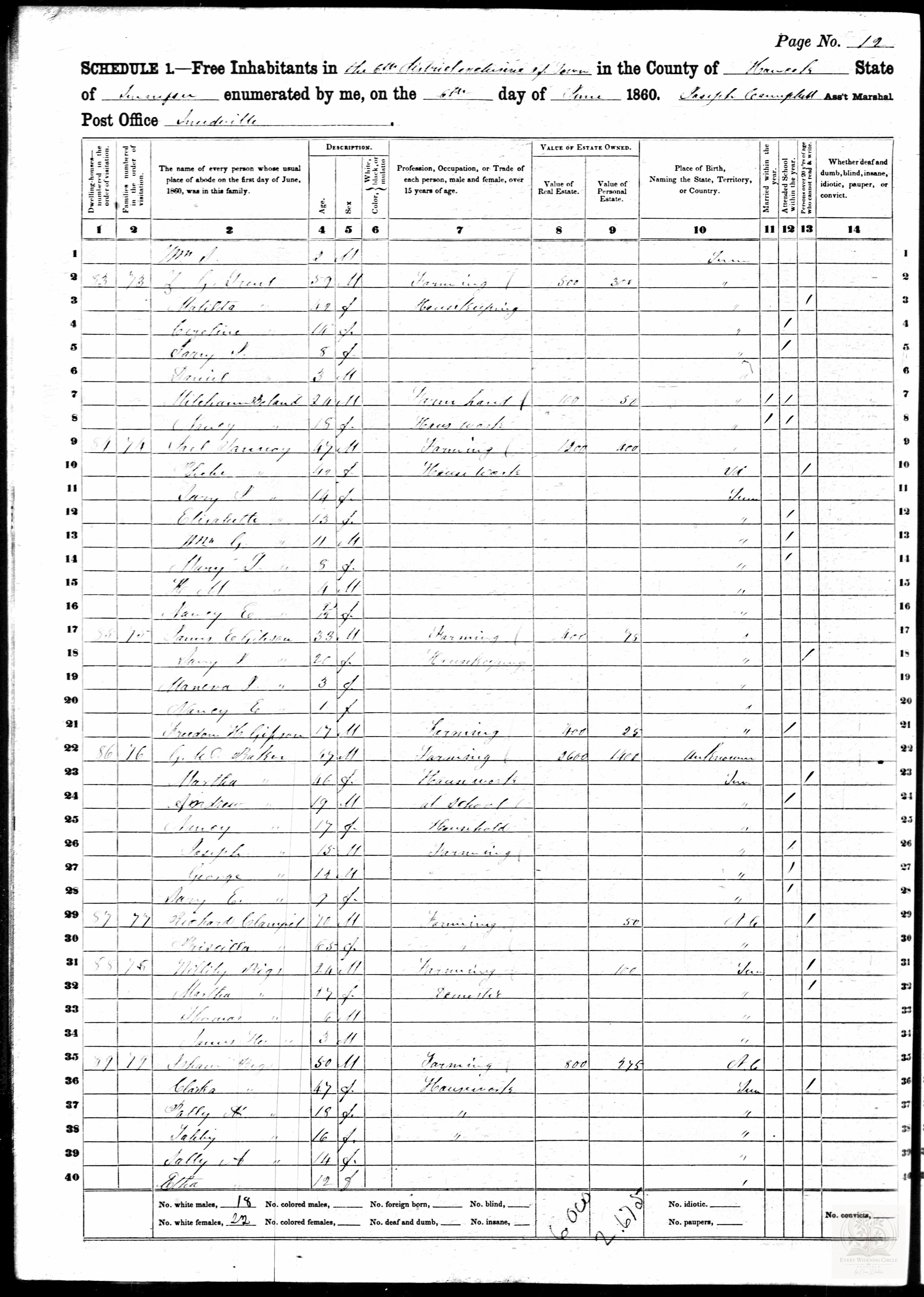
1860 — Sneedville, Hancock County, Tennessee. Age 59, farming, with Matilda. And here’s the part that makes every genealogist smile: the enumerator mangled the surname as “Z G Lunt.” Lunt! If you’re searching for this family and can’t find them, try the mangled versions. Enumerators, bless them.

1860 U.S. federal census, Sneedville, Hancock County, Tennessee, showing Zachariah G. Trent enumerated as "Z G Lunt"

That 1860 census is the last time anyone sees Zachariah on paper. He died about August 1860, in Sneedville. He’s buried in the Trent Cemetery there — Find a Grave Memorial #130592796.

About His Name

You’ll find him as Zachary, Zachariah, and Zechariah Green Trent — and in the records themselves as Zachari, Little Zack, Zak, Zackie, “Z G Trent,” even “Zackasi Trent” and “Fackariah Trent.” I’m mentioning it once so you can find him when you search. That’s just genealogy — names shift like sand, and his is no exception.

Three Marriages

Zachariah was married three times that I can document. Here’s each one, honestly laid out:

1. Naomi Taylor Greene — married 1818, Hawkins, Tennessee. Naomi was born January 7, 1801, in Rowan County, North Carolina, daughter of Jeremiah and Anne (Hartley) Greene. Her maiden name was Taylor — she’d married a Greene first, and was known as Naomi Greene when she married Zachariah. She died December 26, 1877, in Morristown, Hamblen County, Tennessee, and she’s buried in the old city cemetery there.

Seven children I can document: Nancy Trent, John Hicks Trent, James William Trent, Stokely Donaldson Trent, Manila Trent, Cinthea Greene Trent, and Mary Jane Trent. Manila married Jefferson Baker, and their descendants carry this line forward.

2. Myra Singleton — “partners” about 1832, Hawkins, Tennessee. I want to be careful here: the record doesn’t call this a marriage. It says “partners.” Myra (also recorded as Mira, Miriah, Miry) Singleton was born between 1812 and 1814 in Lee Valley, Hawkins, Tennessee. Their children carried “Singleton” as a middle name: Frances “Frankie” Singleton Trent and Lucinda Singleton Trent. There may have been a third girl, Rhoda. Myra later appears as Myra Lawson — she married a Lawson after Zachariah. The records give me “partners, 1832,” and that’s what I’m reporting.

3. Matilda — wife by the 1850 census. My Matilda. She appears as Zachariah’s wife in the 1850 and 1860 censuses. I have no confirmed marriage date for them. Four children I can document: Sarah Jane Trent, Caroline M. Trent, Nancy Trent, and Daniel Lewis Trent.

Now here’s a confusion I want to flag for fellow researchers, because it will trip you up: Zachariah had two daughters named Nancy — one by Naomi (the elder) and one by Matilda. As descendant Caroline Tassey wrote to me: “the two Nancy Trents has caused much confusion.” She’s right. When you’re researching this family, always check which Nancy.

Caroline’s Obituary — The Daughter Who Carried the Line

Caroline Trent Pratt — Zachariah and Matilda’s daughter, my 3rd great-grandmother — got a beautiful sendoff in The Argos Reflector on November 13, 1919. Born June 12, 1845, in Hancock County, Tennessee, she married William Harrison Pratt in 1865, and the paper called their marriage “one long happy and harmonious experience.” Ten children, twenty-nine grandchildren living, four great-grandchildren. She died November 5, 1919, at 74, a faithful member of the Church of Christ at Francesville, Indiana. Through Caroline, Zachariah’s blood runs straight down to my mother, my grandmother, and me.

Her death notice ran in the Weekly Republican the same week (November 13, 1919, p. 5) — and it spells her name “Tratt.” Another variant for the search files. It notes she died Wednesday at 2:45 at her daughter Mrs. Jesse Tomlinson’s home in Argos, suffered a stroke the Saturday before, and her body was shipped Friday to Francesville, Indiana for funeral services.

William Pratt, Caroline Trent Pratt, and Orville Nickerson standing outside a house, early 1900s.
William Pratt and Caroline Trent Pratt with Orville Nickerson (center). Caroline was Zachariah and Matilda’s daughter — my 3rd great-grandmother. (Family photo, identifications handwritten on the back.)

Pictured left to right: William Harrison Pratt (my 3rd great-grandfather), Orville Nickerson (center), and Caroline Trent Pratt (my 3rd great-grandmother, Zachariah and Matilda’s daughter). The identifications are handwritten on the back of the original — it’s a real photo postcard from the early 1900s, the kind families mailed to each other.

The DNA Backs the Paper

My files carry a research note: “3 Trent lines and their DNA.” A Family Tree DNA Trent Project participant descends from William D. Trent Sr. and Charity Burton — and also from Zachariah G. Trent and Naomi Greene. The Y-DNA results show the William D. Trent line matches the Trent lines of Campbell County, Virginia, including the lines of Alexander Trent.

Zachariah was the son of Alexander Trent, who served in the War of 1812 — and Zachariah was Alexander’s heir, with a War Bounty Land Warrant in his name as Alexander’s heir. The Trent Y-DNA results fall into three distinct groups, and the East Tennessee/Campbell County group — which includes Zachariah’s line — all match each other.

What that means: the DNA supports the paper trail connecting Zachariah to Alexander Trent to the Campbell County, Virginia Trents. The paternal side is solid.

A Same-Name Warning

Fellow researchers, heed this one. In my files there are two Confederate Civil War records for a “Zachariah Trent” — a private in Capt. Patteson’s Company, Virginia Heavy Artillery (Campbell Battery), enlisted March 5, 1862.

That is not our Zachariah. He died about August 1860 — two years before that young man enlisted. This is a different, younger Zachariah Trent, and it’s exactly the kind of same-name trap that can send your research sideways for months. As Caroline Tassey warned me: “there were two Zachariah Trents at that time.” Always check the dates. Always.

What I Still Don’t Know (The Honest List)

How he died. The killed-in-service story is unproven — no record, no newspaper, nothing. It stays out of the fact column until I find proof.

Whether the Native ancestry claim holds. Family tradition says Zachariah was reported to have Native ancestry, and the Bolin line connects to Saponi tradition. But it’s a family/research claim, not a proven fact. I’m still digging.

His exact birth year and place. Between 1801 and 1803, Grayson County, Virginia — though one source says Hawkins, Tennessee. Census ages wander, as we all know.

Why He Matters

Zachariah Green Trent is my 4th great-grandfather, and he’s the reason the Trent line has a paper trail at all. Matilda may be the mystery — but Zachariah is the proof that the family was real, rooted, and respected. A justice of the peace. A sheriff. A landowner. A man whose name shows up in court minutes, tax lists, land deeds, and census rolls across three decades.

And through his daughter Caroline — my 3rd great-grandmother, who married William Harrison Pratt and carried the family from Tennessee to Kentucky to Indiana — his blood runs straight down to my mother, my grandmother, and me.

He left a paper trail a mile long. I just walked it with you.


#ad — My Temu Pick for This Week

LED magnifying glass for reading old records — If you’re squinting at census images like the “Z G Lunt” mangling above, or trying to read 1830s handwriting on a land deed, this is the tool that saves your eyes. Bright LED light, large lens, and it makes those faded enumerator scribbles actually readable. I use mine constantly.

(Affiliate link — I earn a small commission if you buy, at no extra cost to you. Thank you for supporting the research!)

#ad


Sources

  • Justice of the Peace appointment, June 11, 1832, Hawkins County, Tennessee
  • Justice of the Peace appointment — National Banner and Nashville Whig (Nashville, TN), November 7, 1829, p. 3 (Newspapers.com)
  • 3rd Sheriff of Hancock County, Tennessee, 1849–1850
  • Land acquisition: 830 acres from Samuel Nicholson, April 30, 1830; additional land from William D. Trent and Alexander Trent, March 18, 1833
  • Hawkins County court minutes: road juries (1831, 1836, 1837); present at court (August 1831); writ for money owed (July 1838)
  • 1836 Hawkins County tax list; Tennessee early tax records
  • U.S. Federal Census: 1830 Hawkins, TN (NARA M19, Roll 178, Page 83); 1840 Knox, KY (NARA M704, Roll 116, Page 315); 1850 Hancock, TN (Roll M432_881, Page 25B); 1860 Hancock, TN (NARA M653, Page 462 — enumerated as “Z G Lunt”)
  • US Selected Federal Census Non-Population Schedules, 1850–1880 — Zachariah G. Trent
  • War Bounty Land Warrant — Zachariah Green Trent, heir of Alexander Trent (War of 1812)
  • Find a Grave Memorial #130592796 — Zachariah Green Trent, Trent Cemetery, Sneedville, Hancock County, Tennessee
  • Tennessee State Marriages, 1780–2002 — Caroline M. Trent marriage record
  • Obituary of Mrs. Caroline Pratt, The Argos Reflector, November 13, 1919, p. 1 (courtesy Marshall County Historical Society, Plymouth, Indiana — researched by Judy McCollough, Historical Archive Manager, April 2003)
  • Death notice of Mrs. Caroline Tratt, Weekly Republican, November 13, 1919, p. 5 (courtesy Marshall County Historical Society, Plymouth, Indiana)
  • Caroline Trent Pratt death certificate, Marshall County, Indiana, Certificate #307 (father “Zachari Trent”)
  • Family Tree DNA Trent Project — Y-DNA results, East Tennessee/Campbell County group
  • Brick Wall Wednesday #1: Matilda — Who Was She Before She Married Zachariah Green Trent? (conidubois.com) — companion piece on Matilda
  • Personal correspondence: Douglas Trent to Rhonda Yamauchi, June 2003; Caroline Tassey to Coni Dubois, May and September 2013

Who do you want to see next? Tell me below.

© 2026 Ever Widening Circle Research by Coni Dubois LLC. All rights reserved.

Posted in Coni Dubois, Coni's Stuff, Ken Feder, Travel, Tribal

Ancestor of the Day #2: Ernest Emmit Griffith — The Morning the Dynamite Went Off

Oval studio portrait of Emmett Griffith, a young man in a suit and tie, circa 1910s

He was 26 years old, a farmer in Whitney Township, Michigan, and he died at 11:30 on a Thursday morning — September 23, 1915. His death certificate says it in handwriting I can read plain as day: “Dynamite Shot (accidental).”

Watch the Ancestor of the Day short film:

Michigan certificate of death for Emmet Griffith, died September 23, 1915 — cause of death written as 'Dynamite Shot (accidental)'

Ernest Emmit Griffith was my great-grandfather. The newspaper called him Emmett. The death certificate calls him Emmet. My own research files say Ernest Emmit. I believe they’re all the same man — records spell names the way ears heard them — and his mother’s name wobbles the same way: Cortright, Courtright, Cartnight. I grew up hearing “Cartright.” That’s how family history really sounds.

Here’s what happened that morning, from the Arenac County Independent, September 23, 1915 — “EXPLOSION KILLS TWO MEN”:

Emmett Griffith and 19-year-old Robert Smith were blowing up stumps, clearing farmland the way everybody did it then. They sat down on a log to rest a moment. Beside them sat a pail holding 20 sticks of dynamite, a quantity of dynamite caps, and fuse. Both men were smoking, and the supposition is that a spark from one of their pipes fell into the pail. The explosion came a few minutes after they sat down.

Griffith had both legs blown off near the thigh and was otherwise mangled. He lived two to three hours. Smith lost a leg and an arm and died about five o’clock that afternoon. Both men regained consciousness before they died, and both told the same story. The funerals were held Saturday and Sunday.

Here is the article itself, word for word:

“Explosion Kills Two Men: Two Delano Farmers, Robert Smith and Emmett Griffith, Have Fatal Accident with dynamite. As a result of a premature explosion of 20 sticks of dynamite, the lives of two well known Delano farmers were snuffed out last Thursday. Emmett Griffith and Robert Smith were blowing up stumps and had set down on a log to rest a moment. Near them was a pail containing 20 sticks of dynamite, a quantity of dynamite caps and fuse. They both were smoking and the supposition is that a spark from one of their pipes fell into the pail and caused the explosion which occurred a few minutes after they had seated themselves. Griffith had both legs off near the thigh and otherwise mangled. He lived for only two or three hours after the accident. Smith had one leg and one arm blown off and suffered other severe injuries. He died about 5 o’clock that afternoon. Both men regained consciousness before they died and told the same story as to how the accident occurred. The funerals were held Saturday and Sunday. Griffith was 26 years old and leaves a widow and one child. Smith was 19 years old and single. The sympathy of the entire community is extended to the bereaved relatives.”

— Arenac County Independent, September 23, 1915 (transcription contributed by Penny Bliss, MIGenWeb Arenac County; the clipping in Coni’s research files is credited to researcher Penny Carney)

He was buried September 25, 1915, at Sims-Whitney Cemetery in Au Gres — the same Griffith family plot I wrote about here on the blog back in 2014: http://conidubois.com/2014/07/08/griffith-family-plot-sims-whitney-cemetery-also-known-as-point-lookout-cemetery/

Now here is what the newspaper didn’t know, or didn’t print. Ernest had married Lucy Genevieve Amo on March 29, 1909 — he was 19, she was 26. They’d already buried a baby boy, Murther, who died of cholera at five months in 1911. And five weeks before that dynamite went off, on August 19, 1915, Lucy gave birth to a daughter. That baby grew up to be my grandmother.

The paper said he left “a widow and one child.” My records say more than that. I report the paper’s words as written — and I keep my own count beside them. That’s the pledge: the record, honestly, even when the records argue with each other.

He was 26. A farmer. A husband. A father who never got to watch his youngest grow up. The clerk wrote “Dynamite Shot (accidental)” and moved on to the next certificate. I don’t move on. He’s mine.

Outdoor photograph of Emmett Griffith standing beside his seated wife Lucy Amo Griffith, who holds their small child on her lap, circa early 1910s

🔍 LOGO HUNT: I hid my Ever Widening Circle logo somewhere in the family photo above — first one to spot it and tell me in the comments gets a shoutout in tomorrow’s Ancestor of the Day!

🗳️ YOU PICK ANCESTOR #3: Starting today, YOU vote who I feature next! Here are your three choices:

  1. Lucy Genevieve Amo (1882–1947) — Ernest’s widow. She buried her dynamite-killed husband in September 1915… and was married again by the next August. Then married a third time. The dynamite widow with three husbands.
  2. Clorenda Rose Short Barber Porter (1838–1912) — my 3rd great-grandmother. In July 1912 her husband, a Civil War veteran, died at 9 PM — and two hours later, shattered by the shock, she walked onto the porch, cried out, and fell dead in the farmhand’s arms. The coroner wrote her cause of death as “a shock occasioned by the death of her husband.” They were buried in a single grave.
  3. Theodore James Barber (1835–1863) — he marched off with the Union’s 57th Pennsylvania at 28 and never came home from Chancellorsville.

Vote in the comments below (or in the Facebook group poll) — winner gets featured next, and I’ll read out the results in tomorrow’s post. Get your people voting!

Your turn: Has a sudden death ever rewritten your family tree in a single day? Tell me in the comments.

Tomorrow afternoon: another ancestor, another record. And remember — one Ancestor of the Day each week is YOUR ancestor. Brick wall? Send it through my contact form at https://conidubois.fyi/contact.

— Coni

Sources: State of Michigan Certificate of Death, Arenac County, Whitney Township (Sept 23, 1915 — Coni’s files) · “EXPLOSION KILLS TWO MEN,” Arenac County Independent, Sept 23, 1915 (transcription at MIGenWeb Arenac County https://migenweb.org/arenac/wp-content/uploads/2023/04/d-explosion-kills-griffith-smith-bliss.pdf, contributed by Penny Bliss; the clipping in Coni’s research files is credited to researcher Penny Carney) · Individual Report for Ernest Emmit Griffith, by Coni Dubois (1900 & 1910 U.S. Federal Census; Michigan Marriage Records; Michigan Deaths and Burials Index; Find A Grave #62841351) · Griffith Family Plot @ Sims-Whitney Cemetery http://conidubois.com/2014/07/08/griffith-family-plot-sims-whitney-cemetery-also-known-as-point-lookout-cemetery/ (this blog, 2014)

#AncestorOfTheDay #EverWideningCircle

Posted in Coni Dubois, Coni's Stuff, Tribal

2026 Native American record releases and how to use them for research

This spring two major things happened at once. FamilySearch pushed a huge batch of new and re-indexed records in its April 2026 update, over one billion records total, and inside that update was an expansion to the core Native collection: United States, Native American, Census Rolls, 1885-1940. At the same time the National Archives and Records Administration has been finishing a multi-year push to get Bureau of Indian Affairs records out of the basement and online, including a new BIA Photographs Finding Aid and near-complete digitization of the most-used BIA microfilm publications in Record Group 75.

The center of all of this is NARA microfilm publication M595, Indian Census Rolls, 1885-1940. It is 692 rolls of annual censuses that Indian agents were required to file after an Act of Congress on July 4, 1884. This is not the regular federal census. This is the reservation census taken every year, often on June 30. If your ancestor was enrolled and living on or near a reservation, they should be in M595. The information changes by year. Early years are just name, age, sex. By the 1920s and 1930s you often get English name and Indian name, roll number, age, sex, relationship to head of household, marital status, degree of blood, and sometimes allotment or residence notes. NARA now has these rolls digitized in its Catalog as Indian Census Rolls and they are also on microfilm as M595, and copies are on FamilySearch, Ancestry and Fold3.

FamilySearch also maintains state-specific slices of the same film, most notably Washington, Native American, Census Records, 1880-1952. If you have Northwest ancestry it is worth searching both the national collection and the Washington collection because indexing was done at different times and a name that is missing in one can appear in the other. The national collection recently had 112 newly indexed entries added, which sounds small but each entry unlocks a full page of relatives.

There is a second collection that most people miss: United States, Native American Birth and Death Records, 1885-1940. This is the birth and death supplement that was filed with the annual rolls, especially for 1925 to 1933. When it is present it gives you census roll number, surname and given name, date of birth or death, sex, tribe, ward status, degree of father’s blood, degree of mother’s blood, degree of child’s blood, and whether the person was at the jurisdiction where enrolled. For western reservations like Western Navajo this supplement is often on roll 644 and similar rolls.

The NARA side is equally important. NARA has said that digitization of the most heavily used BIA microfilm publications in RG 75 is about 95 percent complete, including records that used to be held in Anchorage for Alaska Natives. That includes school censuses, allotment records, and annuity rolls. In early 2026 NARA also expanded its BIA Photographs Finding Aid, which finally brings together photos that were scattered across regional facilities. You can now search by tribe, school, or agency. For boarding school history, the National Indian Boarding School Digital Archive is building a parallel portal and so far offers records from nine schools including Chemawa, Carlisle Indian Industrial School, Cushman Indian School in Tacoma, and Pipestone Indian School. NARA itself also holds school land and building records and maps that can help you pinpoint where a school was and what records might exist for it.

How to use it all together in practice. Start with one solid hit in M595. Write down the agency name exactly as written, the year, the roll number, and the page number. Then browse that same agency three years before and three years after. Agents kept families in the same order year to year, so you can track births, deaths, and marriages even when the index fails. Pay attention to the roll number column. A sudden new number often means marriage to someone from another family or enrollment from another agency. Note the remarks column, it often says died, married, transferred, or dual enrollment.

Once you have a cluster of years, pull the birth and death rolls for that agency. That gives you exact dates and parental blood degree, which you will need for lineage packets. Then go to NARA’s Indian Census Rolls page and its tribal rolls overview. If your family is one of the Five Civilized Tribes in Indian Territory before 1907, M595 is just a clue. You will need to go to the Dawes Commission Final Rolls and enrollment cards. For almost every other tribe, you will want to use the agency and years you found to ask for that tribe’s base rolls, allotment rolls, and other enrollment lists in RG 75. The government has never created one master list of all Native Americans, so you have to work agency by agency.

For organizing and sharing, make a simple packet per ancestor. One folder with all M595 images for that person across years, one image of the birth or death roll, any BIA photo or school attendance record, and a full citation that reads NARA M595, Indian Census Rolls, 1885-1940, roll number, agency, year, and line or family number. Tribal enrollment offices and family members both want the citation, not just a screenshot.

Finally, search the same name in three places. FamilySearch search, the NARA Catalog, and Ancestry or Fold3 free at a library or NARA facility. All three use the same M595 film but different handwriting interpretations. If you search all three you will find about twenty percent more relatives that one index alone would miss. If you have a surname and a state or a suspected tribe, start with M595 and then layer the birth and death rolls and the photo finding aid. That combination is what makes the 2026 releases so powerful.

Core Links:


1. FamilySearch April 2026 overview listing the United States Native American Census Rolls 1885-1940 as an expanded collection: https://www.familysearch.org/en/newsroom/new-free-historical-records-from-31-countries-april-2026-update

2. Detailed list of April 1-30 2026 new and updated collections on The Ancestor Hunt which mirrors FamilySearch release notes: https://theancestorhunt.com/blog/familysearch-new-and-updated-collections-april-1-30-2026/

3. FamilySearch collection page for United States Native American Census Rolls 1885-1940 collection ID 2761958 which is NARA microfilm M595: https://www.familysearch.org/search/collection/2761958

4. FamilySearch collection page for United States Native American Birth and Death Records 1885-1940 the supplement that gives blood degree and birth dates: https://www.familysearch.org/search/collection/2765178

5. NARA main page for Indian Census Rolls 1885-1940 explaining M595 is 692 rolls and how to access the digitized series in the National Archives Catalog: https://www.archives.gov/research/native-americans/census/research-indian-census.html

6. NARA guide to Bureau of Indian Affairs Records Tribal Rolls Record Group 75 explaining that there is no single master list and rolls were created by agency: https://www.archives.gov/research/native-americans/rolls

7. NARA article Increasing Access to Native American Records describing the new BIA Photographs Finding Aid: https://www.archives.gov/about/speeches/2022/increasing-access-native-american-records

8. NARA guide to BIA Boarding School Records including land and building records and where maps are held: https://www.archives.gov/research/native-americans/schools

9. NARA other Indian School Records list with sample entries like Sisseton Agency School Attendance Records 1922 and notes about photographs through the BIA Photographs Finding Aid: https://www.archives.gov/research/native-americans/schools/school-records-more.html

10. For general context on M595 use and the 1884 law requiring annual agency censuses: https://www.archives.gov/research/native-americans/census/research-indian-census.html

11. If you want to browse all FamilySearch Native American resources in one place: https://www.familysearch.org/en/wiki/United_States_Native_American_Records

Posted in Coni Dubois, Coni's Stuff

LINEAGE LOG – DUBOIS KINSHIP PRESERVATION SERIES


The document “LINEAGE LOG – DUBOIS KINSHIP PRESERVATION SERIES.pdf” is a comprehensive genealogy workbook created by Coni Dubois.

It is designed as a professional working archive to meticulously document family history. The workbook provides structured templates for recording a wide variety of genealogical data, from basic relationships and vital records to oral histories, migration patterns, property ownership, military service, and family artifacts.
Key Features and Organization

This Revised & Expanded Edition contains a Master Index that outlines 30 distinct, purpose-driven worksheets to help researchers organize their findings. The 34-page PDF is fully fillable, allowing readers to type directly into the fields. Four worksheets are brand new to this edition: Research Plan & Next Steps, Ancestor Timeline, Tribal & Native Heritage Record, and DNA & Genetic Genealogy.

The major categories include:
* Core Ancestral Profiling: Includes individual biographical data, vital record analysis and mapping, ancestral profiles, and a master family profile for lineage reconstruction.
* Family and Household Reconstruction: Features dedicated logs for spouses and unions, children of those unions, grandchildren summaries, and household census extractions.
* Research and Evidence Tracking: Provides structured sheets for a master source and citation log, an evidence review and lineage proof summary, and a log for research notes and findings.
* Historical and Cultural Context: Contains an ancestor profile deep-dive for narrative biographies, migration and movement logs, and a dedicated worksheet for family legends and oral histories.
* Specialized Historical Records: Includes highly specific templates for logging land and property records, military service data, occupation and skills profiles, community and social standing, medical and health histories, religious and spiritual life, and economic and financial profiles.
* Artifact and Media Preservation: Features an heirloom and artifact catalog, as well as a two-part photographic record index to catalog family objects, provenance, and historical images. Each worksheet is designed with verification checklists at the bottom to ensure all sources are cited, dates are verified, and relevant data is fully confirmed.

TO DOWNLOAD: Click Here

Posted in Coni Dubois, Coni's Stuff

🌳 Genealogy Friends! 📜
I created this Tips for Beginning Genealogists graphic to help anyone starting their family history journey. Genealogy can feel overwhelming at first, but a few good research habits can make all the difference!

Feel free to save it, share it, and pass it along to anyone learning about family history. The more we help each other, the more stories we preserve for future generations.

Remember:
✨ Record your facts
✨ Cite your sources
✨ Look for patterns
✨ And always follow the records!

Happy ancestor hunting!
— Coni
Visit: www.conidubois.com

Posted in Coni Dubois, Ken Feder

100th Anniversary of People’s State Forest Oct 6th, 2024

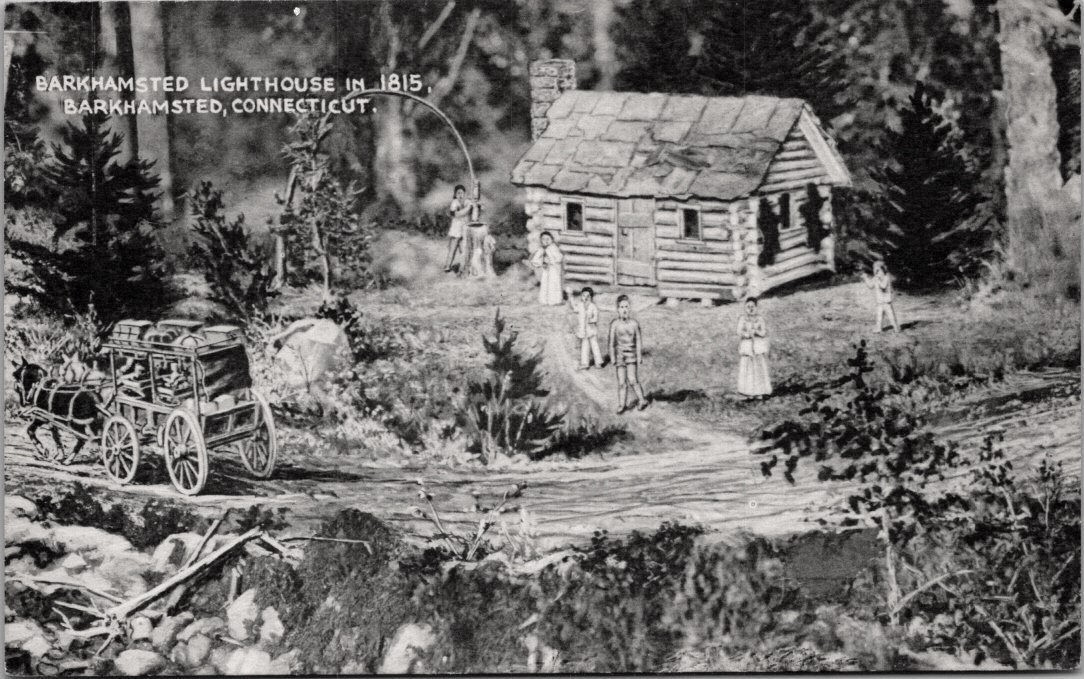
Celebrating the 100th Anniversary of People’s State Forest in Barkhamsted, Connecticut is home to three of the state’s designated State Archaeological Preserves. Ken Feder directed the excavation of two: the metaphorically named Lighthouse community and the 2,850-year-old Walter Landgraf Soapstone Quarry.

On Sunday, October 6th, at Matthies Grove in Peoples State Forest, East River Road, Barkhamsted, FALPS and the State of Connecticut celebrated the true essence of the “Peoples” State Forest. Attendees delved into its founding, participated in forest-related activities, watched oxen pull logs to a portable sawmill and observed the loggers milling the wood. They enjoyed a chain carving contest and witnessed dignitaries plant a ceremonial tree, among many other engaging events.

Both Robert Starr and Ken Feder remarked that it was a splendid day filled with beauty and history.

FALPS : FALPS is a group that works diligently and tirelessly to improve our forests, keep the trails clear, build bog bridges and boardwalks and fun year-round hikes and events to benefit those who visit the area.

Note: I’ll add any newspaper article links or photos of the event as they come in. Unfortunately, I couldn’t make it to the event, but I can’t wait to see all the photos taken.

CT Visit & ct.org

L2R: Sites Archeologist Ken Feder &
Light House Descendant Robert Starr
Photo credit: Ken Feder
L2R: Ken Feder & Ginny Apple
L2R: Ginny Apple & Robert Starr – Photo credit: Robert Starr
Ken Feder Photo credit: Robert Starr
Display by: Ginny Apple (based off archeological places of site)
Photo credit: Robert Starr
Posted in Coni Dubois, Coni's Stuff

Interested in checking out my YouTube channel? I’d love for you to take a look!

Photo AI created/generated @conidubois

To view:

Coni Dubois YouTube Channel

As I prepare for the Barkhamsted Lighthouse Gathering, which marks its 10th year since its inception, I am also revamping and modernizing my various social media channels. My goal is to streamline all of my content and make it easily accessible. Additionally, I am working on creating new research materials for the upcoming occasion.

With that said, I have tons to share and more stories to tell and looking forward to catching up with everyone.

🤗 Coni

Posted in Coni Dubois

🚨 Calling all Barkhamsted Lighthouse Village People

  Mark your calendars for October 5th and 6th, 2024 because it’s going to be a celebration like no other! We are thrilled to announce that it will be the 100th anniversary of Peoples Forest and we want all descendants to be a part of it. Whether you can make it or not, you are welcome to join in on the festivities. It’s going to be an unforgettable event!

Note: Map Date 6/18/2009 (need newer version)

Sunday, October 6th, 11:30 a.m.-4:30 p.m., Matthies Grove, Peoples State Forest, East River Road, Barkhamsted. Come join FALPS and the State of Connecticut in celebrating what truly is the “Peoples” State Forest. Learn about its founding, watch and participate in various forest-related activities, see oxen pull logs up to a portable sawmill and watch the loggers mill the wood, watch a chain carving contest, join dignitaries in planting a ceremonial tree and much more. Free and open to all.

Hi everyone 👋

The Barkhamsted Light House Village has been experiencing a lot of great things lately and I am excited to announce an upcoming event that everyone should know about. Although I am not certain if I can attend (it is marked on my calendar as a possibility), I am considering organizing a virtual alternative for event if not going to make it. I hope many will plan to attend this amazing event.

Help Us Celebrate 100 Years!

Barkhamsted forest group receives funding for film, study – By Emily M. Olson, Staff Writer – Oct 31, 2023

_________________________________________

Couple messages sent to family on event:

1. Via Facebook Messenger from Ginny Apple to Coni Dubois

Hi Coni. Hope you’re doing well. I don’t know if you know it or not, but the Friends of American Legion and Peoples State Forests are, in concert with DEEP, planning the 100th Anniversary Celebration of Peoples State Forest on October 6th from 11:30 a.m. to 4:30 p.m. at Matthies Grove in Peoples State Forest. 

We believe a presence of the Lighthouse Community family would be an important addition to the event.

We have planted around 60 trees already, in Celebration, and will be joined by the Governor and the DEEP Commissioner for a ceremonial tree planting.

We hope that you’ll be able to come and, as such an important part of the history of the Forest, it would be a major presence for us.

Hope all is well. 

Thanks, 

Ginny

________________________________________________

2. Via email from Paul Hart to Coni Dubois

Hi Coni-

Hope all is well with you.  I just wanted to let you know that we are planning for a big celebration for the 100th anniversary of Peoples Forest.  Peoples was dedicated on October 4, 1924. They had a huge event with thousands of people attending back then.  Our plans are coming together for a two day celebration: on Saturday evening, October 5 we will have a kickoff gathering, and then on Sunday October 6 during the day, we are going to have a bunch of programs, exhibits and displays recognizing this important birthday of Peoples Forest, which is a resource much appreciated by the community here.  This will all take place in the Matthies Area (more or less across from Squire’s Tavern).

 Let me know your thoughts and wish you the best.

Paul Hart

Barkhamsted Historical Society

_______________________________________

Hope many that live close will be able to attend 🤗

Posted in Sherry Lyn Carsten

Reclaiming our Native American Culture…

I have known my whole life that my maternal grandmother had Native American ancestry. When I was a teenager my US History teacher gave us some extra credit work of creating a family tree. So I went to my grandmother and asked her to share what she knew.

This image has an empty alt attribute; its file name is 6319a286-b77f-4bc8-b83d-35ea76fb264a.jpg
Ruth Ann, Edith and Sherry (unknown date)

Her grandfather was Frederick Roy Webster. And he claimed to be the grandson of an Indian Chief in a newspaper article about their wedding anniversary as well as his obituary. He was the son of Solomon “Ol Sol” Webster and Mary Wilson (Though his death certificate states his mother was Sarah Charugn, which is completely wrong). As stated in a previous blog, Solomon was the son of Montgumery “Gum” Webster of Mehegan descent. Mary Wilson was the daughter of William P. Wilson Jr and Harriet Wilson. William was the grandson of James Chagum (of Narragansett descent) and Molly/Mary Barber, of the Lighthouse Village in Barkhamsted, Connecticut.

This image has an empty alt attribute; its file name is 38092bbf-7f73-495c-a8c5-07bafe80d6c6.jpg
Fred Webster Family
(I got the photo from my grandmother Edith Webster Lash (daughter of Bert), she told me that this was her father’s family on the day of her mother’s funeral (July 1921) it was with other photos of Berts girls with their cousins, Nora’s daughters. Grandma had all the names right except for Almo & Bryon Judson Price, I sent this photo to Onalee Ordiway Potter (Byron’s granddaughter) & she named the people. Also the date on the photo says “OCT 56” this can’t be, since both Mary & Fred Webster died in 1942)

…Some in Michigan are Living…

Calling me back “home,” beckoning me is a little piece of land. Ironically it is called Barkhamsted Lighthouse. I ponder the inhabitants of the Lighthouse “Tribe” even thought what it’s name would mean to those coming after them. To me it is a beacon deep in my heart. A passion that was my mother’s and my grandmother’s to stand where the Websters & Chagum’s once stood. To see the old cemetery & foundations of the homes, that are barely noticed today. To somehow feel their presence from the past. To visit the town’s Historical Society and Records vault, to find my ancestors name in some forgotten record.

This image has an empty alt attribute; its file name is lighthousevillage.jpg
Photo from The Legend of Barkhamsted Light House, by Lewis Sprauge Mills, (Lewis Sprauge Mill, publisher. Barkhamsted, CT).

In Lewis S. Mills book, “The Legend of the Barkhamsted Light House” page 93 he writes…

“Molly Barber and James Chaugham
Dead and Buried-gone forever:
Scattered now are their descendants.
Some are in the Town of Woodbury
Busy digging graves and hunting;
Some in Riverton and Colebrook
Some in Harwinton and Winsted,
Some in Michigan are living.

… Generations speeding onward
In an ever widening circle,
Carry far the blood of Chaugham
And his spouse, brave Molly Barber…”

My family are part of that “…SOME IN MICHIGAN ARE LIVING….”

During my childhood my mom and my grandma always tried to find out more about our ancestors and our culture. We went to a couple of Pow-Wow’s here in Saginaw area of Michigan and I was mesmerized by the drums and dancers. When I was older some Native American singers called Rain Song came to the church we were attending and played. That is where I came up with the name to my blog “Echo’s of Lost Footprints.”

Fred & Mary’s marriage record below…

This image has an empty alt attribute; its file name is 41326_342407-00387.jpg

I found a quote somewhere on the web that I wrote down, “We will be known forever by the tracks we leave!” I believe this is a call to arms for me. I believe it’s the echo’s of my ancestors that are calling out for me to find them & learn about the “tracks” they left for me to find. Also, it’s a challenge for us, to leave a legacy for our children, grandchildren & beyond… a legacy of purity, wholesomeness of heart & bravery.

In March our local library was part of the One Book Shiawassee, is a Community Read effort with the goal to invite Shiawassee County residents to collectively read the same book at the same time. We read FIREKEEPERS DAUGHTER by Angeline Boulley, and I got to see/hear her at an authors event hosted by One Book Shiawassee.

Some other events were the Deer Hide bracelet craft with Reg Pettibone, a member of the Ho-Chunk Nation, he shared with those attending about deer and the cultural significance to village life and Native American culture. And later Reg, along with his wife Marca, from the Paiute Nation, & their daughters presented a unique and engaging cultural performance that amazes, entertains and educates. Reg, draws on his traditional upbringing to provide the audience with a better understanding of true native culture through dance, song, stories and audience participation. Here are some photos I took during these events.

This image has an empty alt attribute; its file name is 433001183_10161338254044507_1841892462981541788_n-2-edited.jpg

Here is my daughter, Shelbi with Reg Pettibone after the Deer Hide Bracelet Craft event (I didn’t realize his eyes were shut). She was so proud to learn about the Native culture. My ancestors were Mohegan and Narragansett, so things would be different with some similarities.

Logos above are the Narragansett & Mohegan Tribes logos.

Much Love from Michigan, Sherry Lyn

Posted in Coni Dubois

Connecticut Public Radio: Series on Connecticut Slavery

Got an email from Liz Lightfoot I wanted to share:

Via Liz: (Witness Stones Project)
On that note, I wanted to mention that all this week Connecticut Public Radio has been doing a series on Connecticut slavery. Today’s final episode of the series, Unforgotten: Connecticut’s Hidden History of Slavery, focuses specifically on how students have responded to doing Il Witness Stones Project. As you will see, Dennis Culliton (WS founder/executive director), Joy Burns (WS director of outreach), and Jumoke McDuffie-Thurmond (poet, my former teaching colleague/WS collaborator) are featured, as are several remarkable students. Hopefully you’ll get a sense of what this experience meant to the students and how deeply they engaged…

If you’re interested, here is the full CT Public series: https://www.ctpublic.org/2024-03-15/slavery-north-connecticut-new-england-students-history.

All best,
Liz 

(Note) Here are 2 links for you if above link doesn’t work:

1. https://www.pbs.org/video/historical-examination

2. https://www.pbs.org/show/unforgotten-connecticuts-hidden-history-of-slavery/