I have decided to write a children’s book—because some stories are too important to wait until we’re grown to hear them. This one has lived in my heart for years, passed down through generations, whispered in family stories, and rooted in the soil of a forgotten village that shaped who I am.
Now FREE to Read Online—Because This History Belongs to All of Us.
Some stories are too important to keep behind closed doors.
Barkhamsted Light House Village: A True American Story is one of those stories—a legacy of resilience, erasure, and reclamation that shaped my family, and echoes through the roots of this country.
That’s why I’ve made the full book available to read online, free of charge. Because this isn’t just my history. It’s ours.
🌿 What Is the Barkhamsted Light House Village?
Hidden deep in the woods of Connecticut, the Barkhamsted Light House Village was home to a multiracial, multicultural community of Native, African, and European descent.
These families—Chagum (Chaugum/Chaugham), Barber, Freeman, Wilson, and others—lived together in defiance of the rigid racial and social boundaries of their time.
They were labeled “outcasts.” But they were builders, farmers, protectors, and storytellers. They were my ancestors.
📖 Why I Wrote This Book
As a genealogist and historical researcher, I’ve spent decades tracing the truth of my lineage. What I found in the Light House Village wasn’t just a forgotten settlement—it was a foundation. A place where dignity, identity, and community thrived despite systemic erasure. But their story had been distorted, dismissed, or buried.
So I wrote this book to set the record straight—not just for my family, but for every family whose truth has been silenced.This is a true American story. And it deserves to be known.
💻 Read It Now, Share It Freely
You can read the full book online, right now, for free:
Whether you’re a descendant, a history lover, or someone seeking deeper understanding of America’s hidden past, I invite you to explore this story—and share it. Because healing begins with truth. And truth belongs to everyone.
🔍 What You’ll Discover – Meticulous research drawn from land deeds, court records, oral traditions, and archaeology – Personal reflections on legacy, identity, and reclamation – Illustrations that bring the village to life – A call to action to honor erased histories and uplift living descendants.
💔 Why It Still Matters
In a time when history is contested and truth is politicized, this story reminds us: the past is not gone. It lives in us. And we have a responsibility to carry it forward with clarity, compassion, and courage.
The Barkhamsted Light House Village may have been erased from maps—but not from memory. And now, through this book, it stands again.
🌿 In honor of those who came before, and for those still finding their way— To my ancestors: I see you.
📌 A Note About Access
At this time, Barkhamsted Light House Village: A True American Story is available to read online only. I haven’t yet figured out how to make personal copies available for purchase—and truthfully, this isn’t about money for me. It’s about truth. Legacy. And love.
I wrote this book to honor my ancestors and share their story freely with anyone who needs it. When the time comes to offer printed copies, I’ll make sure they’re accessible to all. Until then, I invite you to read, reflect, and share the online version with anyone who might find healing or connection in its pages.
Thank you for walking this journey with me.
🪶 Coni Dubois
Descendant of the Light House Village – Keeper of Stories
The earliest known write-up I have found on Barkhamsted Light House (As seen here, Lighthouse was separated). So, in my work, I have started referencing as such… The Barkhamsted Light House Village.
The Barkhamsted Light House Village was a historical community located in what is now Peoples State Forest in Barkhamsted, Connecticut¹. It was set on a terrace above the eastern bank of the West Branch Farmington River¹. In the 18th and 19th centuries, it was a small village of economically marginalized mixed Native American, African American, and white residents¹.
The area known as the Barkhamsted Light House Village had its beginnings in the mid-18th century with the purchase of land by James Chagum/Chaugham and later his children¹. The community was eventually abandoned in the 1860s, its residents apparently moving to seek better economic opportunities¹.
The site is accessible via a short hiking trail from East River Road in Peoples State Forest, and has been designated a state archaeological site¹. Excavations have uncovered foundational remains of ten buildings, four charcoal kilns, a well, and a small cemetery¹.
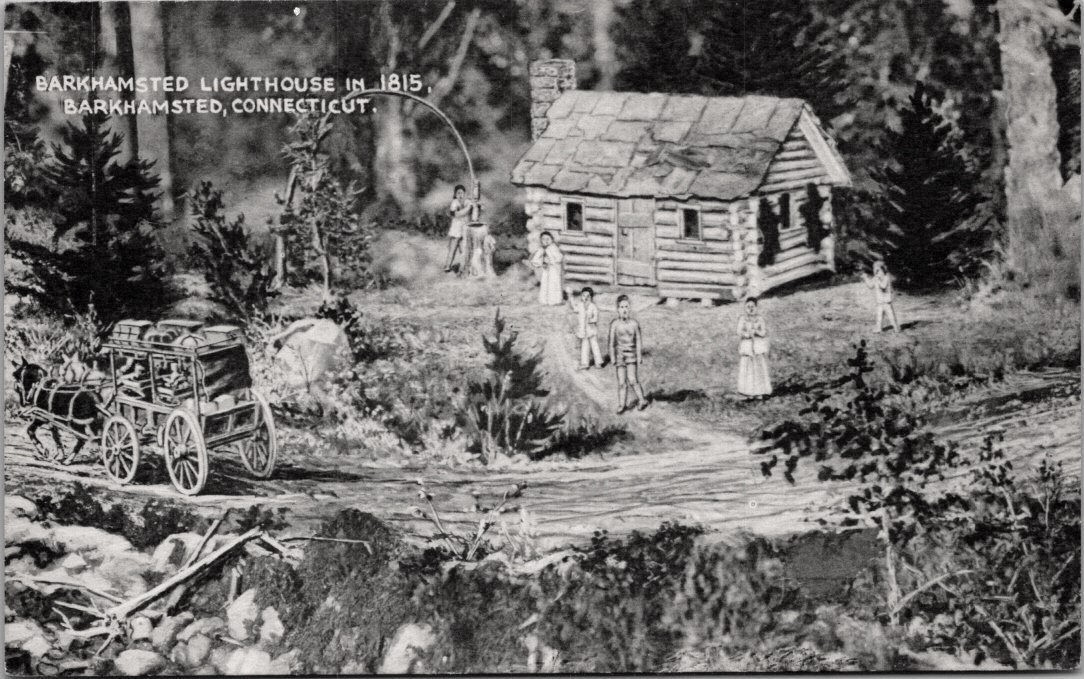
The village was given the name “Light House” because its lights acted as a beacon marking the north–south stage road that paralleled the river¹. The twinkling lights in the teepees & cabin of the Chaughams and their neighbors assured passengers in the night that they still followed the right path².
I have known my whole life that my maternal grandmother had Native American ancestry. When I was a teenager my US History teacher gave us some extra credit work of creating a family tree. So I went to my grandmother and asked her to share what she knew.
Ruth Ann, Edith and Sherry (unknown date)
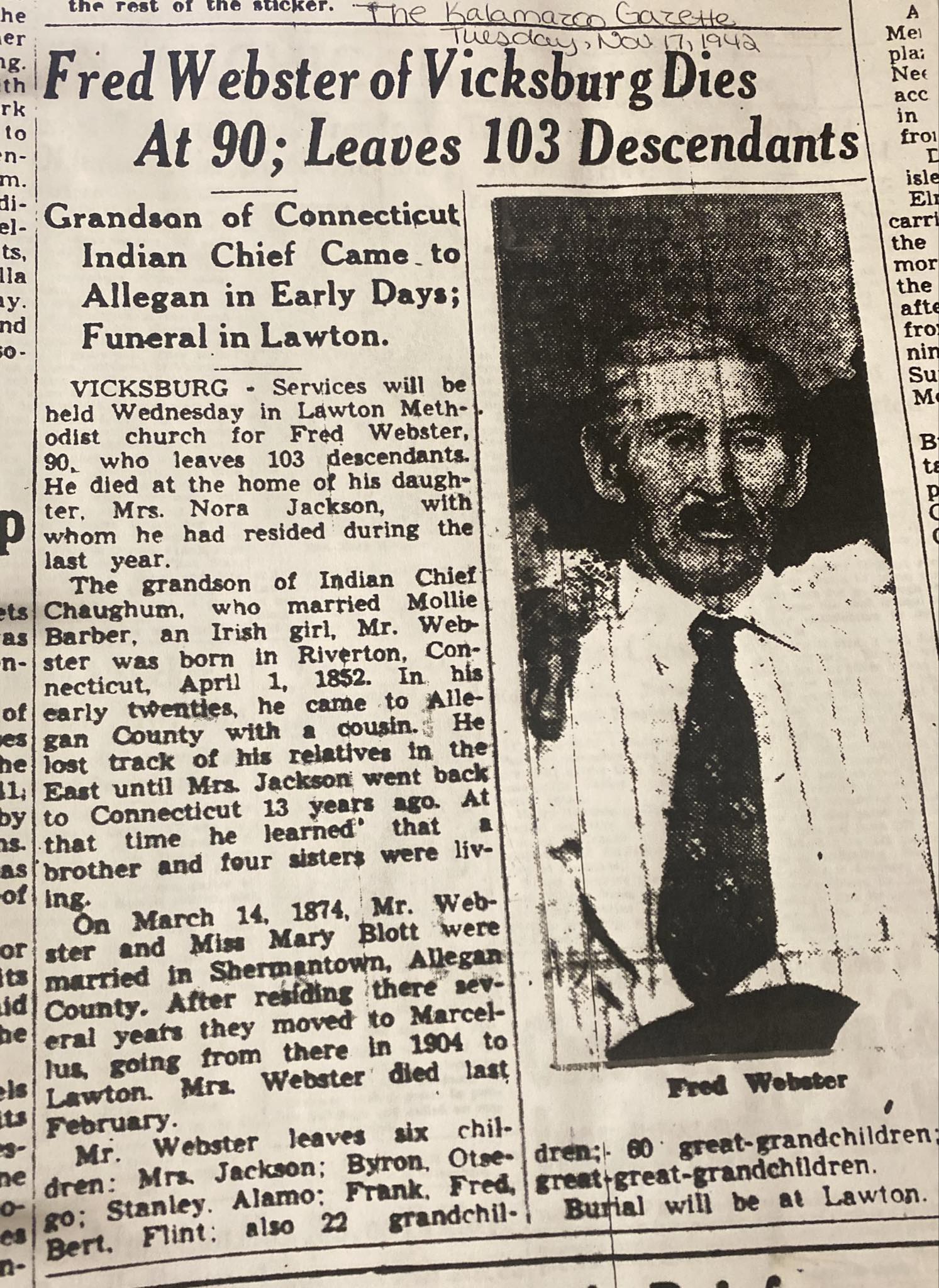
Her grandfather was Frederick Roy Webster. And he claimed to be the grandson of an Indian Chief in a newspaper article about their wedding anniversary as well as his obituary. He was the son of Solomon “Ol Sol” Webster and Mary Wilson (Though his death certificate states his mother was Sarah Charugn, which is completely wrong). As stated in a previous blog, Solomon was the son of Montgumery “Gum” Webster of Mehegan descent. Mary Wilson was the daughter of William P. Wilson Jr and Harriet Wilson. William was the grandson of James Chagum (of Narragansett descent) and Molly/Mary Barber, of the Lighthouse Village in Barkhamsted, Connecticut.
Fred Webster Family (I got the photo from my grandmother Edith Webster Lash (daughter of Bert), she told me that this was her father’s family on the day of her mother’s funeral (July 1921) it was with other photos of Berts girls with their cousins, Nora’s daughters. Grandma had all the names right except for Almo & Bryon Judson Price, I sent this photo to Onalee Ordiway Potter (Byron’s granddaughter) & she named the people. Also the date on the photo says “OCT 56” this can’t be, since both Mary & Fred Webster died in 1942)
…Some in Michigan are Living…
Calling me back “home,” beckoning me is a little piece of land. Ironically it is called Barkhamsted Lighthouse. I ponder the inhabitants of the Lighthouse “Tribe” even thought what it’s name would mean to those coming after them. To me it is a beacon deep in my heart. A passion that was my mother’s and my grandmother’s to stand where the Websters & Chagum’s once stood. To see the old cemetery & foundations of the homes, that are barely noticed today. To somehow feel their presence from the past. To visit the town’s Historical Society and Records vault, to find my ancestors name in some forgotten record.
Photo from The Legend of Barkhamsted Light House, by Lewis Sprauge Mills, (Lewis Sprauge Mill, publisher. Barkhamsted, CT).
In Lewis S. Mills book, “The Legend of the Barkhamsted Light House” page 93 he writes…
“Molly Barber and James Chaugham Dead and Buried-gone forever: Scattered now are their descendants. Some are in the Town of Woodbury Busy digging graves and hunting; Some in Riverton and Colebrook Some in Harwinton and Winsted, Some in Michigan are living.
… Generations speeding onward In an ever widening circle, Carry far the blood of Chaugham And his spouse, brave Molly Barber…”
My family are part of that “…SOME IN MICHIGAN ARE LIVING….”
During my childhood my mom and my grandma always tried to find out more about our ancestors and our culture. We went to a couple of Pow-Wow’s here in Saginaw area of Michigan and I was mesmerized by the drums and dancers. When I was older some Native American singers called Rain Song came to the church we were attending and played. That is where I came up with the name to my blog “Echo’s of Lost Footprints.”
Fred & Mary’s marriage record below…
I found a quote somewhere on the web that I wrote down, “We will be known forever by the tracks we leave!” I believe this is a call to arms for me. I believe it’s the echo’s of my ancestors that are calling out for me to find them & learn about the “tracks” they left for me to find. Also, it’s a challenge for us, to leave a legacy for our children, grandchildren & beyond… a legacy of purity, wholesomeness of heart & bravery.
In March our local library was part of the One Book Shiawassee, is a Community Read effort with the goal to invite Shiawassee County residents to collectively read the same book at the same time. We read FIREKEEPERS DAUGHTER by Angeline Boulley, and I got to see/hear her at an authors event hosted by One Book Shiawassee.
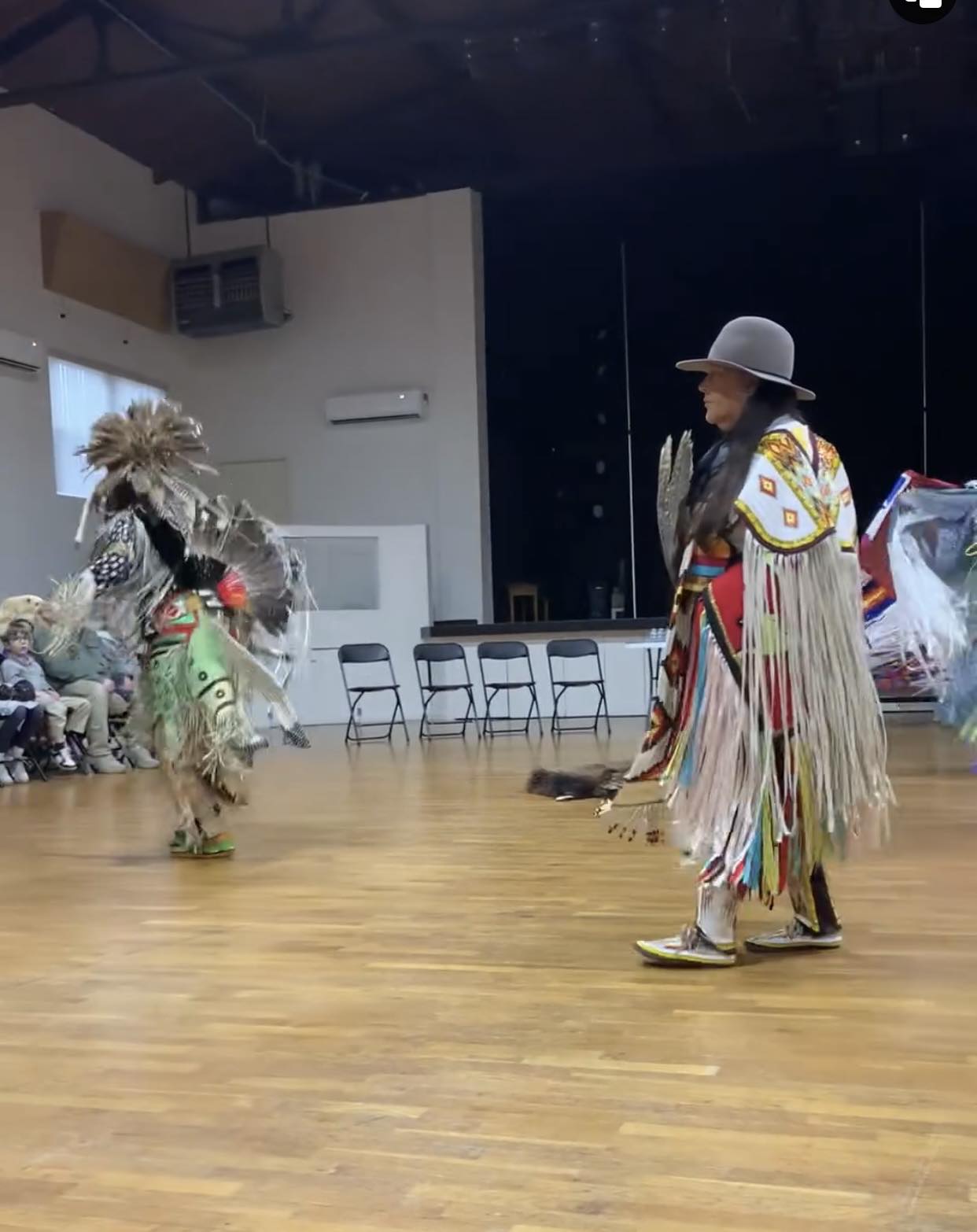
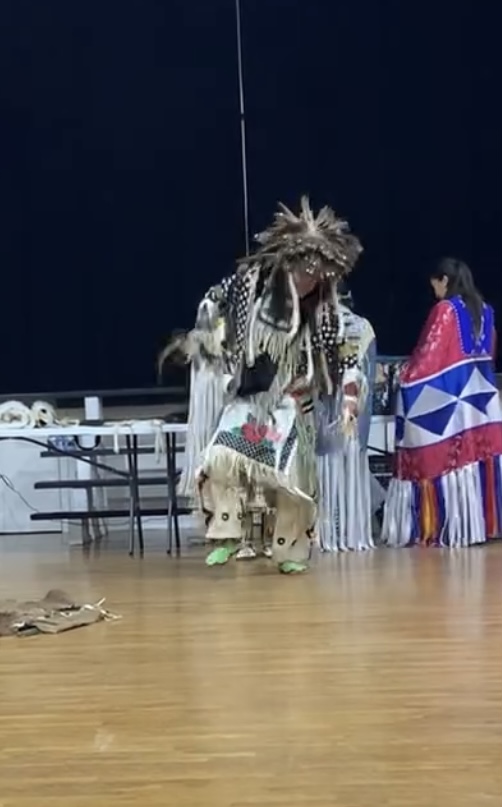
Some other events were the Deer Hide bracelet craft with Reg Pettibone, a member of the Ho-Chunk Nation, he shared with those attending about deer and the cultural significance to village life and Native American culture. And later Reg, along with his wife Marca, from the Paiute Nation, & their daughters presented a unique and engaging cultural performance that amazes, entertains and educates. Reg, draws on his traditional upbringing to provide the audience with a better understanding of true native culture through dance, song, stories and audience participation. Here are some photos I took during these events.
Here is my daughter, Shelbi with Reg Pettibone after the Deer Hide Bracelet Craft event (I didn’t realize his eyes were shut). She was so proud to learn about the Native culture. My ancestors were Mohegan and Narragansett, so things would be different with some similarities.
Logos above are the Narragansett & Mohegan Tribes logos.
Got an email from Liz Lightfoot I wanted to share:
Via Liz: (Witness Stones Project) On that note, I wanted to mention that all this week Connecticut Public Radio has been doing a series on Connecticut slavery. Today’s final episode of the series, Unforgotten: Connecticut’s Hidden History of Slavery, focuses specifically on how students have responded to doing Il Witness Stones Project. As you will see, Dennis Culliton (WS founder/executive director), Joy Burns (WS director of outreach), and Jumoke McDuffie-Thurmond (poet, my former teaching colleague/WS collaborator) are featured, as are several remarkable students. Hopefully you’ll get a sense of what this experience meant to the students and how deeply they engaged…
The Witness Stones Project is a non-profit educational initiative whose mission is to restore the history and honor the humanity of the enslaved individuals who helped build our communities.
In Sept 2023 I was contacted by Historian Paul Hart of Barkhamsted Historical Society about the Barkhamsted Lighthouse Village being featured in one of the Witness Stone projects.
Paul Hart was in touch with one of the project leaders and included them in our email correspondence. Shortly after, I received a message from Laura McCarthy Ed.D., the Director of the Academic Success Center. Having recently visited the Lighthouse site, she expressed interest in learning more about the village and its inhabitants. She asked if I would be willing to assist with the project. Without hesitation, I gladly agreed to help in any capacity needed.
“The Witness Stones Project is a critical necessity for our country. The effort is not critical solely because it restores the humanity that was stolen from the enslaved. It is critical because it can change a student’s empathetic orientation to the hard facts of our country’s past. It is critical because we need a truthful telling of America’s history that acknowledges the contributions of all Americans.“
“Our history is not without pain. Neither is our present. Nor will our future be unless we own our history and grow from it together. Our real history is our children’s right. It is their legacy. And it must be their truth. And if we do this right, the ability to discuss, understand, acknowledge, and reconcile our collective history will be our children’s power.”
Pat Wilson Pheanious, JD, MSW Chair of the Board of Directors Witness Stones Project, Inc.
Hey there, we’re all about diversity, equity, and inclusion! It’s super important to us that everyone feels valued and respected, no matter who they are. We’re committed to creating a welcoming environment where all voices are heard and everyone has an equal opportunity to succeed. Let’s celebrate our differences and work together to make our community awesome for everyone!
The Witness Stones Project’s purpose is to uncover, restore, and honor the history and humanity of enslaved individuals.
We believe diversity, equity, and inclusion must be at the center of how we think and act in order to fulfill that mission.
We value the diversity of the students, educators, parents and families, communities, staff and board members, and funders, and we recognize how each stakeholder contributes to the development of the organization in unique, impactful ways.
We seek to create equitable access to our curriculum and program resources, along with opportunities within and in partnership with the organization.
We prioritize creating spaces where all are recognized, honored, and welcomed.
Approved by the Board of Directors, 2022.
On Sept 13th 2023 they accepted us as one of their projects (super exciting) and started with plans to move forward with project.
Laura McCarty emailed me the rundown of activities:
The Witness Stone Project: We will be following the curriculum of The Witness Stones Project to commemorate the life of those who were enslaved in Connecticut. We’ve chosen to commemorate the life of James Chaugham, as he was enslaved in Rhode Island. https://witnessstonesproject.org/ We will produce two pieces to commemorate James Chaugham’s life, a book and a ceremony. The ceremony will be held in April/May and we will host and event to share our learning’s about his life, share our reflections, and lay a Witness Stone.
The students participating in the project: the students who will be going through this project are from a few different Northwestern Connecticut Community College groups—Team Success Scholars, History Association, and Phi Theta Kappa (the honor society for two-year colleges). The majority of students will be from Team Success Scholars. The Team Success Scholars program has to do Community Action Projects, which is affiliated with Oxford Consortium on Human Rights. Two of the students will be going to Oxford University to talk about their work on the Lighthouse Community in March, 2024.
One group of students will be looking at the genealogy of the Lighthouse Community. I am asking this group to interview three descendants on their connection to the Lighthouse Community. I am hoping that you would help us with this!
Troutbeck Symposium: The Troutbeck Symposium is the culmination of local history project-based education. This symposium is held the historic Troutbeck Inn, which was the site of two critical meetings of the NAACP. The symposium will be held April 28-30th. Here is a website that hosts the work that has been done to this point: https://coloringourpast.org/
We are kicking off our year tomorrow with a tour of the Lighthouse Community. The WitnessStones Project will share a lecture on the History of Slavery in Connecticut on Sept. 28th, and then the students will be broken into their workgroups to make the plans. They will present their workplans on October 13th at Quinnipiac University. This presentation is part of the Oxford Consortium on Human Rights work.
Thanks! Laura
Email via Laura McCarthy: The students and I toured the Lighthouse Community yesterday to give them a sense of this project. On September 28th from 12:30-1:45pm, we are having Liz Lightfoot from The WitnessStones Project give a lecture on the History of Slavery in Connecticut. This will be in Founders Hall Auditorium and is open to the public. You are welcome to join. This initial work is laying the foundation for the students to conceptualize the life and times of James Chaugham.
Thank you for your assistance! Laura
I was overjoyed to discover that the Barkhamsted Lighthouse Village archaeologist and author Kenneth (Ken) Feder was also participating in the project.
Ken is also the founder and director of the Farmington River Archaeological Project which studies the prehistory of the region in northwest Connecticut and author of books on that of the Barkhamsted Lighthouse Village.
I donated my research & genealogy book I have been working on – of the Lighthouse People. Sent them several files to help the students.
It was at this time, that I was also introduced via email to Liz Lightfoot (Director of Operations – Witness Stones Project), Dennis Culliton (Witness Stones Project), Jessie DePonteand team.
On Oct 23rd 2023 I received an update via email from Laura McCarty
Hi Everyone!
Thank you all for your support with the Lighthouse Project. I feel like we are officially launched. Our students have a firm understanding of the project and its parameters. On October 13th, they presented the project at the Oxford Consortium on Human Rights. It was a real delight to see them be able to communicate the project and its importance to faculty from Oxford University, Quinnipiac University, Bridgewater State University, and Sonoma State University.
We have broken the students into teams—Genealogy, Narrative Writing, and Social Media. We will begin meeting with these teams to launch their individual work in the next two weeks. The students’ goal is to produce a documentary film, with assistance from Ben Willis. Ben is funded through the Troutbeck Symposium and is free to us! We have begun a repository for film documenting our work…. We have aspirations for a social media presents and a book. Of course, all of this will conclude in May with a placing of a WitnessStone in James Chaughum’s memory.
The leads for these projects are: Genealogy—Jessie DePonte, Narrative Writing—Todd Bryda and Laura McCarthy, and Social Media/Event—Maggie Sullivan. We will be reaching out to Liz and Coni for research support with the students’ work. Coni, thank you for your years of dedication to documentation and researching your family. These connections and documents are impressive!Thanks to all your work, I easily located another descendant, who is a former student of mine, Jess Tessman!I worked closely with Jess when she was a student here and having her involved makes this project so much more significant to me personally.
I will be attending a presentation by Kenny Feder on Sunday at the American Indian Studies Institute in Washington, CT. Mr. Feder did the monumental archeological work of uncovering the remains of the Lighthouse Community.
Thanks!Laura
Email from Liz Lightfoot 0n Oct 26, 2023:
Hi again, Coni. I just wanted to say again how terrific it was to speak with you, how grateful we are for your remarkable research and your generosity in sharing it, and how much I admire you for devoting so many years (and so much love) to this important work. What an extraordinary job you do – it’s truly inspiring and vitally important!
All best, Liz
Sometime in November 2023 Ken Feder and I had a video conference with the students.
Feb 2024 I receive an email from Liz Lightfoot:
Coni, your research was beyond helpful! What a phenomenal job you have done, and clearly it’s been a labor of love. I’m so excited to see what the students come up with.
Thank you all for helping me learn about this fascinating man and his family. It’s a story everyone should know.
All best,Liz
Upcoming: I will be Zooming with students this week to answer questions they have prepared for me~
“I feel incredibly privileged to have been a part of this incredible project and its team. Collaborating with the entire team has been an amazing experience and I am eagerly anticipating the final results from the project’s students.“
My final thoughts,
It is crucial to share the entire story, holding nothing back. By allowing others to follow the Barkhamsted Lighthouse narrative, we can present a fresh perspective to younger generations. Witnessing their unique viewpoint on this piece of history will undoubtedly be intriguing. Let’s not shy away from the truth and embrace the opportunity to educate and inspire the future.“ Coni Dubois
We’re currently in the process of finalizing the times and dates for the placement of the Witness Stone at Barkhamsted Lighthouse Village. As soon as they are confirmed, we will make sure to keep everyone informed.
Thank you for your patience.
Books by Ken Feder via Wikipedia
Feder, Kenneth (1998). Lessons From the Past: An Introductory Reader in Archaeology. McGraw-Hill Humanities/Social Sciences/Languages. ISBN978-0-7674-0453-2.
Feder, Kenneth; Coauthor – Michael Alan Park (1989). Human Antiquity: An Introduction to Physical Anthropology and Archaeology. Mayfield Publishing. ISBN978-0-87484-828-1.
Feder, Kenneth (1993). A Village of Outcasts: Historical Archaeology and Documentary Research at the Lighthouse Site. Mayfield Publishing. ISBN978-1-55934-255-1. Feder, Kenneth; Coauthor – David A. Poirier (2001). Dangerous Places: Health, Safety, and Archaeology. Bergin & Garvey. ISBN978-0-89789-801-0.
Feder, Kenneth; Coauthor – Thomas R. Hester; Coauthor – Harry J. Shafer (2009). Field Methods in Archaeology, 7th Edition. Mayfield Publishing. ISBN978-1-59874-428-6.
Hello everyone! I am pleased to announce that I am back to conducting research after a long hiatus. Due to a year of illness, I took a break from the internet and my research. My main focus has been on recovering, and I am happy to report that I am finally feeling like myself again and in good health.
With that being said, it’s time to start planning our 2025 Barkhamsted Lighthouse Village Gathering! I hope to see many of you there, and now is the time to request your time off from work. The gathering will take place on the weekend of July 4th, 2025 at the Barkhamsted Lighthouse Archaeological Preserve in Barkhamsted, Connecticut. The event is set on Facebook (make sure to let us know if planning on attending via event page in link)
If you are not on the descent list, please contact me to be included. I will be confirming all descendants and issuing descendant cards at a cost of $30 each. This fee covers the production costs, and the remaining funds will be used for the gathering in 2025.
I am in need of a team in Connecticut to assist with organizing and setting up the event, as I currently reside in Louisiana. Additionally, my cousin Veronica Lee Hawkins and I are looking for an Airbnb to rent for the weekend in 2025. If anyone knows of one that will be available, please let me know so we can secure it.
Furthermore, I will be creating a Barkhamsted Lighthouse Newsletter to keep everyone informed of all the events and activities planned for the gathering. For now, you can find info on BLVD Association & download the descendant’s packet at: https://conidubois.com/111-2/association/
In Barkhamsted Lighthouse House Village, nestled in the picturesque countryside of Connecticut in the 1800s, lived a remarkable couple named Molly Barbour and James Chagum. Molly, a spirited white woman, defied societal norms of the time and married James, a proud Indian man. Together, they embarked on a journey that would shape their lives and touch the hearts of the entire village.
Molly and James were blessed with seven children, each embodying the unique blend of cultures that their parents represented. The family’s home, a symbol of their love and unity, stood tall amidst the rolling hills, its light shining brightly as a beacon of acceptance and understanding.
Despite the challenges they faced, Molly and James persevered, teaching their children the values of compassion, tolerance, and the importance of embracing one’s heritage. The village, initially skeptical of this unconventional union, gradually came to admire the couple’s unwavering love and the beautiful family they had created.
Molly, with her gentle nature and nurturing spirit, became an advocate for harmony between different communities. She organized cultural exchanges, inviting people from all walks of life to the village to share stories, traditions, and experiences. Through these gatherings, prejudices were shattered, and friendships were forged, fostering a sense of unity and respect among the villagers.
James, on the other hand, shared his deep connection to nature and taught his children the wisdom of the land. They would spend hours exploring the nearby forests, learning about medicinal herbs, and understanding the delicate balance of the ecosystem. The family’s bond with nature became a source of inspiration for the entire village, instilling a profound appreciation for the environment.
As the years passed, the Barkhamsted Lighthouse House Village flourished, becoming a symbol of hope and harmony in a world often divided by ignorance and fear. Molly and James’s children grew into compassionate individuals, each contributing to their community in their unique ways.
Their eldest son, Solomon, became a respected storyteller, preserving the rich history and traditions of both cultures. Their daughter, Hannah, followed in Molly’s footsteps, working tirelessly to promote education and equality for all. The other children, too, found their callings, from art to agriculture, each leaving a lasting impact on the village and all who knew them.
Molly and James lived their lives with grace and dignity, their love for each other and their children serving as a testament to the power of acceptance and understanding. Their legacy echoed through the generations, reminding the villagers of the transformative power of unity and the beauty that lies in embracing diversity.
In the embrace of Barkhamsted Lighthouse House Village, the barriers of race and culture were transcended, allowing the human spirit to thrive. Molly and James, forever remembered as pioneers of love and acceptance, left an indelible mark on the hearts of all who knew them, forever illuminating the path towards a more inclusive and compassionate world.
Connecticut was home to several Native American tribes, including the Mohegan, Pequot, Nipmuc, and Eastern Woodland Indians. The Mohegan and Pequot were the two most powerful and largest tribes. They were both part of the Algonquian-speaking tribes, and their populations were estimated at 2,000 and 8,000 people respectively. The Nipmuc tribe was a smaller group that often merged with other tribes. The Eastern Woodland Indians were more nomadic and spread throughout much of the eastern United States. These tribes had a rich culture and believed in the power of nature and spirituality. Today, these tribes continue to preserve their culture and heritage through museums and cultural centers.
The indigenous people of North America inhabited the Eastern Woodlands, a cultural area that stretched from the Atlantic Ocean through to the eastern Great Plains and from the Great Lakes region to the Gulf of Mexico, covering the present-day Eastern United States and Canada. The Plains Indian culture area is located to the west, and the Subarctic area lies to the north. Indigenous groups in the Eastern Woodlands spoke various languages belonging to several language groups, including Algonquian, Iroquoian, Muskogean, and Siouan. They also spoke isolated languages such as Calusa, Chitimacha, Natchez, Timucua, Tunica, and Yuchi. Many of these languages remain in use today. The origin of Farmington lies in the fertile meadows beside the Farmington River that Native Americans referred to as Tunxis Sepus (“at the bend of the little river”). The Tunxis Indians, a sub-tribe of the Saukiogs, built a temporary settlement on these meadows where they fished, farmed, and hunted during the harvest seasons.
Farmington is situated in Hartford County, and its eastern boundary is marked by the Talcott Mountain ridgeline. The Tunxis Indians named the region Tunxis Sepus, meaning “bend of the little river,” which eventually became known as Farmington after its incorporation in 1645. In the 1800s, Farmington gained a reputation as the “Grand Central Station” of Connecticut’s Underground Railroad. The Farmington River Valley, which includes the area of present-day Farmington, Connecticut, was home to various indigenous peoples for thousands of years before the arrival of European settlers. The primary group of indigenous people who lived in the region was the Tunxis tribe. In the 17th century, European colonists established settlements in the area, leading to conflicts between the indigenous peoples and the settlers. The Tunxis people were eventually forced to abandon their ancestral lands and move to reservations in other parts of Connecticut, while others assimilated into the colonial society. Today, the Indian tribes and their descendants continue to be an important presence in Connecticut, and their culture and traditions are celebrated and preserved through various cultural heritage organizations and events.
The early Connecticut Tribes were led by several chiefs throughout its history. The information that survives regarding the chiefs of the Indian people is, unfortunately, limited.
Some of the known Tribes include: The Tunxis tribe, also known as the “Koasek,” lived in central Connecticut and western Massachusetts. They had close relationships with the tribes around them, including the Massachusett, Mohawk, and Mohegan. They primarily lived in villages along the river, which are now part of the towns of Farmington, Avon, and Simsbury.
The Wangunk, an Algonquian-speaking Native American group, once occupied the region and settlement of Mattabesset alongside the Connecticut River. It is worth noting that the Mattabesset River flows into the Connecticut River near Middletown, Connecticut. European colonial settlers established and developed Middletown on the western part of the region, while a series of settlements emerged on the eastern side, including Chatham and Middle Haddam, which eventually became East Hampton, Connecticut. The Wangunk people were the original inhabitants of the region, and Dutch Europeans first visited the area in 1614. When English colonizers arrived in the area, the Native American sachem, Sowheag (also known as Sequin), led the local community. Following conflicts with the new settlers, Sowheag relocated from Pyquaug – which was later named Weathersfield – to Mattabesett.
Great Sachem of the Mattabessett Indian Tribe, Sequasson Sequin Sowheag, was born in 1530 in Livingston, New York, USA. His parents were Mattabesetts Seguin Montauk and Sarah Phinney Root. Sowheag later married Sowheag Sequassan “Sequin” Mattabesetts-Wyandance in 1542 in Wethersfield, Hartford, Connecticut, USA. Together, they had at least two sons. Sowheag passed away between 1605 and 1635 in Montauk, Suffolk, New York, USA, at a remarkable age of 105 years old. There are varying spellings for Mattabesset, such as Mattabesec, Mattabeseck, Mattabesset, Mattabesset, and Mattabéeset. Despite this, it is commonly pronounced as “Matta-bess-ic.”
The Pequot and Mohegan tribes were believed to have migrated from the direction of the Hudson River. At the time of initial contact with Whites, the Pequots were viewed as warlike and feared by neighboring tribes. The Pequot and the Mohegan were jointly ruled by Sassacus until the revolt of Uncas, the Mohegan chief. In 1635, the Narraganset drove the Pequot from a corner of present-day Rhode Island that they had been occupying. Two years later, the murder of a trader who had mistreated some Indians embroiled the Pequot in war with the Whites. At the time, their leader controlled 26 subordinate chiefs and claimed authority over all of Connecticut lying to the east of the Connecticut River and as far west as New Haven or Guilford, as well as all of Long Island except the westernmost end. Through the intervention of Roger Williams, the English secured the help or neutrality of surrounding tribes. The English then attacked and demolished the principal Pequot fort near Mystic River, killing over 600 people of all ages and genders. The tribe was so weakened that after several desperate attempts at further resistance, they split into small groups and abandoned their homeland in 1637. Sassacus and many of his followers were intercepted as they attempted to flee to Mohawk, with most of them either captured or killed. Those who surrendered were divided among the Mohegan, Narraganset, and Niantic tribes, and their land came under the control of Uncas. Although their Indian overlords treated them harshly, the Pequots were eventually taken out of their hands by colonists in 1655 and relocated to two villages near Mystic River, where some of their descendants still reside. Some individuals relocated to other places such as Long Island, New Haven, and the Nipmuc country, while others were kept as slaves among English settlers in New England or sent to the West Indies.
The Pequot Indians, also known as Sickenames in a Dutch deed mentioned by Ruttenber (1872), meant “destroyers” according to Trumbull’s (1818) translation. The Pequot tribe belonged to the Algonquian linguistic stock and spoke a y-dialect that was closely related to Mohegan. The Pequot tribe held the coastal area of New London County from the Niantic River to nearly the Rhode Island state border. Before being forced to leave by the Narraganset, the Pequot extended into Rhode Island up to the Wecapaug River. The Pequot tribe had a range of settlements: Asupsuck, which positioned inland from the town of Stonington; Aukumbumsk or Awcumbuck, located near Gales Ferry in the center of the Pequot territory; Aushpook, situated in Stonington; Cosattuck, presumably close to Stonington; Cuppanaugunnit, likely located in New London County; Mangunckakuck, probably positioned below Mohegan along the Thames River; Maushantuxet, located in Ledyard; Mystic, near West Mystic on the west side of the Mystic River; Monhunganuck, situated near Beach Pond in Voluntown; Nameaug, near New London; Noank, found at the present-day site of that name; Oneco, located in the town of Sterling; Paupattokshick, positioned on the lower stretch of the Thames River; Pawcatuck, probably near the Pawcatuck River in Washington County, Rhode Island; Pequotauk, located near New London; Poquonock, found inland from Poquonock Bridge; Sauquonckackock, situated below Mohegan on the west side of the Thames River; Shenecosset, located near Midway in the town of Groton; Tatuppequauog, located below Mohegan along the Thames River; Weinshauks, situated in Groton; and Wequetequock, positioned on the east bank of the river of the same name. Mooney (1928) estimated the Pequot tribe had a population of 2,200 in 1600. Following the Pequot War in 1637, the population was reported to be 1,950, but this figure is likely too high. By 1674, the remaining Pequots in their native territory numbered around 1,500, which dwindled to just 140 in 1762. In 1832, only 40 mixed-blooded individuals were reported, but the census of 1910 recorded 66 individuals, 49 of whom resided in Connecticut and 17 in Massachusetts. The Pequots are most renowned for their bitter and catastrophic experience during the Pequot War, as described above. A post village in Crow Wing County, Minnesota bears their name.
The Mohegan tribe is believed to have originated as a branch of the Mahican people. Under the leadership of Sassacus, who was the chief of the Pequot, they were initially subject to Pequot rule. However, they broke away from the Pequot and became independent. After the Pequot tribe was defeated in 1637, Uncas, the Mohegan chief, became the leader of the remaining Pequot and expanded his territory beyond his original borders. Following King Philip’s War, the Mohegan became the only significant tribe left in southern New England. However, as White settlements grew, the tribe dwindled in both size and territory. Many Mohegan people joined the Scaticook, and in 1788, even more, merged with the Brotherton in New York, forming the largest single group in the new settlement. Those who remained stayed in their original town of Mohegan, where a small group of mixed-blood tribe members still exists today.
The Wawyachtonoc tribe of the Mahican Confederacy occupied the northwestern corner of Litchfield County, but their primary territories were in Columbia and Dutchess Counties, New York. The Mohegan tribe, which means “wolf,” should not be mistaken for the Mahican. The Mohegan people, who spoke a y-dialect closely related to the Pequot, were part of the Algonquian linguistic stock. Initially, the Mohegan inhabited most of the upper Thames Valley and its branches, and later they claimed control over some of the Nipmuc and Connecticut River tribes, as well as the old Pequot territory. The Mohegan had several villages, such as Ashowat, Catantaquck, Checapscaddock, Kitemaug, Mamaquaog, Mashantackack, Massapeag, Mohegan, Moosup, and Nawhesetuck, also several villages including Pachaug, situated in Griswold; Paugwonk, located near Gardiner Lake in Salem; Pautexet, situated near present-day Jewett City in Griswold; Pigscomsuck, found on the right bank of Quinebaug River near the current border between New London and Windham Counties; Poquechanneeg, located near Lebanon; Poquetanock, situated near Trading Cove in Preston; Shantuck, situated on the west side of the Thames River, just north of Mohegan; Showtucket or Shetucket, found close to Lisbon, in the fork of the Shetucket and Quinebaug Rivers; Wauregan, located on the east side of Quinebaug River in Plainfield; Willimantic, situated on the site of the present city of Willimantic, and Yantic, located at the present Yantic on Yantic River.
Wappinger Indians. The valley of the Connecticut River was the home of several bands which might be called Mattabesec after the name of the most important of them, and this in turn was a part of the Wappinger.
The Western Niantic Indians resided along the seacoast from Niantic Bay to the Connecticut River. The Western Niantic tribe had two known villages – Niantic or Nantucket, located close to present-day Niantic, and another village near Old Lyme. Originally considered part of the same tribe as the Eastern Niantic, the Western Niantic were separated from them by the Pequot. They suffered significant losses in the Pequot War and, following its conclusion in 1637, were made subject to Mohegan authority. Many Western Niantic people later joined the Brotherton Indians in 1788. While a small Niantic village near Danbury was reported in 1809, it may have contained members from western Connecticut tribes. Nevertheless, Speck (1928) found multiple individuals of mixed Niantic-Mohegan ancestry living among the descendants of the Mohegan tribe. These individuals were the descendants of a pure-blooded Niantic woman from the mouth of the Niantic River. The Western Niantic tribe had an estimated population of 600 in 1600, 100 in 1638, and around 85 in 1761. The name of the Western Niantic is commemorated in Niantic village, Niantic River, and Niantic Bay in New London County. Niantic is also the name of post villages in Macon County, Ill., and Montgomery County, Pa.
The Algonquian town of Farmington, CT was initially inhabited by the Tunxis tribe before European contact. Sadly, the tribe was devastated by disease and violence, leaving only 50 members alive by 1725. However, in the mid-18th century, members of the Quinnipiac, Sukiaugk, and Wangunck tribes joined the survivors, forming a new group known as the Farmington Indians. Farmington Indians were predominantly Christian, having been introduced to the religion by Rev. Samuel Whitman in 1732. After he died in 1751, Rev. Timothy Pitkin continued the mission, though not as intensely as his predecessor. Nonetheless, the Farmington Indians catered to their own religious needs. Along with six other Algonquian settlements that eventually joined the Brothertown movement also, Farmington became an active participant in regional networks of Algonquian Christian worship.
The Brothertown movement was a combined tribe created from Algonquian people found around the Long Island Sound. They immigrated to Oneida territory twice: first in 1775 and then again in 1783. Samson Occom preached in Farmington, and in 1772, he introduced his future son-in-law, Joseph Johnson, as a schoolteacher and preacher. Although Johnson’s formal teaching stint there was brief (only ten weeks), he used Farmington as his base from which to organize the Brothertown movement. The Farmington aided and supported Johnson’s cause, proving instrumental to his mission. Most of the immigrants on the unsuccessful 1775 expedition were from the Farmington Indians. These immigrants eventually found refuge in Stockbridge, MA, where some Tunxis were already residing. Years later, when Brothertown was re-established in 1783, Elijah Wampy, a leader from Farmington, joined and became part of the town’s leadership. However, not all Farmington Indians left for Brothertown; some chose to remain in their hometown. Nevertheless, by the end of the 19th century, these remaining Farmington Indians either left the area, died out, or assimilated into a different community.
During the 18th and early 19th centuries, James Chaugham (also known as Chagum) was one such revered leader, belonging to the Barkhamsted Lighthouse Village alongside his wife Molly (or Mary) Barber. The names Chagum, Chagam, Chaugham, and Shawgum were linked to various Native American tribes in Connecticut, Rhode Island, and Block Island. Chaugham’s leadership was vital, negotiating with colonial authorities and preserving his people’s autonomy amidst growing European influence. He was widely respected as a sagacious, sympathetic leader who fervently advocated for his people’s traditions’ protection and preservation. The historical narrative of the Chagum, Chagam, Chaugham, and Shawgum Indians throughout American history is intricate and multifaceted. Several individuals with these surnames were integral participants in early American history, with relations to both European colonizers and other Native American tribes. Moreover, some of them were chiefs or leaders within their respective tribes and played significant roles in diplomacy and decision-making
Today, many individuals with these surnames are tracing their roots and learning more about their ancestors and their contributions to early American history. It is through the work of genealogists like Coni Dubois that the stories of these tribes and their people are preserved and shared with future generations.
Information on Chagum connections:
Several different types of historical documents and records mention the Chagum, Chagam, Chaugham, and Shawgum surnames with Native American tribes and individuals. Some of these documents include:
Treaty records: Many treaties between Native American tribes and European colonizers or the American government include the signatures or names of individuals with these surnames.
Land records: Several land records in New England and other parts of the United States contain the names of Chagum, Chagam, Chaugham, and Shawgum individuals with land ownership or disputes.
Census records: Federal census records from the 1800s onwards often include information about individuals’ races or ethnicities, and many individuals with these surnames appear in these records.
Church records: Many Native American tribes were Christianized by missionaries, and church records from this period often include information about Native American congregants, including their surnames.
Family records: Many families with these surnames have kept records of their genealogy, including birth and marriage certificates, family bibles, and other documents. These are just a few examples of the types of historical documents and records that have information about the Chagum, Chagam, Chaugham, and Shawgum surnames concerning Native American tribes and individuals.
The Barkhamsted Lighthouse was a historical community located in what is now Peoples State Forest in Barkhamsted, Connecticut. Set on a terrace above the eastern bank of the West Branch Farmington River, it was in the 18th and 19th centuries a small village of economically marginalized mixed Native American, African American, and white residents. It was given the name “lighthouse” because its lights acted as a beacon marking the north-south stage road that paralleled the river. The archaeological remains of the village site were listed on the National Register of Historic Places in 1991 as Lighthouse Archeological Site.
Today, Chief James Chagum/Chaugham is remembered as an important historical figure in Connecticut. Chief James Chagum/Chaugham was also a big part of the Satan Kingdom story. Satan Kingdom is a valley located in Farmington, Connecticut, USA. The origins of the name are not exactly clear but the name Satan Kingdom has been used since the 18th century and has a long history of Native American connections associated with it. Today, the valley is primarily used as a recreational area that offers a range of outdoor activities. It’s home to the Farmington River Tubing, which provides an exciting tubing experience in the river.
The Satan Kingdom State Recreation Area is also located in the valley and features hiking trails, fishing spots, and picnic areas. Overall, despite the ominous name, Satan Kingdom & Barkhamsted is a beautiful place to enjoy nature and outdoor activities.
Another location associated with Chagum’s is Chagum Pond, also known as Spring Pond, which is a freshwater pond located on Block Island off the coast of Rhode Island. The pond is named after the Chagum family, which was a prominent Native American family on the island during the 17th century. The Chagum family was part of the Manissean tribe, also known as the Island Indians, who inhabited Block Island before the arrival of European settlers. They were respected leaders among their people and worked to maintain good relations with the English colonizers who were expanding into the region. During the 1660s, tensions rose between the Manisseans and the colonizers over control of the island’s resources. Nevertheless, the Chagum family managed to maintain their position of influence on the island and continued to shape Block Island’s history for many generations. Today, Chagum Pond remains an important natural landmark on Block Island. The Chagum family is recognized as a significant part of the island’s indigenous history.
Please help me welcome Ken Feder (Kenneth L. “Kenny” Feder), a professor of archaeology at Central Connecticut State University and author of several books on archaeology and criticism of pseudoarchaeology such as Frauds, Myths, and Mysteries: Science and Pseudoscience in Archaeology. His book Encyclopedia of Dubious Archaeology: From Atlantis to the Walam Olum was published in 2010. His book Ancient America: Fifty Archaeological Sites to See for Yourself was published in 2017. He is the founder and director of the Farmington River Archaeological Project and is the main Archaeologist of our Barkhamsted Lighthouse site!
I am so excited to have him on board and can’t wait to see what he publishes for us!
I will be becoming more active on this blog myself and have tons of exciting things coming souon!
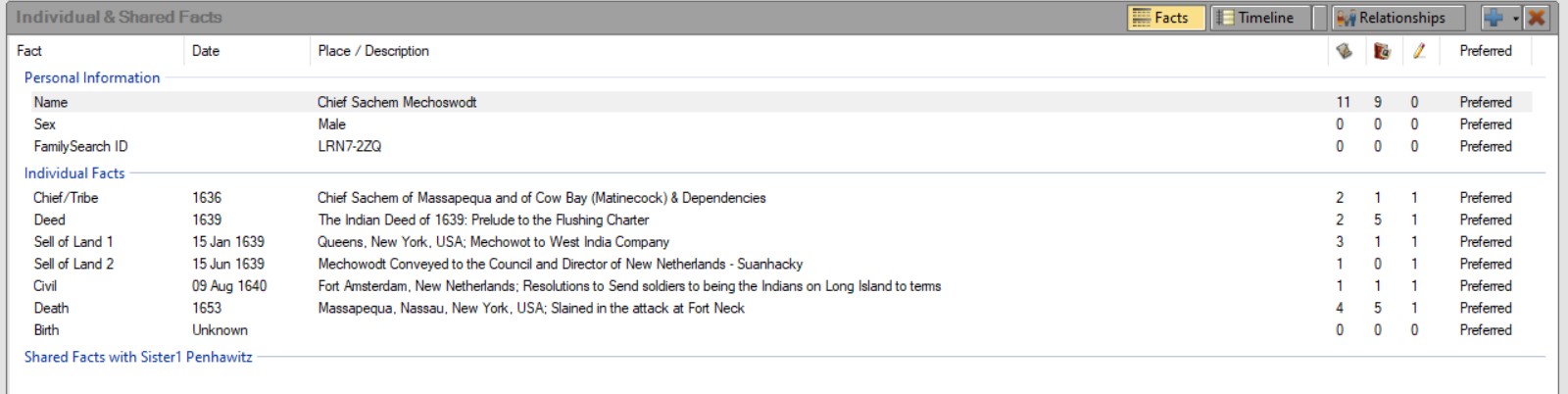
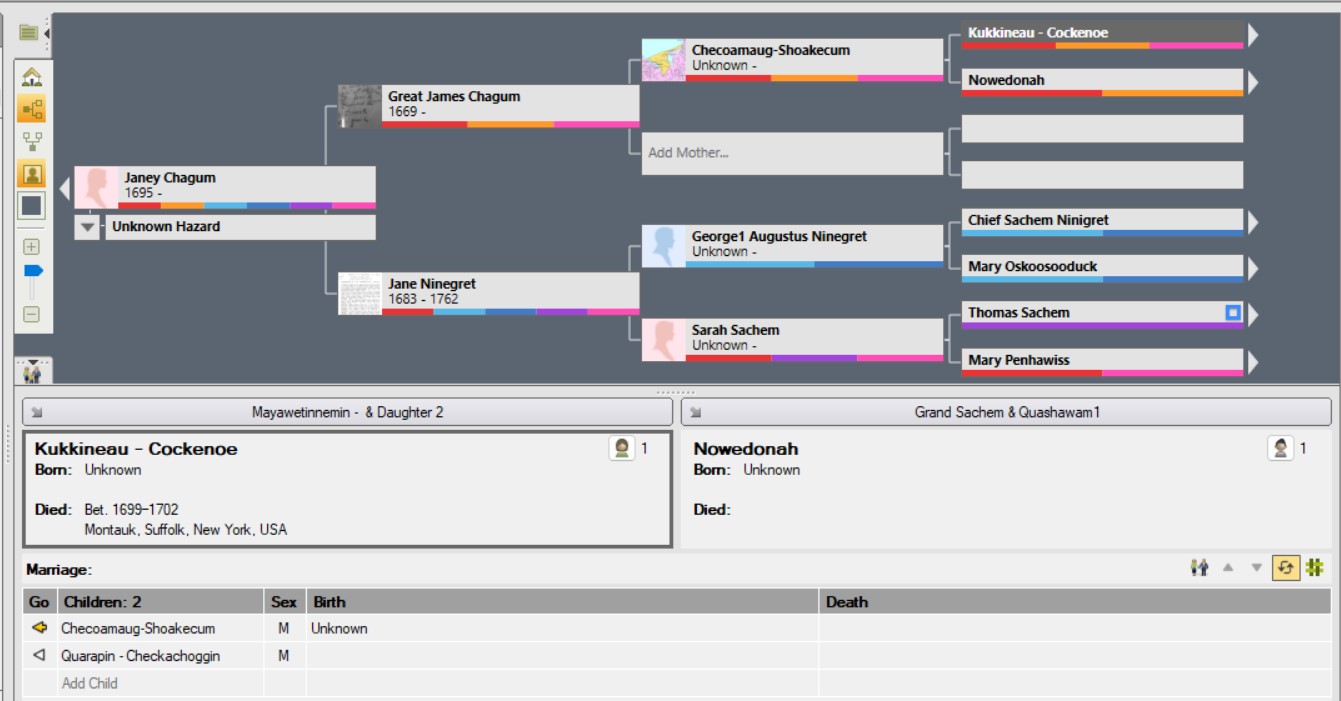
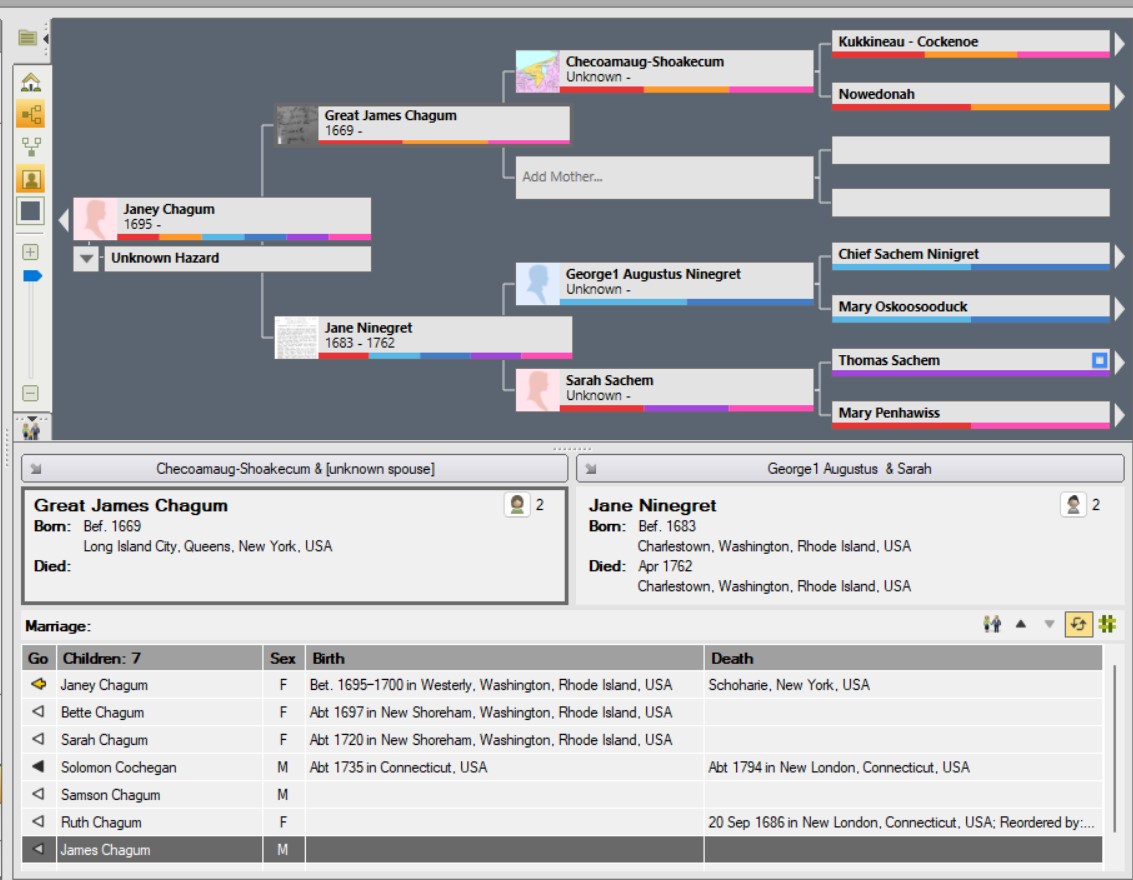
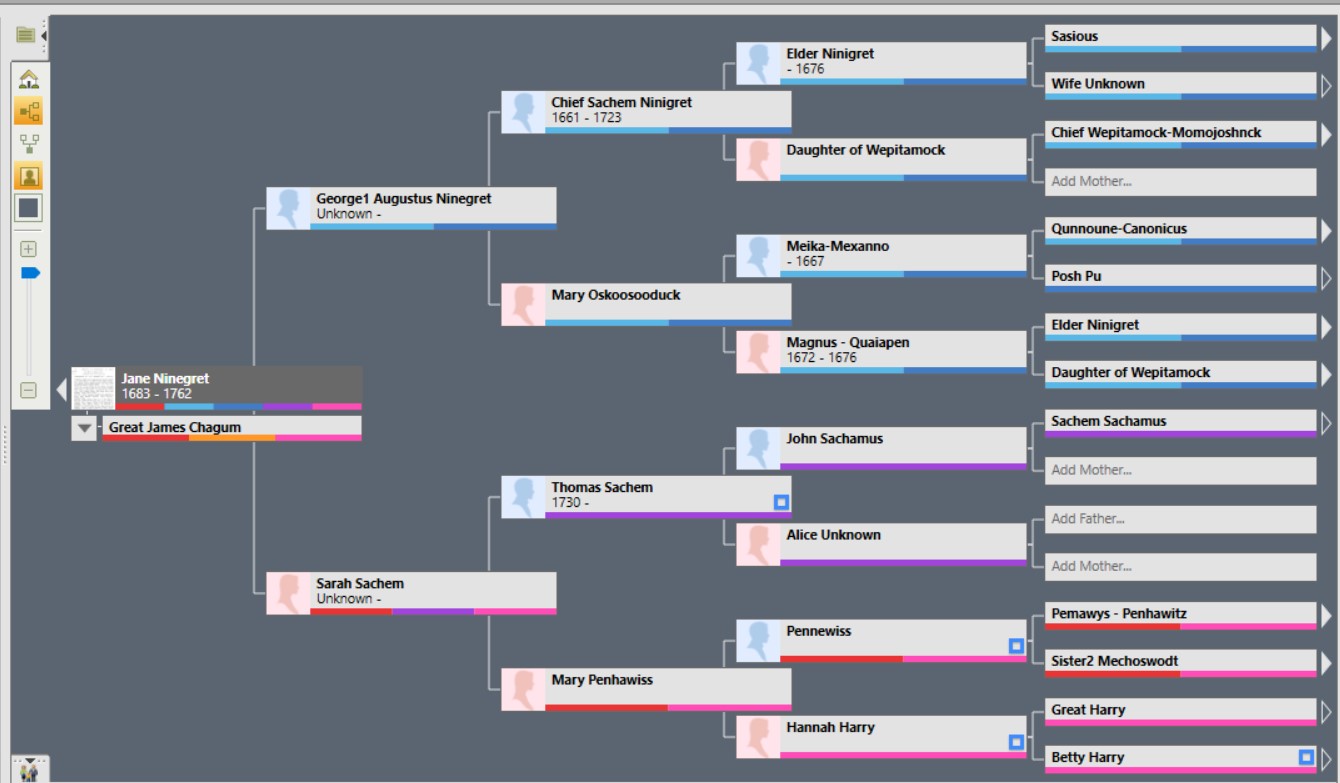
Starting with the oldest Ancestor/male line – which starts with Chief Sachem Mechoswodt – working down to James Chagum of the Barkhamsted Lighthouse Village in Barkhamsted, CT.
I have 2 versions of my research books that are available below/online:
1st one is the old format and shows detailed facts and all my notes and markups. (Marked as detailed below) and the 2nd version is of my new formatting and is my new book format – shows photos/records and documents along with place and name indexing in the back of the below research book. (Marked as compressed)
1st is a Genealogy chart with their children that I have been able to prove
2nd are facts/records/info that I have been able to find on each individual
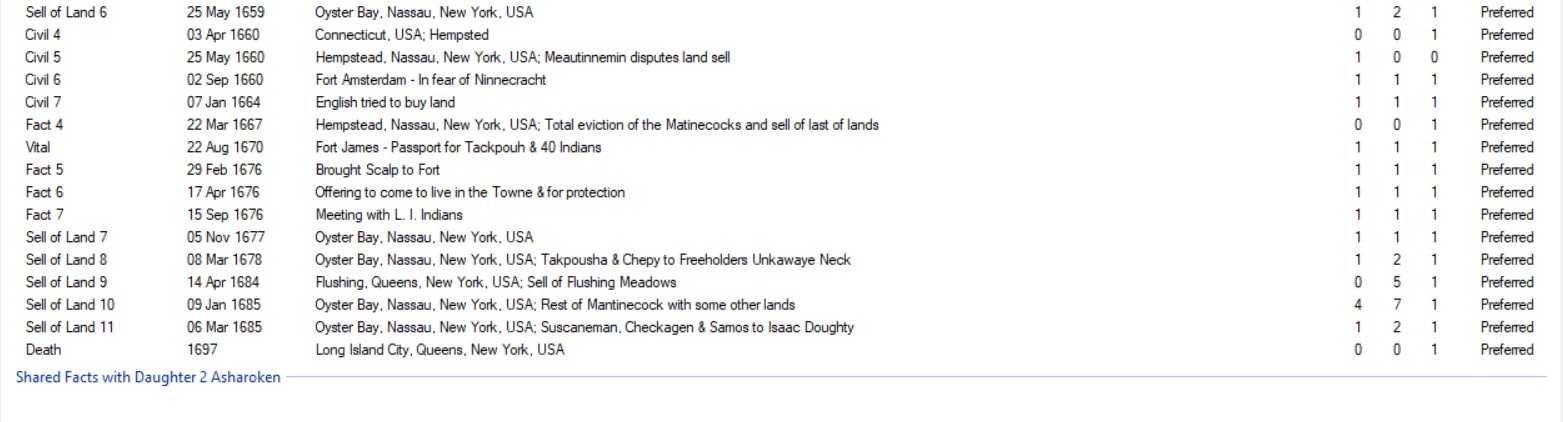
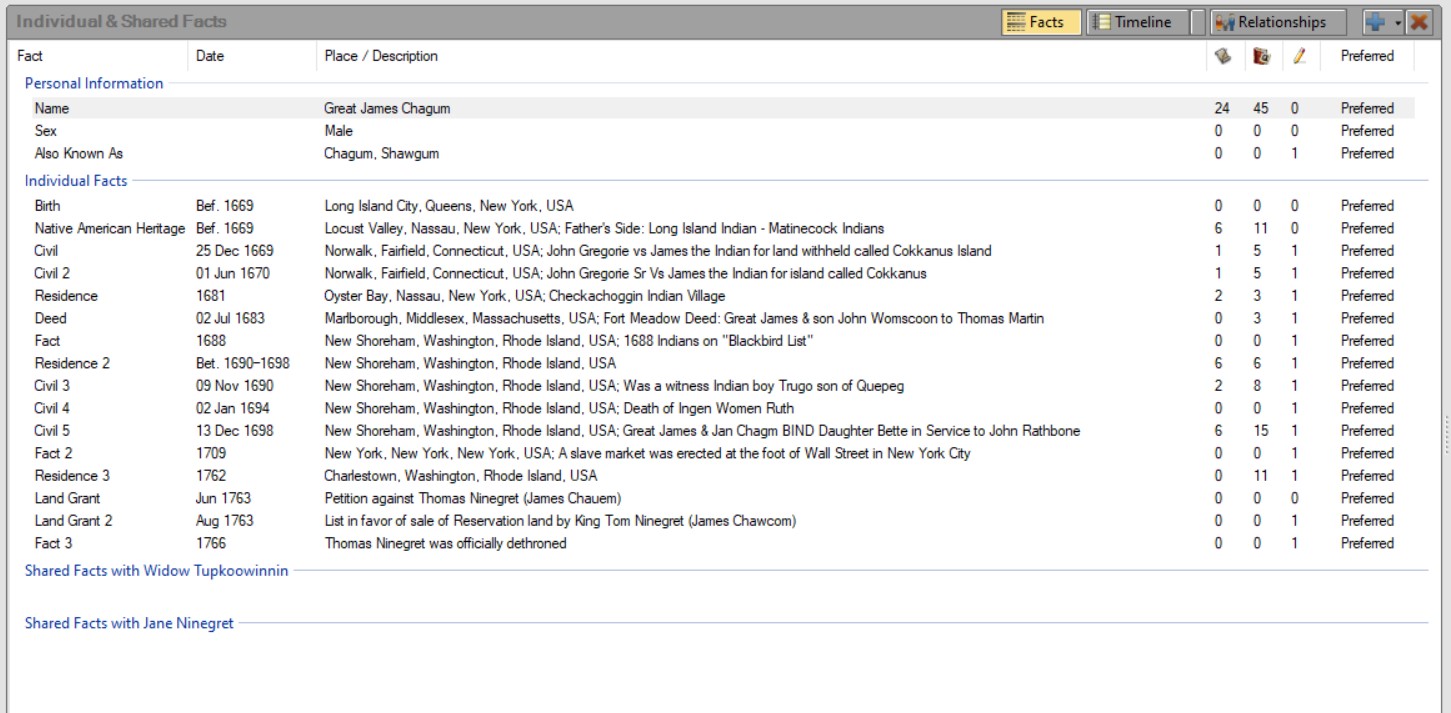
1. Children of Chief Sachem MechoswodtChief Sachem Mechoswodt Research by Coni Dubois2. Children of Mayawetinnemin/Tachapousha Mayawetinnemin/Tachapousha Research by Coni Dubois3. Children of Kukkineau/CockenoeKukkineau-Cockenoe Research by Coni Dubois4. Children of Checoamaug/ShakecumChecoamaug-Shoakecum Research by Coni Dubois5. Children of Great James ChagumGreat James Chagum Research by Coni DuboisJaney1 (Ninegret/Sachem) Chagum – Wife/Mate to Great James Chagum – Mother to Janey2 ChagumJaney1 (Ninegret/Sachem) – Wife/Mate to Great James Chagum Research by Coni Dubois6. Janey2 Chagum – Daughter of Great James and Janey1 (Ninegret/Sachem) Chagum – Who I believe is the MOTHER of James Chagum of Barkhamsted.7. Children of Chief James & Mary/Molly ChagumChief James Chagum of Barkhamsted Lighthouse Village – Part 2
This site is dedicated to the ancestors of the Johnson, Booker and Petruff families of Rhode Island, Connecticut and Pennsylvania and thier connecting lines of lineage.





















 Ever Widening Circle